Press ESC to close

ABT-263: How a Senolytic therapy may help restore aging skin

Key takeways

  • ABT-263 (Navitoclax) improved wound healing in aged mice by selectively eliminating senescent, or “zombie,” cells.
  • Senescent cells are one of the Hallmarks of Aging and are associated with chronic inflammation, impaired tissue repair, and age-related diseases.
  • The findings add to growing evidence that senolytic therapies may help restore tissue function by targeting the biological mechanisms of aging.
  • Unlike cellular reprogramming, which aims to rejuvenate cells, senolytics remove dysfunctional cells that accumulate over time.
  • Although these results are preclinical, they represent another important step toward developing interventions that target the biology of aging.

A new study from Boston University suggests that removing senescent, or “zombie,” cells may help restore the skin’s ability to repair itself during aging. In aged mice, researchers found that the senolytic compound ABT-263 (Navitoclax) significantly improved wound healing by selectively eliminating these dysfunctional cells.

The findings add to growing evidence that targeting one of the Hallmarks of Aging may improve tissue function. Together with recent advances in cellular reprogramming, they reflect a broader shift in longevity research—from understanding the biology of aging to testing interventions that may modify it.

A new milestone in Senolytic research

Senolytics are widely considered one of the three major therapeutic strategies currently shaping longevity research, alongside biological age measurement and cellular reprogramming.

The latest senolytic study provides further evidence that key biological mechanisms of aging may be modified through targeted interventions.

While cellular reprogramming aims to make old cells biologically younger, senolytics take a different approach. They identify and eliminate damaged cells that have accumulated over time.

Both strategies target fundamental causes of aging rather than individual diseases.

What are Senescent cells?

Scientists often describe senescent cells as “zombie cells.”

These are cells that have suffered damage and stopped functioning normally. Unlike healthy cells, they no longer divide or contribute effectively to tissue repair. However, they also refuse to die.

Instead, they remain in tissues and release inflammatory molecules into their surroundings.

This phenomenon is known as the Senescence-Associated Secretory Phenotype, or SASP.

Over time, senescent cells accumulate throughout the body. They are found in:

  • Skin
  • Blood vessels
  • Muscles
  • Kidneys
  • Lungs
  • Brain

Researchers believe their accumulation contributes to many features of aging, including slower wound healing, chronic inflammation, tissue degeneration, and increased disease risk.

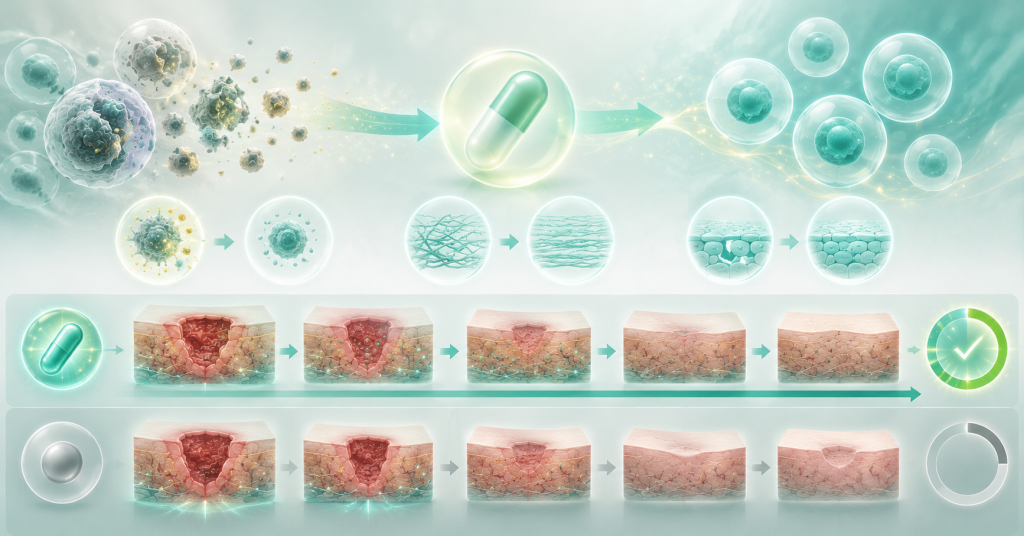
Senolytics Reverse Skin Aging: ABT-263 Removes Zombie Cells and Restores Tissue Repair

How the Senolytic compound restored tissue repair

The new study focused on ABT-263, also known as Navitoclax, a senolytic drug designed to selectively eliminate senescent cells.

Researchers applied the compound to aged skin and monitored its effects on tissue regeneration.

The treatment produced measurable improvements in several markers of tissue repair.

Animals treated with the senolytic compound showed:

  • Reduced numbers of senescent cells
  • Lower inflammatory signaling
  • Improved tissue remodeling
  • Faster wound healing

After the trial, 80% of wounds that were treated were fully closed, while only 56% of the untreated control group recovered. 

The researchers also noticed that pathways in the body responsible for tissue regeneration and repair became activated.

It would not just mask the symptom; the treatment appears to have a much more targeted effect against the mechanisms behind aging.

Why this matters beyond the skin

At first it might seem like this story is about skin care; it’s not.

Our skin reflects a much broader process occurring in the body, and senescent cells that can harm skin repair also amass in the same tissues, contributing to heart disease, neurodegeneration, metabolic health, and frailty.

This is one reason the longevity industry has taken a keen interest in senolytics.

If the skin can be healed in old age through removal of senescent cells, perhaps we will soon be able to do the same for other tissues in the body.

Today the focus is broadening, and researchers are already turning their attention to the treatment of conditions as varied as osteoarthritis, pulmonary fibrosis, and age-related immune suppression, using senolytic approaches.

Cellular Reprogramming vs. Senolytics

The two most important rejuvenation strategies emerging today take fundamentally different approaches to aging.

Cellular ReprogrammingSenolytics
Makes aged cells youngerRemoves aged cells
Targets epigenetic agingTargets cellular senescence
Uses Yamanaka factorsUses senolytic compounds
Resets cellular identityClears dysfunctional cells
First human trials underwayRapidly expanding research pipeline

Both approaches target hallmarks of aging rather than symptoms.

Many scientists believe future longevity therapies may combine elements of both strategies.

One intervention could remove damaged cells. Another could rejuvenate the healthy cells that remain.

Why Cellular Senescence matters

Cellular senescence was identified as one of the original Hallmarks of Aging in 2013. Since then, growing evidence has linked the accumulation of senescent cells to chronic inflammation, impaired tissue repair, and many age-related diseases.

Unlike some hallmarks that remain difficult to target, cellular senescence has emerged as one of the most actionable. Senolytic therapies are specifically designed to eliminate these dysfunctional cells while preserving healthy tissue.

Although this approach is still largely experimental, studies such as the recent Boston University research suggest that targeting cellular senescence may help restore tissue function and could become an important strategy in future longevity medicine.

Conclusion

This study adds to growing evidence that cellular senescence is more than a biological marker of agingit may also become a therapeutic target.

Although the findings are limited to preclinical models, they suggest that selectively removing senescent cells can improve tissue repair and support healthier aging.

Much more research is needed before senolytic therapies can be used in routine clinical practice. Nevertheless, together with recent advances in cellular reprogramming and biological age measurement, this work reflects a broader shift in longevity research—from understanding the biology of aging toward developing interventions that may one day modify it.

References & sources

Boston University study (2026)
Topical senolytic therapy improves wound healing in aged skin by eliminating senescent cells.
Nature Aging (2026).
(Primary study on which the article is based. Add the DOI or journal URL once available.)López-Otín, C., Blasco, M. A., Partridge, L., Serrano, M., & Kroemer, G. (2023).
Hallmarks of Aging: An Expanding Universe.
Cell, 186(2), 243–278.
https://doi.org/10.1016/j.cell.2022.11.001López-Otín, C., Blasco, M. A., Partridge, L., Serrano, M., & Kroemer, G. (2013).
The Hallmarks of Aging.
Cell, 153(6), 1194–1217.
https://doi.org/10.1016/j.cell.2013.05.039Kirkland, J. L., & Tchkonia, T. (2020).
Senolytic drugs: from discovery to translation.
Journal of Internal Medicine, 288(5), 518–536.
https://doi.org/10.1111/joim.13141Di Micco, R., Krizhanovsky, V., Baker, D., & d’Adda di Fagagna, F. (2021).
Cellular senescence in ageing: from mechanisms to therapeutic opportunities.