Key Takeaways
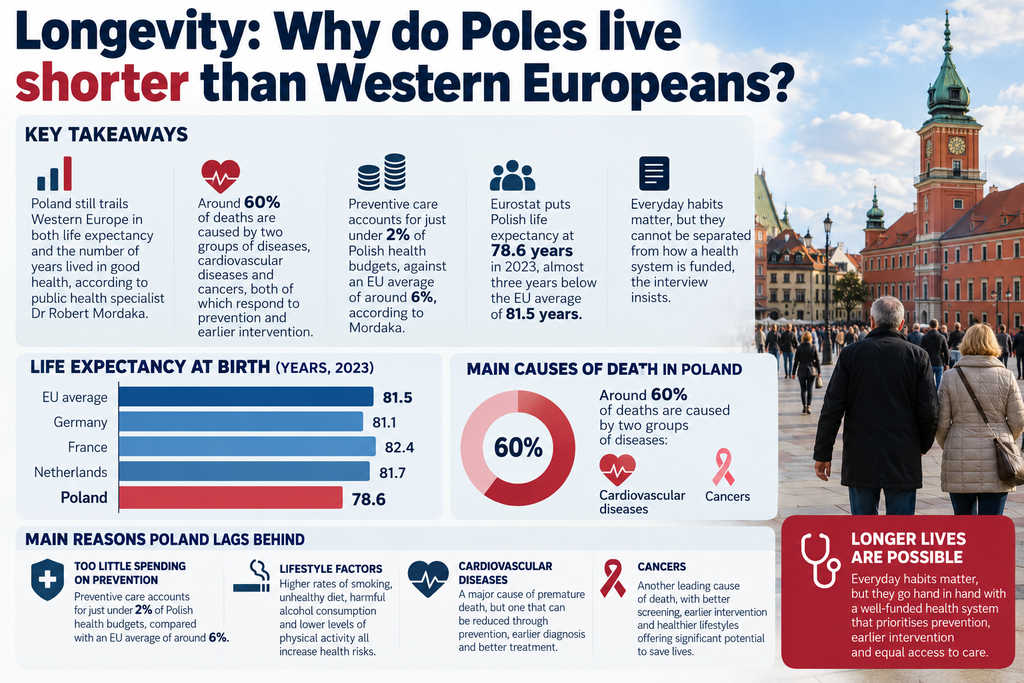
- Poland still trails Western Europe in both life expectancy and the number of years lived in good health, according to public health specialist Dr Robert Mordaka.
- Around 60% of deaths are caused by two groups of diseases, cardiovascular diseases and cancers, both of which respond to prevention and earlier intervention.
- Preventive care accounts for just under 2% of Polish health budgets, against an EU average of around 6%, according to Mordaka.
- Eurostat puts Polish life expectancy at 78.6 years in 2023, almost three years below the EU average of 81.5 years.
- Everyday habits matter, but the interview insists they cannot be separated from how a health system is funded.
Poland has never had a longer average life expectancy than it does today, yet it still sits clearly below the level of Western Europe. That gap was the subject of an interview given to Euronews by Dr Robert Mordaka, a public health specialist, at the Economic Forum in Karpacz, published on October 7, 2026. His message is direct: Poland lags behind not only in how long people live, but also in how many of those years are spent in good health, and prevention is the lever closest to hand.
The interview is short, but it touches on questions that sit at the heart of longevity science. What separates lifespan from healthspan? How much of the gap comes from individual behaviour, and how much from the way a health system is financed? This article places Mordaka’s remarks alongside official European statistics to give a fuller picture.
A gap of almost three years
According to Eurostat, average life expectancy in the European Union reached 81.5 years in 2023, while Poland stood at 78.6 years. Poland’s own statistics office reports a slightly different figure for the same year, 78.21 years, with 74.65 years for men and 81.99 years for women. Polish women therefore live nearly eight years longer than Polish men.
Provisional Eurostat data for 2024 show the EU average rising to 81.7 years. The highest values were recorded in Italy and Sweden, and the lowest in Bulgaria, Romania and Latvia.
| Country (provisional 2024 data) | Life expectancy at birth |
| Italy | 84.1 years |
| Sweden | 84.1 years |
| Spain | 84.0 years |
| EU average | 81.7 years |
| Latvia | 76.7 years |
| Romania | 76.6 years |
| Bulgaria | 75.9 years |
Source: Eurostat, provisional estimates for 2024. Poland’s 2023 figure (78.6 years) comes from the Eurostat release covering that year.
Poland is one of nine EU countries where life expectancy still does not exceed 80 years, most of them in Central and Eastern Europe, according to Statistics Poland. The direction of travel is nonetheless positive: life expectancy in Poland has risen from 77.5 years in 2015 to 78.7 years in the latest national reporting, and gaps with the EU have been narrowing since the early 1990s.
Not only how long, but how well
Mordaka’s central point is that the shortfall is not limited to the number of years lived. It also concerns the years spent in good health, a metric he says urgently needs to improve.
Key Concept: Healthy life years Healthy life years, also called healthy life expectancy, measure the average number of years a person can expect to live without significant limitations due to illness or disability. Researchers use it to distinguish lifespan, how long someone lives, from healthspan, how long they live well.
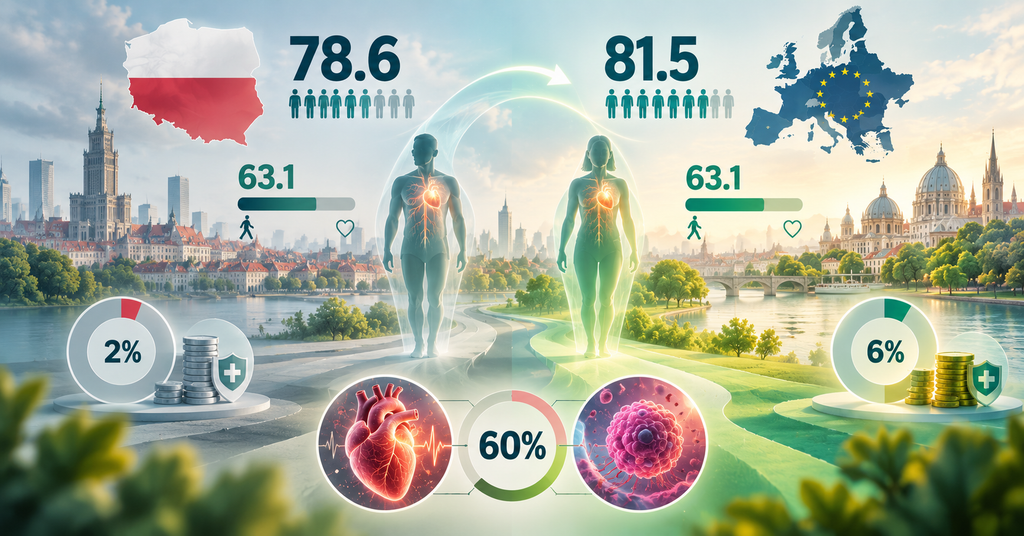
The statistics paint a nuanced picture. Statistics Poland reports that healthy life years at birth reached 63.1 years in 2023, the same as the EU average, and 1.5 years more than in 2015. Eurostat figures cited by Polish media put healthy life expectancy at 61.3 years for men and 64.6 years for women, with Polish women ranking above the EU average and men slightly below it.
The gap becomes clearer later in life. The OECD and European Commission report Health at a Glance: Europe 2024, as summarised by Polish health media, found that life expectancy at 65 in 2022 was 19.5 years on average in the EU, against 17.7 years in Poland. More striking still, the number of healthy years remaining at 65 fell in Poland from 9.5 in 2005 to 8.1 in 2022, while the EU average rose from 8.3 to 9.1. These indicators are measured differently, so they cannot be compared like for like, but together they explain why healthy longevity is not simply a by-product of living longer.
Two disease groups, one major opportunity
According to Mordaka, around 60% of deaths are caused by two major groups of illnesses: cardiovascular diseases and cancers. For both, he argues, prevention and earlier intervention when risk factors appear can play a decisive role.
This framing matters for longevity. Cardiovascular disease and cancer are the main diseases of ageing that cut lives short in high-income countries, and many of their risk factors, such as high blood pressure, raised cholesterol, tobacco use or excess weight, can be identified and managed years before symptoms appear. A health system that detects and treats these risks early can add years of life and, just as importantly, years of independence.

Prevention is still underfunded
Mordaka is careful to say that the problem does not come down only to the choices made by individual Poles. The way the healthcare system operates is also crucial, and Poland is among the EU countries that spend the smallest share of their health budgets on prevention.
His figures are stark. The EU average is around 6% of health budgets devoted to preventive care, while Poland spends just under 2%. Without funding, he warns, this trend cannot be reversed. In other words, public campaigns urging healthier habits will only go so far if screening programmes, primary care follow-up and risk management are not resourced to match.
Key Concept: Life’s Essential 8 Life’s Essential 8 is a framework for cardiovascular health popularised by the American Heart Association. It covers eight areas: blood pressure, blood glucose, cholesterol, body weight, sleep, diet, physical activity and not smoking.
Mordaka draws attention to these eight areas as the practical core of individual prevention. Keeping blood pressure, glucose and cholesterol under control, maintaining a healthy weight, sleeping enough, eating a balanced diet, staying active and avoiding tobacco are, in his view, the small everyday decisions that add up over decades. His own example is deliberately mundane: whether you buy a sugary drink at the shop or pick up water instead.
Obesity, smoking and inactivity: the habits that shorten life
Mordaka identifies obesity as one of the biggest current threats to health. He says studies indicate it can shorten life by as much as 15 years. Smoking is another major factor, taking several years off life expectancy depending on how many cigarettes are smoked each day and for how long.
Physical inactivity also weighs on longevity. That is why the expert recommends starting with two basic steps: reviewing your diet, with a healthy plate adapted to your age and state of health, and increasing the amount you move. His summary of the second point is blunt: exercise is “the best medicine.”
The World Health Organization’s guidance gives this advice a concrete target. Adults should aim for at least 150 minutes of moderate physical activity per week. That does not require intensive training: brisk walking, cycling or other moderate exercise all count.
The 15-year figure for obesity is Mordaka’s characterisation of the research and should be read as an upper bound for severe, long-lasting cases rather than an average effect. The direction of the evidence is nonetheless consistent: excess weight, tobacco and low physical activity are among the most important modifiable drivers of premature death.
Why the gap exists: more than one answer?
It would be a mistake to read the interview as a complete explanation. Mordaka’s focus is prevention and lifestyle, and he explicitly links these to health system funding. Other factors that researchers commonly examine, such as income, education, access to specialist care, occupational exposures and historical differences in healthcare investment, are not addressed in the interview and are not the subject of this article.
The broader data also suggest that Poland’s position is not fixed. Life expectancy has risen steadily, self-assessed health has been converging with the EU average, and women in Poland already report healthy life expectancy above the EU average. The challenge now is to turn extra years of life into extra years of good health.
What this means for longevity?
For longevity research and policy, the Polish case illustrates a principle that applies across Europe. Progress in life expectancy does not automatically translate into progress in healthspan, and the countries that succeed in extending healthy years tend to be those that invest early in prevention. Sweden, for instance, has seen the number of healthy years at 65 rise from 10.9 to 13.9 between 2005 and 2022, according to the OECD data cited above.
For individuals, the practical message from the interview is modest but actionable: know your numbers, eat well, sleep, stop smoking and move regularly. For health systems, it is a reminder that prevention is a budget line, not only a slogan.
Level of evidence
Expert opinion combined with population-level statistics. The interview reflects the views of one public health specialist, supported by national and European statistics on life expectancy and healthy life years. These data show where Poland stands relative to the EU but do not, on their own, establish how much of the gap is caused by prevention funding, individual behaviour or other social and economic factors.
FAQ
How much shorter is life expectancy in Poland than in the EU?
In 2023, Eurostat put life expectancy in Poland at 78.6 years compared with an EU average of 81.5 years, a gap of almost three years.
What causes most deaths, according to Dr Mordaka?
He says around 60% of deaths are caused by cardiovascular diseases and cancers, two groups of illness in which prevention and earlier intervention can play a key role.
How much does Poland spend on prevention?
According to Mordaka, just under 2% of health budgets in Poland go to prevention, compared with an EU average of around 6%.
What are Life’s Essential 8?
They are eight areas of cardiovascular health: blood pressure, blood glucose, cholesterol, healthy weight, sleep, diet, physical activity and not smoking.
How much exercise do adults need?
World Health Organization guidelines recommend at least 150 minutes of moderate physical activity per week, such as brisk walking or cycling.
Methodology
This article is based primarily on the Euronews interview with Dr Robert Mordaka published on October 7, 2026, also republished by Yahoo News Singapore and Lumi News Malaysia. Context on life expectancy and healthy life years was cross-checked against Eurostat releases, Statistics Poland (GUS) data and reporting on the OECD and European Commission report Health at a Glance: Europe 2024. Where sources use different years or indicators, this is stated in the text.
Disclaimer
This article is for informational purposes only and does not constitute medical advice. Statistics on life expectancy describe populations and do not predict the outcome for any individual. Consult a healthcare professional before changing your diet, exercise routine or treatment.
Sources
- Euronews. “Longevity: why do Poles live shorter than Western Europeans?” October 7, 2026.
- Yahoo News Singapore and Lumi News Malaysia. Republications of the Euronews article. October 7, 2026.
- Eurostat. “EU life expectancy estimated at 81.7 years in 2024.” 2025.
- Polskie Radio / PAP. “Poland falls short of EU life expectancy average, Eurostat finds.” 2024.
- Statistics Poland (GUS). Life expectancy and healthy life years data; SDG reporting platform.
- OECD and European Commission. “Health at a Glance: Europe 2024,” as summarised by MedExpress.
- World Health Organization. Physical activity guidelines for adults.
Continue exploring longevity
Explore this longevity topic