Key Takeaways
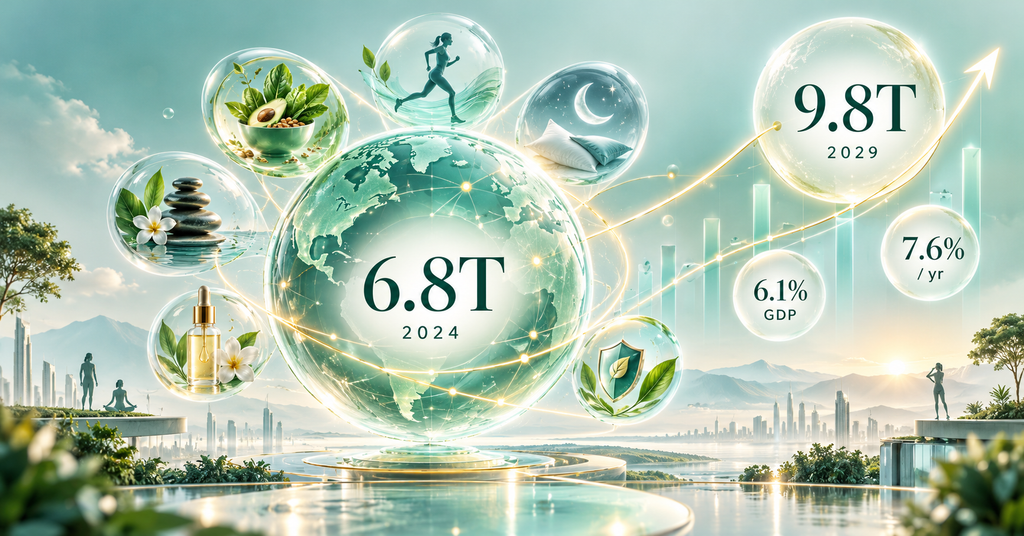
- The global wellness economy reached $6.8 trillion in 2024 and is projected to approach $9.8 trillion by 2029, according to the Global Wellness Institute (GWI).
- Wellness now represents about 6.1% of global GDP, up from 5.7% in 2019, and its projected annual growth (7.6%) outpaces the world economy (4.5%).
- The narrower longevity market, estimated at $28 billion in 2024, could exceed $47 billion by 2033, according to Bilan.
- Luxury houses, from Dior to Guerlain to Six Senses, are repositioning longevity as a promise of transformation and long-term support.
- This market says little about whether the offers actually work. It mostly reveals who can afford them.
A few years ago, longevity belonged to laboratories and biohacker circles. Today it is moving into spas, luxury hotels, beauty houses and the strategies of the largest groups. One figure sums up the scale of the shift: $6.8 trillion, the size of the global wellness economy in 2024 according to the Global Wellness Institute.
But longevity is not simply one more segment of this market. It is becoming its common thread, and a new terrain of social distinction. This article places the wellness boom in its numerical context, explains why luxury is taking an interest, and asks what this dynamic does and does not tell us about ageing well.
A $6.8 trillion market
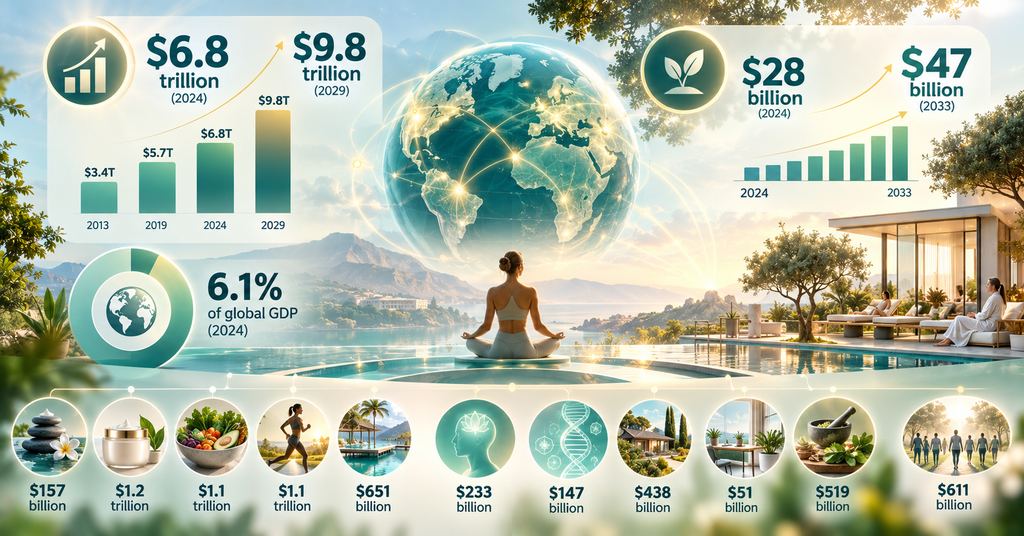
The Global Wellness Economy Monitor 2025, published in November 2025, values the wellness economy at $6.8 trillion in 2024, up 7.9% in one year. The market has doubled since 2013, when it was valued at around $3.4 trillion. The GWI projects growth of 7.6% a year through 2029, reaching nearly $9.8 trillion.
| Indicator | 2013 | 2019 | 2024 | 2029 (projection) |
| Market size | ≈ $3.4 trillion | – | $6.8 trillion | ≈ $9.8 trillion |
| Share of global GDP | – | 5.7% | 6.1% | 7.1% |
Source: Global Wellness Institute, Global Wellness Economy Monitor 2025.
To give a sense of scale, the GWI compares wellness with other sectors. It is larger than sport (2.7trillion),tourism(5 trillion), the green economy (5.1trillion)andinformationtechnology(5.3 trillion). It is nearly four times the size of the pharmaceutical industry ($1.8 trillion) and roughly 60% of all global health spending.
Key Concept: The wellness economy The GWI groups eleven sectors under this term: personal care and beauty, healthy eating and nutrition, physical activity, wellness tourism, wellness real estate, traditional and complementary medicine, mental wellness, spas, thermal and mineral springs, workplace wellness, and public health, prevention and personalized medicine.
The geographic distribution is concentrated. North America (2.3trillion),Asia-Pacific(2.0 trillion) and Europe ($1.7 trillion) together account for nearly 90% of the total. Spas alone are worth $157 billion, and the GWI lists the AI-enhanced spa among its trends for 2026.
Longevity: a market within the market
The longevity market proper is harder to pin down. According to Bilan, it was estimated at $28 billion in 2024 and should pass $47 billion by 2033, with annual growth close to 7%. These estimates vary with the definition used, and they do not overlap neatly with the GWI figures.
The reason is simple. The GWI explains that longevity will not be treated as a separate sector in its future editions, because it already runs through all the others. It shows up in wellness tourism, beauty, nutrition, physical activity and mental wellness. One segment illustrates this porosity well: personalized medicine, valued at $147 billion, with projected growth of 9.3% a year, driven by consumers willing to pay for diagnostics and more sophisticated medical-wellness programs.
From lifespan to healthspan: a change of promise
Key Concept: Lifespan and healthspan Lifespan is how long a person lives. Healthspan is how long they live in good health, with energy, mobility and independence.
This shift in vocabulary is what opens the door to luxury. According to a column by Rémi Le Druillenec, founder of the agency Héroïne, written for Luxus+ in June 2026, longevity no longer speaks only of years gained but of energy, presence, balance and a new relationship to the body and to time. He points out that by 2030, one person in six worldwide will be over sixty. The question is no longer just how long we last, but how well.
This promise meets a historic value of luxury: long time horizons. For a long time, the houses sought to make objects last: a bag, a watch, a piece of jewelry. With longevity, they offer to accompany what the client is becoming.
From status luxury to transformative luxury
Héroïne describes three successive ages. Status luxury was based on possession. Experiential luxury was based on the moment lived. Transformative luxury would now aim to accompany longer, more intimate and more lasting transformations. What is at stake changes: it is no longer about buying a sign, but about entering a continuous relationship with a brand, made of rituals and personal journeys.
The large groups are positioning themselves accordingly. The alliance between Kering and L’Oréal is read, in this perspective, as a sign of the will to build new territories of value at the crossroads of beauty, care, wellness and longevity.
On the ground, several concrete examples are cited:
- Beauty: the vocabulary of anti-ageing is giving way to skin longevity, prevention and cellular health. Galénic has opened a Maison on rue de la Paix, where skin longevity becomes a physical journey, all the way to the Capsule, conceived as a space for cellular expertise.
- Travel: Guerlain has announced a partnership with Orient Express Sailing Yachts for journeys dedicated to wellness and beauty.
- Lifestyle: with Haute Wellness, Dior activates the pillars of movement, sleep, mindfulness and recovery, through objects such as a night mask or a silk pillowcase.
- Hospitality: the Six Senses x Rose Bar alliance aims at a lasting transformation platform that acts on sleep, recovery, nutrition and stress regulation.
When data becomes commonplace, meaning becomes rare
One of the most interesting ideas in this column concerns standardization. Today, many longevity offers converge on the same foundation: blood tests, metabolic analyses, body scans and epigenetic recommendations, in a setting that blends high-tech clinic and holistic center. The more they resemble each other, the more interchangeable these protocols become.
The risk, the author stresses, is that the transformation stops once the client returns to real life, with its constraints and contradictions. The competitive advantage then shifts from the precision of the diagnosis to what makes change last: ritual, relationship, trust and desire. This is where luxury claims to bring what health and technology do not always create on their own.
This reasoning has a limit worth keeping in mind. It describes a brand strategy, not proof of effectiveness. Making a habit desirable may help sustain it, but it does not show that a specific program extends life or improves health.
Is ageing well a class marker?
Bilan goes further and speaks of a social marker. According to its investigation, published on August 10, 2026, getting a vitamin drip between two meetings, stepping into a reoxygenation cabin or ordering superfoods at a business lunch now count as new social codes. Since the Covid-19 pandemic, the high-performing body is said to have become a symbol of power. The headline points to a new social divide that the billions invested are not enough to bridge.
This reading echoes a well-established fact in public health: social inequalities weigh heavily on life expectancy and on years lived in good health. The difference lies in what is being sold. The best-documented determinants, such as physical activity, diet, sleep, quitting tobacco, access to care and social ties, are not reserved for the wealthy by nature, but they are easier to sustain with time, income and a supportive environment.
The premium longevity market therefore risks separating two things: longevity as a set of living conditions accessible to as many people as possible, and longevity as a premium product. Only the first is backed by decades of population-level data.
What the wellness boom does not tell us
The GWI figures measure spending by consumers, businesses and institutions in wellness-related sectors. They do not measure health outcomes, nor the effectiveness of the protocols on sale. A market that doubles in ten years does not, in itself, prove that its products work.
For Sogevity readers, this suggests three habits. Distinguish offers backed by clinical evidence from those based on customer experience. Be wary of promises to reverse ageing. And remember that the most solid levers, moving, sleeping well, eating well and staying connected, cost less than most premium packages.
Level of evidence
Market data and sector analysis. The figures rely on estimates from market research organizations and on press and opinion articles. They describe the size and economic dynamics of the sector, but they do not establish the effectiveness of longevity treatments or programs, nor a causal link between this spending and consumers’ health. The passages on luxury reflect strategic analysis, and the Bilan investigation could only be consulted here through its public summary.
FAQ
How much is the global wellness economy worth?
According to the Global Wellness Institute, it reached $6.8 trillion in 2024, about 6.1% of global GDP, and is projected to approach $9.8 trillion in 2029.
How big is the longevity market?
Bilan estimates it at $28 billion in 2024 and more than $47 billion by 2033. Figures vary with the definition, because the GWI considers that longevity runs through all wellness sectors.
Why is luxury interested in longevity?
Because it extends luxury’s historic promise of duration and quality, and lets brands build continuous relationships with clients, according to the Héroïne column.
What is the difference between lifespan and healthspan?
Lifespan is total length of life; healthspan is the length of life lived in good health and independence.
Do these longevity programs extend life?
The sources consulted do not demonstrate it. They describe a market and brand strategies, not clinical results.
Methodology
This article draws on three main sources: the column “La Longévité : le prochain horizon du luxe” published by Héroïne (June 15, 2026), the public summary of the Bilan investigation (August 10, 2026) and Optimize 360’s overview of the wellness economy. Market figures were cross-checked against the Global Wellness Institute’s Global Wellness Economy Monitor 2025 release and page, and against trade press. The full text of the Bilan article, which is behind a paywall, was not accessible: only publicly available elements were used.
Disclaimer
This article is for informational purposes only and does not constitute medical, financial or investment advice. Market estimates are projections and may change. None of the products or programs mentioned is endorsed by Sogevity.
Sources
- Global Wellness Institute. Global Wellness Economy Monitor 2025 and press release of November 19, 2025.
- Bilan. “Longévité : bien vieillir devient un marqueur de classe sociale.” August 10, 2026.
- Héroïne / Luxus+. Rémi Le Druillenec, “La Longévité : le prochain horizon du luxe.” June 15, 2026.
- Optimize 360. “6 800 milliards de dollars : l’économie du bien-être change d’échelle.”
- Spa Business, Australasian Leisure Management, European Spa Magazine. Coverage of the Global Wellness Economy Monitor 2025. November 2025.
Continue exploring longevity
Explore this longevity topic