Key takeaways
- UV exposure can damage mitochondria in skin cells and contribute to skin aging.
- Mitophagy removes damaged mitochondria and helps keep cells healthy.
- In mice, a stem cell-derived secretome increased mitophagy and improved several measures of UV-related skin damage.
- The treatment also reduced activity in cGAS-STING, an inflammatory pathway.
- The study was done in mice and lab-grown human skin cells. It has not been tested in people.
Could clearing damaged mitochondria help protect skin from UV damage?
The sun also impacts more than just the outer layer of the skin; it also can suffer from continued UV exposure. The mitochondria, which generate energy for cells, are one of the structures affected. Damage to the mitochondria can increase the inflammation and stress in cells.
Scientists recently investigated whether removal of these dysfunctional mitochondria would help. They utilized a secretome of human umbilical cord mesenchymal stem cells, a mixture of chemicals cells give off when they communicate. The secretome was given to UV-exposed mice and human skin cells in culture and was found to promote mitophagy and decrease a handful of photoaging indicators.
That does not mean it is a treatment for aging skin. The research is still at the laboratory stage.
The role of damaged mitochondria in skin aging
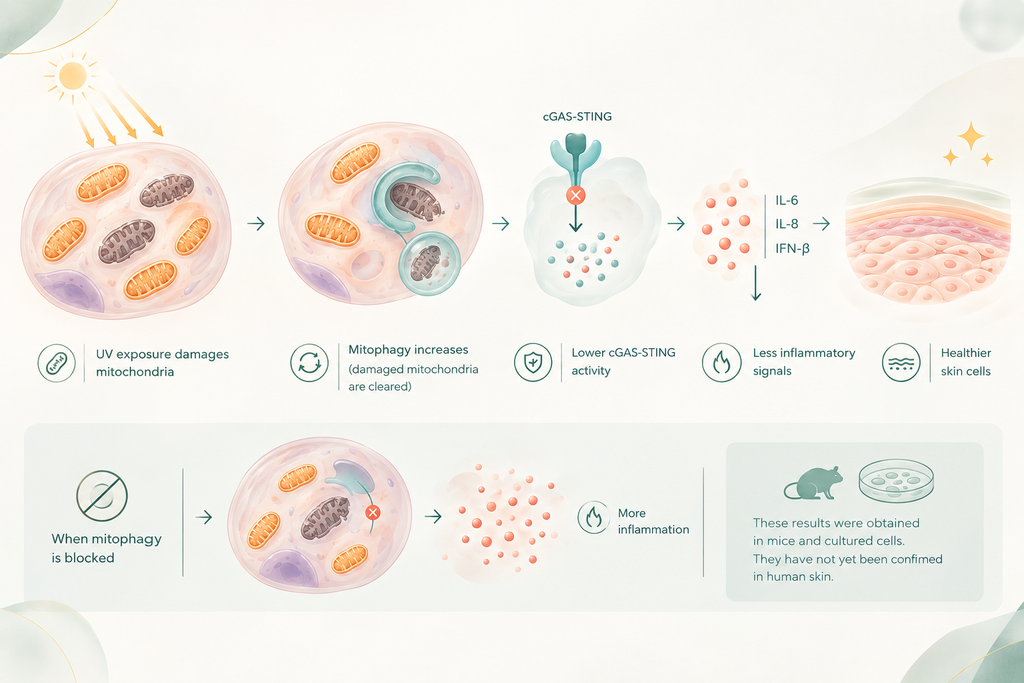
Mitochondria make energy for our cells. They don’t always stay healthy. UV radiation can damage them. Normally, cells deal with this by removing the damaged mitochondria; this is known as mitophagy.
If the cleanup process does not work well, damaged mitochondria can remain inside the cell. They may then contribute to stress and inflammatory signals. For skin exposed to UV radiation over many years, this is one of several processes that may contribute to aging.
Mitophagy is therefore not a treatment on its own. It is one part of the cell’s normal system for dealing with damage.
Protective effects of a stem cell-derived secretome against photoaging
Researchers exposed mice to UVA and UVB radiation for 40 days. They then applied the hUC-MSC-derived secretome to the skin.
The treated mice showed several changes associated with less UV-related skin damage:
- Less epidermal thickening
- Better skin hydration and elasticity
- Lower transepidermal water loss
- Better preservation of collagen
The researchers also found lower levels of p16 and p21, two markers commonly associated with cellular senescence. The team then tested the secretome on UVB-exposed HaCaT keratinocytes, a commonly used human skin cell line. The treatment improved cell viability and reduced several markers of senescence.
These results suggest that the secretome may influence some of the cellular processes involved in photoaging. However, cell and animal findings do not establish that the same effects occur in people.
Restoring mitophagy and reducing inflammation
UV exposure affected mitochondrial quality control in the skin cells studied. The researchers found that the secretome increased markers linked to mitophagy, suggesting that damaged mitochondria were being cleared more effectively. This change was also linked to lower activity of the cGAS-STING pathway.
cGAS-STING is part of the cell’s immune response that can detect DNA in the wrong place inside a cell and trigger inflammation. When this pathway stays active, it can increase inflammatory signals.
According to the study, the treated cells had lower levels of inflammatory molecules, including IL-6, IL-8, and IFN-β. The researchers tested whether mitophagy was actually involved. When they blocked the process, some of the protective effects of the secretome disappeared. Other experiments that affected STING or increased mitophagy produced similar changes. This points to a possible connection between mitochondrial cleanup and inflammation after UV exposure.
However, the experiments were performed in mice and cultured cells, so the same mechanism has not yet been confirmed in human skin.
Implications for longevity and skin health
Mitochondrial dysfunction, cellular aging, and long-term inflammation could all negatively affect the way skin cells work. This study extends previous findings that mitochondrial quality control may be relevant for tissue aging. Still, the findings do not show that improving mitophagy can reverse skin aging in humans. They provide a possible mechanism for further research rather than an established treatment.
What we still need to know
The research was done in mice and in an immortalized human skin cell line, so the results may not reflect what happens in human skin. The study also did not identify which specific components of the secretome were responsible for the effects.
More research is needed to identify the active molecules and test whether the findings hold up in human skin. Clinical trials would also be needed before considering this approach as a potential treatment for photoaging.
Frequently asked questions
1. What is mitophagy?
Mitophagy is a cellular process that cells use to rid themselves of defective or damaged mitochondria. It maintains the quality of mitochondria in our cells and prevents damaged mitochondria from building up.
2. Can this treatment prevent skin aging?
No. While mitophagy could potentially prevent some of the cellular damage caused by exposure to UV light, there’s no evidence that boosting mitophagy prevents or treats skin aging in humans.
3. Has this treatment been tested in humans?
No. The treatment has only been studied in mice and human skin cells grown in the laboratory. Clinical studies are needed to determine whether it is safe and effective in people.
Methodology
Researchers used UV-exposed mice and skin cells to test hUC-MSC secretome and assess mitochondrial quality, skin damage, and inflammation.
Level of evidence
This is preclinical research based on animal and cell models. It has not yet been tested in humans.
Disclaimer
This article is for informational purposes only and does not constitute medical advice. The findings are preliminary and should not be considered evidence of an established treatment for skin aging.
References
- Tang T, Lin M, Yang J, et al. The Secretome Derived From Human Umbilical Cord Mesenchymal Stem Cells Improves Skin Photoaging by Enhancing Mitophagy to Inhibit the cGAS-STING Pathway. Aging Cell. 2026;25(9):e70701.
- Conway J. Clearing Damaged Mitochondria to Fight Skin Photoaging.