Key Takeaways
- The skin changes with age, including its microbiome and immune activity.
- Skin microbiome changes may be linked to frailty.
- Skin could provide clues about biological aging.
- A microneedle patch may make it easier to study aging skin without a traditional biopsy.
- The approach is still experimental and has not been validated as a test for biological age or frailty.
Wrinkles are only one part of how skin changes with age. The tissue also becomes drier, heals more slowly, and can become more vulnerable to irritation and infection. At the same time, the community of microorganisms living on the skin changes.
These changes are attracting the attention of researchers studying aging and frailty.
In a perspective published in Science on August 27, Sasan Jalili of The Jackson Laboratory and Julia Oh of Duke University argue that the skin could give researchers a practical way to track some of these changes over time.
Unlike most organs, the skin can be accessed and sampled repeatedly without invasive procedures.
Key concept: Biological aging
Biological aging refers to changes in the body’s function and resilience that occur over time. These changes can differ between people of the same chronological age.
The skin microbiome changes with age
As skin ages, its microbial community also changes. Some microbes linked to the skin barrier and immune system decrease, while others linked to inflammation may become more common.
Researchers have also found changes that may help some microbes tolerate antibiotics or antiseptic treatments. These changes may reflect how the skin ages. However, the evidence shows an association, not a direct cause.
Key Concept: Skin microbiome
Skin microbiome refers to the community of microorganisms living on and interacting with the skin.
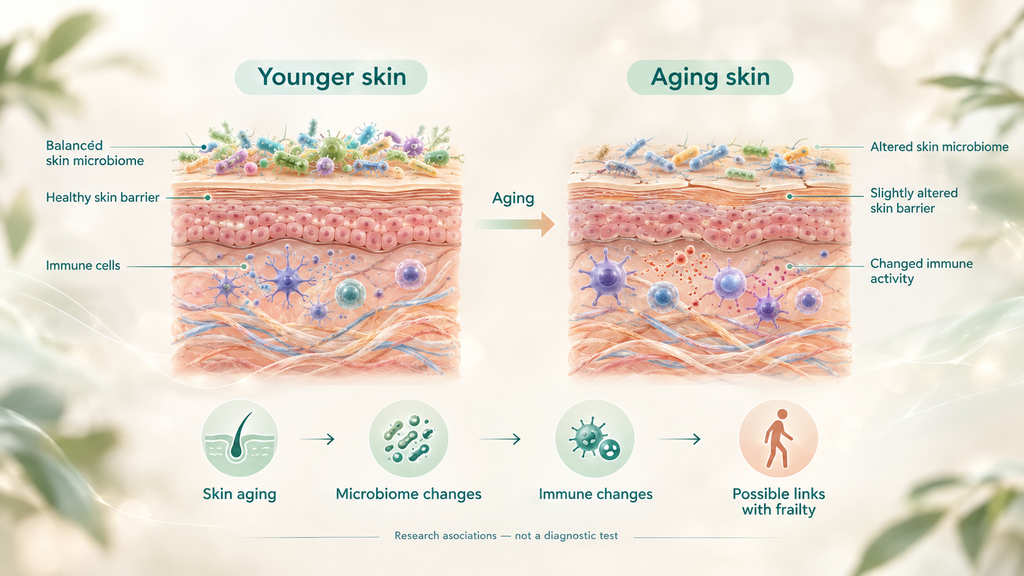
Figure: Aging can affect the skin microbiome and immune environment. Researchers are investigating whether these changes may be associated with frailty.
Frailty could be more informative than age
Age does not always reflect how well a person is aging. Two people of the same age can have very different physical health and responses to illness.
Researchers found that some changes in the skin microbiome may be more closely linked to frailty than to age itself.
This could help researchers better understand why some people experience greater physical decline as they age.
However, it is too early to say that the skin microbiome can predict frailty. More research is needed to confirm these findings.
Key Concept: Frailty
Frailty is a decline in physical resilience that can make a person more vulnerable to illness and other forms of stress.
Why researchers need better ways to sample skin
Researchers can study the skin microbiome by collecting samples from the skin’s surface. But this only shows what is happening on the surface, not deeper in the tissue.
A biopsy can provide more information, but it is invasive and not easy to repeat, especially in older adults. Researchers are therefore looking for less invasive ways to study the skin over time.
A microneedle patch offers another option
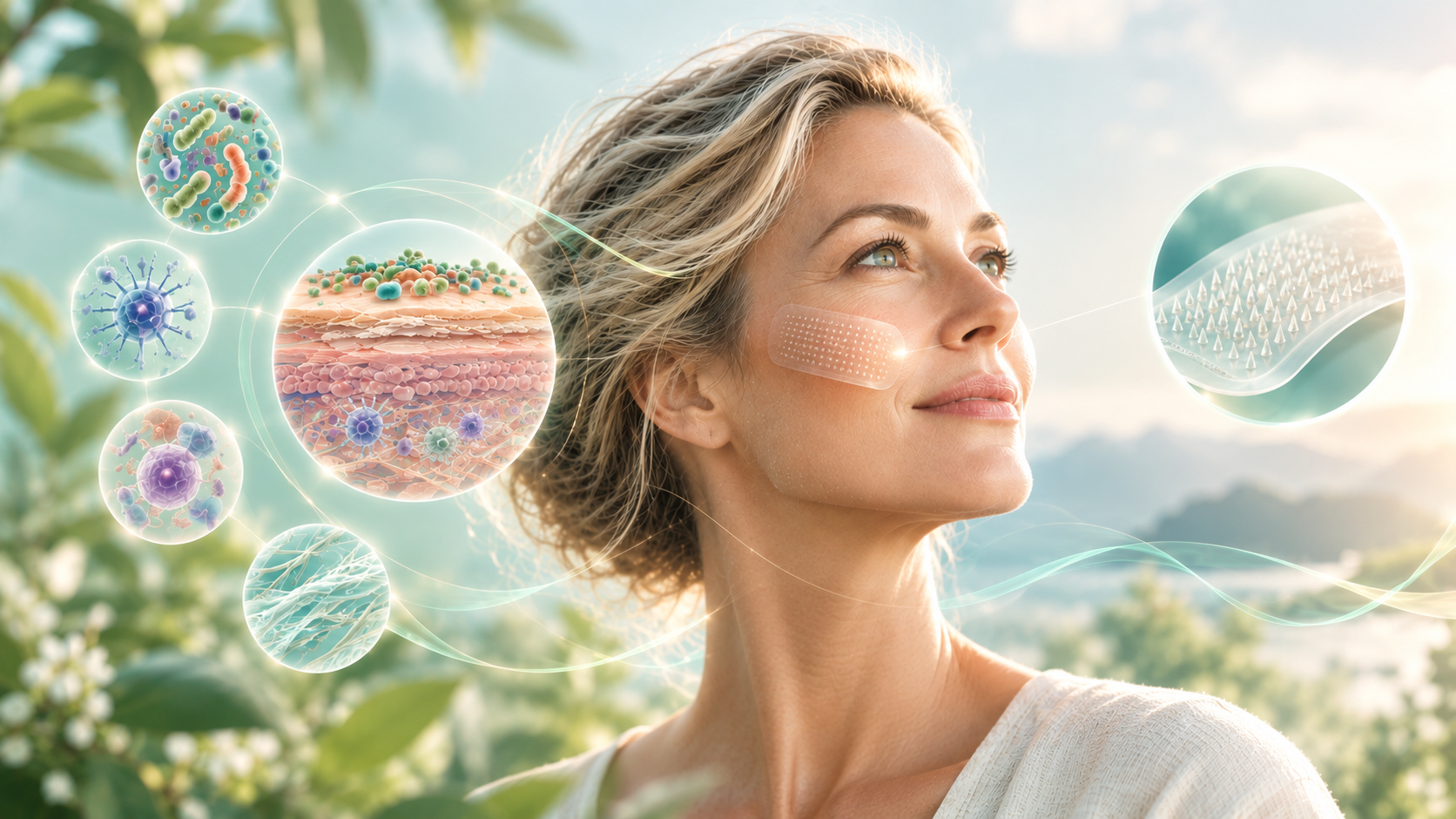
Jalili and his collaborators are testing a small microneedle patch designed to collect information from the upper layers of the skin.
The patch uses tiny projections that enter the skin and interact with cells within the tissue. Researchers hope it can provide information about immune and microbial changes without requiring a conventional biopsy.
The technology was developed with collaborators, including scientists at MIT. Earlier work describing the approach was published in Nature Biomedical Engineering in March 2026.
The patch is not designed to tell someone their “biological age.” Its current purpose is to help researchers study what happens to skin as it ages.
The video below offers a closer look at this microneedle technology.
Level of Evidence
Early-stage research. Studies have found associations between skin microbiome changes, aging, and frailty, while the microneedle patch remains under investigation as a research tool.
What this could mean for longevity research
One of the challenges in longevity research is understanding why people of the same chronological age can experience very different levels of decline.
The skin could offer researchers a practical way to follow some of these changes over time. If specific microbial or immune signals consistently correspond to biological aging or frailty, they could eventually help researchers understand differences in how people age. That possibility has not yet been demonstrated in clinical practice.
For now, researchers are focused on identifying which skin changes are reliable markers of aging and frailty.
FAQ
Does the skin change as we age?
Yes. Older skin generally becomes drier, heals more slowly, and has changes in its barrier, immune activity, and microbiome.
What is the skin microbiome?
It is the community of microorganisms that live on the skin and interact with the surrounding tissue and immune system.
What does the microneedle patch do?
It uses tiny projections to access the upper layers of the skin and collect information from cells within the tissue.
Can the patch measure biological age?
Not at this point. Researchers are still investigating whether skin measurements can provide reliable information about biological aging.
Can it detect frailty?
No. The technology has not been established as a clinical test for frailty.
Methodology
This article is based on the Science perspective “Beyond wrinkles,” published on August 27, 2026, and supporting research from The Jackson Laboratory.
Disclaimer
This article is for informational purposes only. The research discussed does not establish a diagnostic test or treatment for biological aging or frailty.
Sources
- Jalili S., Oh J. “Beyond wrinkles.” Science, August 27, 2026. DOI: 10.1126/science.aeh4348.
- The Jackson Laboratory. “Could skin reveal new clues about aging and frailty?” September 2, 2026.
- Research published in Nature Biomedical Engineering, March 2026, on the microneedle-based approach