
Key takeaways
- Lumeria was founded by Maryanne Alhallak and Anthea Guo after personal experiences with skin conditions highlighted how difficult it can be to find answers and identify effective treatments.
- Its Lumoscope device uses multispectral imaging to capture skin characteristics under visible, ultraviolet, and cross-polarized light, with the aim of providing more consistent tracking than ordinary smartphone photographs.
- Lumeria combines skin scans with information about daily habits, skincare products, sleep, and other contextual factors to help users identify patterns in how their skin changes over time.
- The company positions its technology as a general wellness tool designed to complement dermatologists, rather than diagnose skin conditions or replace professional medical advice.
- Its long-term ambition is to make personalized skin monitoring part of everyday health tracking, while helping people feel more informed and confident about their skincare decisions.
Skin health can be surprisingly difficult to understand. A product that works for one person may do little for another, while changes in sleep, stress, hormones, weather, and everyday habits can all influence how skin looks and feels. Yet many people still rely on trial and error, occasional appointments, and photographs taken under inconsistent lighting to figure out what is happening.
For Lumeria co-founders Maryanne Alhallak and Anthea Guo, the problem is personal. Their experiences with skin conditions, combined with their backgrounds in technology and entrepreneurship, led them to question why people have so few tools to understand their skin consistently outside a clinical setting.
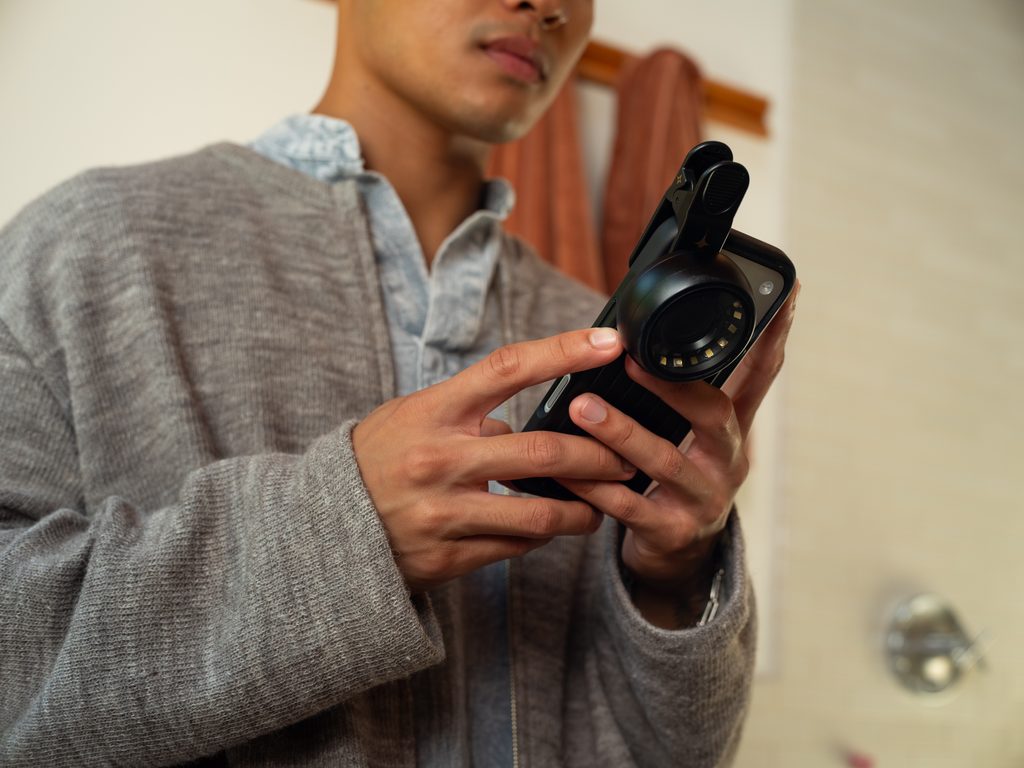
Their answer is Lumeria, a company developing a home-based skin monitoring system built around the Lumoscope, a phone-connected device that uses multispectral imaging. By combining skin scans with information about daily routines and environmental factors, Lumeria aims to help people follow changes over time and make more informed decisions about their skincare.
In this conversation with Sogevity, co-founder and CEO Maryanne Alhallak explains the experiences behind the company, how its technology is designed to work, and why she believes the future of skincare should be more personalized, measurable, and connected to professional care.
The personal experiences behind Lumeria
For Lumeria’s founders, the motivation to build a skin monitoring tool came from experiencing the uncertainty of living with skin conditions themselves. Their stories point to a broader challenge: finding answers can take time, and understanding what triggers a flare-up is not always straightforward.
Sogevity: Lumeria was born out of personal experiences with skin conditions and the challenges of finding answers. Could you tell us more about what inspired you and Anthea to build the company, and how your respective experiences shaped its mission?
Maryanne Alhallak:
Our CTO Anthea’s sister spent 8+ years suffering from severe eczema and sleepless nights, only to discover the root cause was the dust in her carpet: hidden in plain sight the whole time. Anthea experienced this problem herself in sophomore year: it took her 5 months to reach a dermatologist, and four misdiagnoses after that, before finally understanding how to treat her eczema.
I’ve similarly experienced struggles with acne my whole life: it impacted me not only physically, but psychologically, completely obliterating my self-esteem. We both understood just how helpless, difficult, and messy the skincare process is, so we brought our skillsets together to finally create the solution we needed. Anthea previously worked on computer vision at Google and Streamind, and developed knowledge graphs at Boehringer Ingelheim and Berkeley Lab.
I built my first biotech startup by the age of 17, am a lifestyle creator with 25M+ views, and have spent my life getting medical tools to people who can’t reach them. I just dropped out of Berkeley at 19 years old to build this full-time. We did hundreds of interviews with dermatologists, patients, and experts alike to uncover the true gap in skincare: objective guidance and context tracking, all from your home. We are on a mission to empower everyone to have control over their skin’s story, without ever feeling helpless like we experienced ourselves.

Moving beyond trial and error in skincare
Many people invest time and money in skincare products without knowing whether a change in their routine is genuinely helping. Lumeria sees an opportunity to make those decisions more informed by giving users a consistent way to observe their skin and track how it responds over time.
Sogevity: Lumeria aims to help people better understand their skin from home. What gap did you identify in the way people currently monitor their skin, and why did you feel it was important to make this process more accessible and objective?
Maryanne Alhallak:
Everyone owns skincare products, but nobody knows what’s actually working. Our skin is constantly changing due to an infinite number of variables, whether it be sleep, stress, hormones, the weather, or even the products we use every day, but nothing is capturing any of that.
Instead, we end up following skincare routines that worked for someone else, wasting money trying different products, or waiting months to see a dermatologist who only gets to see our skin for a few minutes. And while taking pictures on our phones might seem helpful, lighting, angles, and camera settings make it really difficult to compare photos and gauge improvements without an objective metric to guide it.
Until now, the industry has been built on the assumption that one size fits all, leaving consumers helpless. But that changes with Lumeria. By being able to track your skin consistently at home, we’re unlocking automation in clinical-grade hardware and computer vision to curate a new level of personalized skincare never seen before. Lumeria captures the missing data layer that truly informs what decisions you should make, giving you the power to understand and own your skin’s health data, all from your home.
We’ll finally make it easier for people to actually see how changes happen over time, what’s truly working, and feel more confident in the decisions they’re making about their skin.
What multispectral imaging can reveal about skin?
Ordinary photographs can document visible changes, but they are also affected by lighting, angles, and camera settings. Lumeria’s approach uses different types of light to capture a broader range of skin characteristics. The company believes that combining these images with computer vision can offer a more consistent basis for monitoring changes over time.
Sogevity: The Lumoscope uses multispectral imaging, including visible, ultraviolet, and polarized light, to capture skin signals that ordinary smartphone photos may miss. Could you explain how this technology works and what makes it different from conventional skincare tracking apps?
Maryanne Alhallak:
The Lumoscope shrinks the multi-spectrum imaging dermatology clinics use into a clip for your phone. Press it against your skin and see yourself under three kinds of light: true color (RGB), UV, and cross-polarized. Visible light gives you a clear, true-color image of your skin for us to analyze under different algorithms. UV light helps reveal characteristics such as bacteria and oil buildup, pigmentation, and certain patterns that you wouldn’t normally be able to see with the naked eye.
Cross-polarized light reduces surface glare and allows you to get a better look at redness, pores, and other details below the surface. All together, you see what your mirror can’t: a breakout building days before it surfaces, sun damage hiding under flawless-looking skin. Each scan becomes an objective read (hydration, redness, evenness, pigmentation, texture, pores) plus a score out of 100 and a skin age.
When you take a regular selfie, variables like the angle, lighting, and camera settings can make your skin look completely different from one day to the next. The consistency a Lumoscope provides allows for an accurate baseline, paired with insights you can’t get from either a phone camera or the naked eye. Therefore, you can actually compare your skin over time and see what’s changing, obtaining so much more context and data than before, when technology like this would only stay locked behind clinic doors.
Understanding skin through longitudinal data
A single scan offers a snapshot. Lumeria’s longer-term vision is to build a picture of how an individual’s skin changes alongside their daily habits, product use, and environment. This approach could help users organize observations that might otherwise be difficult to remember or connect, while also giving dermatologists more information to consider during an appointment.
Sogevity: Lumeria combines skin imaging with information about routines, sleep, products, and environmental factors to help users understand changes over time. How does this longitudinal approach work, and how can it help people make more informed decisions about their skincare routines?
Maryanne Alhallak:
Every person’s skin is completely different, with an infinite number of triggers hidden in their daily life. A 15-minute appointment cannot capture all of the information necessary to make a proper decision about a person’s skin, and because every skin technology is locked behind clinic doors, there is no objective way to track this information outside of a clinic. That’s where longitudinal data comes in.
Over time, our model not only tracks your images, but also all the context it can learn about you, so it’s able to surface patterns between gradual changes in your skin and your daily life. It’ll surface habits or products you’d never think of, from your sleep to your cycle to the pillowcase you forgot to wash. It uses this information to provide recommendations from a database of 18,000+ products and ingredients, matched to what your scans actually show works, and not someone’s routine.
And it compounds: every scan adds to your history and to an increased understanding of your skin’s relevant context, so you know what’s actually working as your skin and environment change over time. Your first point of contact becomes your own data instead of someone else’s routine. This makes a dermatologist’s job easier: when you come into the clinic, our app is able to generate a derm-ready report of the most critical flare-ups, context, and insights it’s discovered, so their diagnosis is no longer based on a blind spot, but is precise to you.
AI, Privacy, and the role of dermatologists
As digital tools become more involved in personal health, their value depends not only on what they can measure, but also on how responsibly they interpret and communicate that information. For skin monitoring in particular, there is an important distinction between helping someone observe changes and diagnosing a medical condition. Lumeria says it intends to maintain that distinction while developing its technology and working with dermatology partners.
Sogevity: As AI becomes increasingly involved in personal health and skincare, accuracy, privacy, and responsible guidance are essential. How does Lumeria approach these challenges, and how do you see its technology complementing the work of dermatologists rather than replacing professional medical advice?
Maryanne Alhallak:
We take all three of these really seriously. We want to be clear about what Lumeria is and isn’t. Today, Lumeria is a general wellness product, not a medical device. Think of it as a 24/7 esthetician or skin companion: it helps you see, track, and understand how your skin is changing, but it doesn’t diagnose skin conditions. We work with FDA consultants, and FDA clearance for clinical uses is on our roadmap, built on our trial data. Until then, we’re careful about how we guide people. Lumeria can push you toward a doctor, never away from one. We work with partner dermatology clinics, and our goal is to make their time with patients more valuable.
A patient never comes in with a blank slate, so with Lumeria you can bring your dermatologist months of images, trends, and context instead of relying on memory. Our dataset is labeled by our team and partner dermatologists, it grows every week with new scans, and we’re constantly benchmarking our models so they keep getting better. In our testing, they already outperform frontier vision models. Every scan also calibrates its lighting, so you’re comparing your skin under the same conditions each time. Privacy is a huge priority for us.
The Lumoscope only needs to scan a small area of your skin, so you never have to take a picture of your entire face, and your data is private and encrypted by default. We understand how personal this information is, and we want people to feel comfortable knowing it’s protected. Inclusivity matters just as much. A lot of existing skin-imaging research has focused on a limited range of skin tones, and that’s something we’re extremely passionate about changing. We’re actively building and testing across all six Fitzpatrick skin types so Lumeria works for everyone.
A future where skin health is part of everyday health tracking
Wearables have made it increasingly familiar to monitor certain aspects of health, from heart rate to sleep. Lumeria’s founders believe skin could become another part of that picture. Their long-term ambition extends beyond imaging to a connected ecosystem of personalized skincare services, with the goal of making skin monitoring more accessible and useful in everyday life.
Sogevity: Looking ahead, what is your long-term vision for Lumeria and the future of personalized skincare? What changes would you most like to see in how people understand, monitor, and care for their skin?
Maryanne Alhallak:
Your watch tracks your heart. Your ring tracks your sleep. Nothing has ever tracked your skin. Our hope is that Lumeria becomes a companion people can easily incorporate into their everyday lives, similar to how wearables have made it so normal to track other important aspects of your health, such as sleep and heart rate. Long term, Lumeria becomes vertically integrated: a Lumeria ecosystem where everything you could do for your skin, from telehealth with dermatologists to personalized formulations to a marketplace, is all integrated into Lumeria. Skincare has never had a measurement standard. We will become the first point of contact for any question about your skin and the gold standard of how people understand their skin, whether it be for personal reasons or for dermatologist use.
The goal is for skincare to move toward a more personalized approach, where people can make decisions based on how their skin is actually responding rather than what’s popular at the moment, and where dermatologists have more information to work with, making it easier to have more informed conversations and recognize potential concerns earlier. But more than anything, we want people to feel more confident and in control of their skin. We know firsthand how frustrating and overwhelming it can be when you don’t understand what’s happening or why something isn’t working.
If we can help take away even some of that stress and uncertainty, then we consider our mission to be working, because it’s exactly what we wished we’d had ourselves.
What this means for longevity?
Skin is more than an aesthetic concern. It is a dynamic organ whose appearance and condition can be influenced by aging, environmental exposure, hormones, lifestyle, and underlying health factors. Understanding those changes more consistently could help people ask better questions, recognize patterns, and have more informed conversations with healthcare professionals.
Lumeria’s approach reflects a broader shift toward personalized, data-informed health. Rather than relying entirely on occasional observations or generalized recommendations, the company aims to build an ongoing record of an individual’s skin and the context surrounding it. In principle, this could help people understand their own responses instead of assuming that a popular product or routine will work equally well for everyone.
The distinction between monitoring and medical diagnosis remains important, however. Imaging data and AI-generated insights are only as useful as the methods behind them, the quality of their validation, and the limits communicated to users. Claims about detecting changes before they become visible, evaluating skin age, or outperforming other AI models need to be assessed through transparent testing and independent evidence.
For now, Lumeria represents an emerging approach to home-based skin monitoring rather than an established replacement for dermatological assessment. Its longer-term contribution will depend on how reliably its technology performs across different skin types, how securely personal data is handled, and whether the information it provides genuinely improves decision-making for users and clinicians.
At the heart of the founders’ vision is a simple idea: people should have better tools to understand their skin, without having to navigate every uncertainty alone.
Level of evidence
Evidence level: Early-stage technology and company-reported information.
This article is based primarily on a written interview with Lumeria co-founder and CEO Maryanne Alhallak. The descriptions of the Lumoscope, its imaging capabilities, the company’s AI models, product database, privacy practices, and development roadmap reflect information supplied by the company. Independent clinical validation, comparative performance data, and peer-reviewed studies supporting the specific product claims were not provided for this interview.
Lumeria states that its current product is intended for general wellness and does not diagnose skin conditions. Its technology should not be interpreted as a substitute for assessment or treatment by a qualified healthcare professional.
FAQ
What is Lumeria?
Lumeria is a company developing a home-based skin monitoring system built around the Lumoscope, a phone-connected device designed to capture skin images using multiple types of light.
How does the Lumoscope work?
According to Lumeria, the device uses visible (RGB), ultraviolet (UV), and cross-polarized light to capture different skin characteristics. Its software then analyzes the images and tracks selected features over time.
Can Lumeria diagnose skin conditions?
Lumeria describes its current product as a general wellness tool, not a medical device. The company says it does not diagnose skin conditions and that FDA clearance for clinical uses is part of its future roadmap.
How could tracking skin over time help users?
Lumeria aims to combine repeated skin scans with information about daily habits, skincare products, sleep, and other contextual factors. The goal is to help users identify possible patterns and prepare more detailed information for discussions with dermatologists.
Does Lumeria replace a dermatologist?
No. According to the company, its technology is intended to complement professional care by helping users document changes and share a longer history of observations with their dermatologist.
Methodology
This feature was prepared by Sogevity from a written interview with Maryanne Alhallak, co-founder and CEO of Lumeria, conducted in October 2026. The interview responses have been retained as supplied by the interviewee, with editorial headings and introductory context added for readability. Company-reported technical and performance claims have not been independently verified as part of this interview.
Disclaimer
This article is for informational and educational purposes only. It does not constitute medical advice, diagnosis, or treatment recommendations. Skin imaging and wellness technologies should not replace consultation with a qualified dermatologist or other healthcare professional. Anyone experiencing persistent, worsening, or concerning skin symptoms should seek professional medical advice.
Source
- Lumeria — Official website
- Written interview with Maryanne Alhallak, co-founder and CEO of Lumeria, October 2026.
Continue exploring longevity
Explore this longevity topic