
🟦 Key takeaways
- A naturally occurring component of the skin’s Natural Moisturizing Factor (NMF)
- Plays a central role in maintaining skin hydration and barrier balance
- Supports water retention within the upper layers of the skin
- Widely used in dermatology and dermo-cosmetics for its high tolerance
- Studies associate PCA with improved skin comfort and moisture balance
Pyrrolidone carboxylic acid, often referred to as PCA, is a well-known yet discreet molecule in skin physiology. Naturally present in the outermost layers of the skin, it contributes to hydration, comfort, and barrier integrity. In the context of conscious longevity and skin health, PCA is not viewed as a corrective or aggressive agent, but as a supportive element that works in harmony with the skin’s natural functions. Its relevance lies in its ability to sustain hydration and cellular balance over time, aligning with a calm, science-based approach to sustainable skin vitality.
What is it?
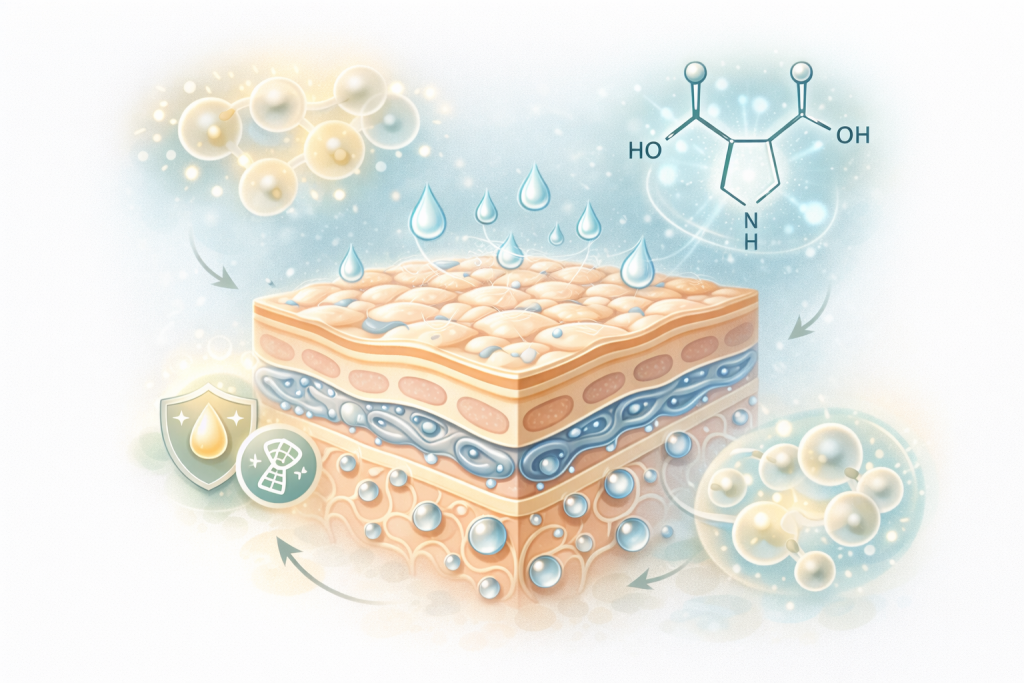
Pyrrolidone carboxylic acid is a naturally occurring derivative of glutamic acid. It is a key component of the skin’s Natural Moisturizing Factor, a complex of molecules responsible for maintaining optimal hydration in the stratum corneum. Biologically, PCA acts as a humectant, meaning it attracts and retains water within the skin. Its distinctive feature is its physiological affinity with the skin, making it particularly well tolerated and effective even in sensitive skin types.
Did you know?
PCA can bind water molecules efficiently, helping the skin maintain hydration even in dry environmental conditions.
How does it work? (mechanisms of action)
Primary action
PCA functions primarily as a humectant. By attracting and holding water molecules, it helps maintain hydration levels in the outer layers of the skin. This process supports enzymatic activity and cellular cohesion within the stratum corneum.
Effects at the tissue level
At the skin surface, PCA contributes to softness, flexibility, and reduced sensations of tightness. At the cellular level, adequate hydration supports optimal barrier function and helps limit transepidermal water loss.
What this means for longevity
By preserving hydration and barrier integrity, PCA may help accompany the skin’s natural aging processes. Well-hydrated skin cells are better positioned to maintain resilience, comfort, and long-term balance.
Study spotlight
2018 – Clinical dermatology study
https://pubmed.ncbi.nlm.nih.gov/29417134/
The study reports improved skin hydration and barrier function with topical use of PCA-containing formulations.
Benefits
Sustained skin hydration
From a scientific perspective, PCA is recognized for its strong water-binding capacity within the stratum corneum.
In practical skincare, this translates into improved comfort and a smoother skin appearance.
Support of the skin barrier
Adequate hydration is essential for barrier integrity. PCA helps maintain the lipid–water balance necessary for effective barrier function.
This may support skin resilience against environmental stressors.
High tolerance for sensitive skin
Due to its endogenous nature, PCA is generally well tolerated.
It is frequently included in formulations designed for reactive or dehydrated skin.
Natural sources
- Naturally produced in the skin from amino acid metabolism
- Present in the skin’s Natural Moisturizing Factor
- Biotechnologically synthesized for cosmetic formulations
Dosage, forms & bioavailability
In skincare formulations, PCA is typically used at concentrations ranging from 0.2% to 2%.
Available mainly as sodium PCA in creams, serums, and lotions.
Often combined with other humectants such as glycerin or hyaluronic acid.
Suitable for daily, long-term use as part of a consistent skincare routine.
Safety & precautions
Pyrrolidone carboxylic acid has a strong safety and tolerance profile in topical use.
Adverse reactions are rare and usually linked to formulation sensitivity rather than PCA itself.
Patch testing is recommended for highly reactive skin.
Professional advice may be useful for compromised or dermatological conditions.
How to integrate it into a longevity skin routine
When to apply it
Morning and evening, ideally on slightly damp skin.
What to combine it with
Works well alongside gentle cleansers, barrier-supporting lipids, and antioxidants.
Example of a simple routine
Cleanse → apply a PCA-containing serum → seal with a lightweight moisturizer.
Who may find it particularly interesting
Individuals with dehydrated, sensitive, or environmentally stressed skin seeking long-term comfort.
Could sustained hydration be a foundation for skin longevity?
Pyrrolidone carboxylic acid illustrates how respecting the skin’s natural physiology can support lasting balance. By gently maintaining hydration and barrier integrity, it aligns with a vision of skin longevity rooted in consistency rather than correction. Integrated thoughtfully, PCA becomes a quiet ally—supporting comfort, resilience, and a more conscious relationship with skin health over time.
Sources
- Rawlings, A. V., & Harding, C. R. (2004). Moisturization and skin barrier function. Dermatologic Therapy.
- Verdier-Sévrain, S., & Bonté, F. (2007). Skin hydration: a review on its molecular mechanisms. Journal of Cosmetic Dermatology.
- Draelos, Z. D. (2018). The science behind moisturizers. Journal of Cosmetic Dermatology.
Continue exploring longevity
Explore this longevity topic


