
🟦 Key takeaways
- A plant-derived surfactant used for gentle cleansing of skin and hair
- Acts while respecting the hydrolipidic film and overall skin balance
- Contributes to improved tolerance of cosmetic formulations, especially for sensitive skin
- Fits into a skincare approach focused on the long-term health of the skin barrier
- Studies suggest a low irritation potential when properly formulated
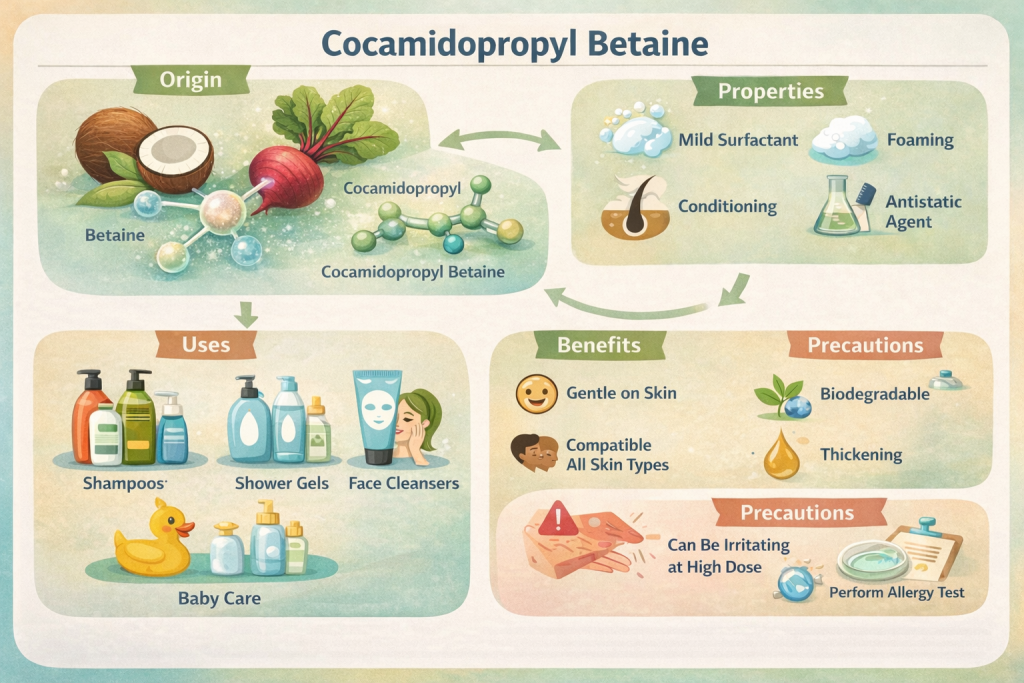
Gone are the days when a “clean” skin had to squeeze under the fingers, a sign of a stripped skin barrier. Today, the health of the epidermis is recognized as the foundation of our global balance, imposing a more measured and respectful approach to care. For instance, Cocamidopropyl Betaine, a surfactant derived from coconut oil, stands out as the reference ingredient to purify the skin without ever compromising its integrity or natural softness.
What is it?
Although not metabolically active, this plant-derived molecule plays a strategic functional role in our daily hygiene routines. By acting as a shield, it solubilizes impurities while reducing the aggressiveness of more powerful cleansing agents. Understanding its origin, mode of action and high skin compatibility will allow you to measure the effectiveness of your care and to optimize the resilience of your protective barrier.
Did you know?
Cocamidopropyl betaine is often used to reduce the irritating potential of sulfates in cleansing formulations.
How does it work? (mechanisms of action)
Primary action
As an amphoteric surfactant, cocamidopropyl betaine carries a variable charge depending on pH. This property allows it to interact effectively with fats and impurities. It facilitates their removal during rinsing while remaining relatively gentle on skin structures.
Effects at the tissue level
At the skin and scalp level, this ingredient acts as a real bodyguard for your hydrolipidic film (this thin layer of water and fat that naturally protects us). Instead of stripping everything in its path, it cleans intelligently: it removes dirt while leaving the good fats. It is the key to avoid dehydration, tightness and these invisible little irritations that end up sensitizing the skin day after day.
What this means for longevity
It’s very simple; each aggressive wash is a micro-shock for the epidermis. By using coconut betaine, we limit these repeated aggressions. Skin that is not constantly busy repairing itself or fighting irritation can use all its energy to renew naturally. In the long term, a preserved skin barrier is a skin that remains supple, comfortable and simply ages better.
Study spotlight
- Year: 2024
- Type of study: Safety assessment of cocamidopropyl betaine, a cosmetic ingredient
- Link: https://pmc.ncbi.nlm.nih.gov/articles/PMC11187029/
- Key result: cocamidopropyl betaine is considered safe, depending on type of skin.
Benefits
Gentle cleansing
From a scientific perspective, its amphoteric structure allows effective cleansing at low concentrations. It allows limiting disruption of surface lipids.
In practical terms, this results in cleansing products that leave the skin feeling supple, without tightness.
Improved formula tolerance
It is frequently included to enhance the overall skin compatibility of a product when combined with other surfactants.
In daily use, this can be suitable for sensitive or reactive skin when used in well-balanced formulations.
Contribution to a sustainable routine
By promoting non-aggressive cleansing, it aligns with a preventive skincare philosophy that respects skin physiology.
This approach may support skin vitality over the long term, consistent with a vision of conscious longevity.
Dosage, forms & bioavailability
Far from the obscure synthetic molecules, Cocamidopropyl Betaine draws its strength from a natural marriage between the fatty acids of coconut oil and betaine derived from sugar beet. In your favorite products, it is dosed with precision (usually between 1% and 10%-30%), to offer a perfect balance between washing power and skin respect. A true team ingredient, it never works alone: it is often associated with moisturizing agents such as aloe vera or panthenol (provitamin B5) to transform your daily hygiene into a real moment of soothing care.
Safety & precautions
In terms of safety, this active has an exemplary tolerance profile, which explains its presence in baby care and delicate face cleansers. If skin reactions are sometimes mentioned, they remain extremely rare and are most often due to manufacturing impurities rather than the molecule itself. For the most reactive or allergic skin types, classic vigilance remains essential, but for the vast majority of users, it remains one of the safest allies to maintain a healthy and balanced skin day after day.
How to integrate it into a longevity routine
When to use it
During daily cleansing, morning and/or evening, depending on skin or scalp needs.
What to pair it with
With moisturizing, lipid-replenishing, and soothing agents to support the skin barrier.
Example of a simple routine
A gentle cleanser formulated with cocamidopropyl betaine, followed by a moisturizer that respects the skin microbiome.
Who may find it particularly relevant
Individuals seeking gentle cleansing products suitable for regular use and aligned with a long-term skincare perspective.
What if gentle cleansing played a role in skin longevity?
Choosing respectful cleansing agents such as cocamidopropyl betaine invites a shift in perspective, viewing daily hygiene as a gesture of preservation rather than correction. By supporting skin balance, this type of ingredient fits naturally into a sustainable skin health approach. Without excessive promises, it highlights that skin longevity often relies on measured choices in harmony with the body’s natural functions.
Sources
- Frosch, P. J., & Kligman, A. M. (2013). Assessment of the irritancy of surfactants. Contact Dermatitis.
- CIR Expert Panel. (2012). Safety Assessment of Cocamidopropyl Betaine. International Journal of Toxicology.
- Draelos, Z. D. (2018). Cosmetic Dermatology: Products and Procedures.
Continue exploring longevity
Explore this longevity topic