Key Takeaways
- A humectant that brings water to the surface layer of your skin.
- Increases your skin hydration levels.
- Strengthens your skin barrier function.
- Glycerin is found in most everyday skincare that is formulated for dry and sensitive skin.
- Studies have found that it increases your skin hydration.
There are so many new actives being introduced to skincare, and it’s unbelievable, and glycerin is still at the top of the list for a hydrator ingredient, simply because it is a superb hydrator, a balancer, and can keep skin comfortable.
Learn how this amazing ingredient works and why it’s become so relied upon in keeping the skin balanced and healthy:
What is glycerin?
Glycerin, also known as glycerol, is a compound that exists naturally in the body as well as in both plant and animal sources.
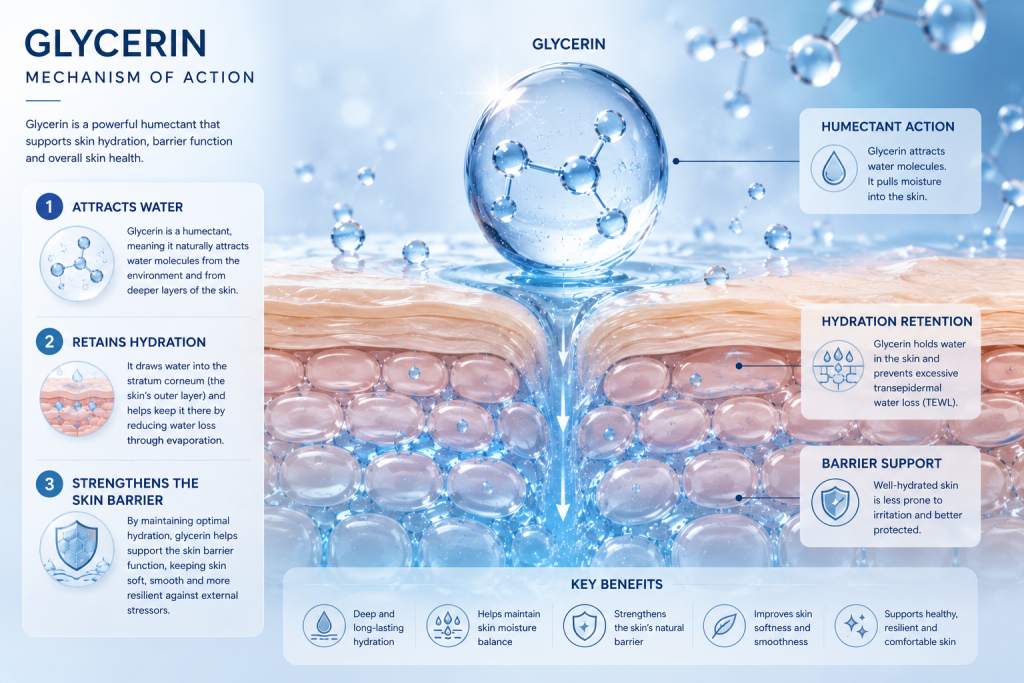
What makes glycerin particularly valuable in skincare is its ability to attract and retain moisture in the skin’s outermost layer, the stratum corneum.
Did You Know?
Research has shown glycerin not only helps in hydrating skin but also helps in the development of the cells in the epidermis.
What does glycerin do for the skin?
Primary Mechanism of Action
Glycerin is a humectant; it is composed of three hydroxyl groups. Due to its molecular structure, it attracts water molecules and helps retain them in the upper layers of the skin.
Such properties can serve to minimize transepidermal water loss, creating a hospitable environment for skin cells to function properly.
Effects on skin tissues
Skin hydration
Glycerin hydrates and softens the skin. Especially during the winter cold, during polluted environments, under air conditioning, or after washing.
Skin barrier function
Adequately moisturized skin has the capacity to support effective barrier function of the skin, and protect the body from its surroundings.
Cellular balance
The skin cells can only reach optimum efficiency if they have the necessary moisture supply. Glycerin can support cell activity in a gentle way.
What this means for longevity
The longevity of your skin is not only defined by how it looks but also by how healthy its integrity, suppleness, and strength remain.
Glycerin’s hydrating properties may support the natural processes in the skin.
Study Spotlight
2008 – Scientific Review
Study: https://pubmed.ncbi.nlm.nih.gov/18510668/
Key Finding: The use of glycerin increases skin moisture. In addition, it was found that it plays an important role in maintaining the skin barrier.
Benefits of glycerin for skin
Supports long-lasting hydration
Healthy skin needs plenty of moisture. Glycerin helps prevent moisture loss and keeps skin hydrated, soft, and comfortable even in dry environments.
May support skin healing
Sufficient moisture is essential for supple and healthy skin. This ingredient helps to retain moisture and strengthen the skin barrier, thereby supporting the skin’s natural regeneration ability.
Promotes softness and suppleness
It is directly related to the firmness and elasticity of the skin. Integrating moisture into your daily skincare routine helps to improve skin condition and keep it healthy in the long term.
Natural sources of glycerin
Glycerol used in skin care products is mainly obtained from the following plants:
- Sunflower oil
- Coconut oil
- Soybean oil
- Rapeseed oil
- Plant-based saponification processes
Dosage, forms & bioavailability
In topical skincare products, glycerin is typically used at concentrations ranging from 2% to 20%, depending on the intended formulation and skin benefits.
Available forms include:
- Moisturizing creams
- Hydrating serums
- Body lotions
- Repair balms
- Gentle cleansers
Potential synergistic ingredients include:
- Hyaluronic acid
- Ceramides
- Panthenol (Provitamin B5)
- Niacinamide (Vitamin B3)
Daily use is recommended to better sustain the skin’s hydration and barrier function.
Safety & precautions
Safe to use on a long-term basis, as long as it is a good-quality skincare product.
Reactions to glycerin are so incredibly rare it is hardly an issue; however, excessively high concentration levels can result in a sticky or unpleasant skin feeling temporarily.
How to Incorporate Glycerin Into a Longevity-Focused Skincare Routine
What to pair with glycerin
Glycerin pairs perfectly with:
- Gentle skin cleansers
- Ceramides
- Hyaluronic acid
- Daily sunscreen
- Antioxidant skincare ingredients
Simple glycerin routine
- A soothing cleanser on your face
- Add a serum containing glycerin, which has moisturizing properties
- Top it off with a cream containing glycerin and ceramides
- Use a broad spectrum SPF cream each morning.
These steps would help promote and sustain skin hydration and skin balance in the long term.
Who may benefit most?
Glycerin may be particularly beneficial for:
- Dry skin
- Sensitive skin
- Mature skin
- People exposed to dry environments
- Anyone looking to promote long-term skin hydration and resilience
Could consistent hydration be one of the simplest ways to support healthy skin over time?
Not everything brand new has to be the most effective skincare ingredients; glycerin is a perfect example of that. Glycerin assists in preserving skin hydration, comfort, and barrier function, and it is still a crucial ingredient in keeping skin healthy with time.
This simple, science-based approach reflects SOGEVITY’s commitment to supporting long-term skin health through informed skincare choices
Sources
- Fluhr JW, Darlenski R, Surber C. Glycerol and the skin: holistic approach to its origin and functions. British Journal of Dermatology (2008). https://pubmed.ncbi.nlm.nih.gov/18510668/
- Hara M, Verkman AS. The roles of glycerol and aquaporin-3 in epidermal biology and skin hydration. Journal of Investigative Dermatology (2008). https://pubmed.ncbi.nlm.nih.gov/18510668/
- Lodén M. The clinical benefit of moisturizers. Journal of the European Academy of Dermatology and Venereology (2005). https://pubmed.ncbi.nlm.nih.gov/15987288/
- Rawlings AV, Harding CR. Moisturization and skin barrier function. Dermatologic Therapy (2004). https://pubmed.ncbi.nlm.nih.gov/14728698/
- National Center for Biotechnology Information (NCBI). Skin hydration and glycerol physiology. https://www.ncbi.nlm.nih.gov/