Key takeaways
- Dimethicone is a silicone commonly used in cosmetics to form a protective barrier on the skin’s surface.
- Its primary mechanism involves reducing transepidermal water loss (TEWL), thereby helping to maintain skin hydration.
- It may contribute to supporting the comfort of fragile skin or skin exposed to external stressors.
- It is frequently found in products designed for dry, sensitive, or irritation-prone skin.
- Clinical studies suggest that certain formulations containing dimethicone may help reduce signs of irritant dermatitis induced by aggressive substances.
Healthy skin is not just about adding moisture; it’s about keeping it. Dimethicone is one of the most widely used silicone ingredients in skincare and is commonly found in moisturizers, barrier creams, sunscreens, and products designed for dry or sensitive skin. Although some question the synthetic nature of dimethicone, doctors have been recommending it for many years to help protect dry, sensitive, and irritable skin.
Explore the mechanisms that make dimethicone a trusted ingredient for protecting the skin barrier and reducing moisture loss.
What is dimethicone?
In biological terms dimethicone does not react in any of the metabolic processes that occur within the body but acts as an occlusive physical barrier on the surface of the skin and does not penetrate deeper.
This unique characteristic provides several desirable properties:
- improved spreadability of formulations;
- an immediate softening effect;
- reduced water loss;
- support for the skin barrier function.
Its relatively large molecular size appears to significantly limit absorption through the skin, contributing to its favorable tolerance profile in common cosmetic applications.
Did You Know?
Despite being a silicone, dimethicone is considered non-comedogenic and is widely recommended by dermatologists for dry, sensitive, and irritation-prone skin due to its low risk of absorption and strong safety profile.
How does It Work?
Primary Action
Dimethicone works by forming a lightweight protective barrier on the skin that helps reduce transepidermal water loss (TEWL), maintain skin hydration, and support overall skin barrier health.
In practice, this helps the skin retain moisture while leaving it feeling smoother and softer.
Much cleaner.
Effects at the tissue level
Skin
Dimethicone can reduce skin dryness by strengthening the skin’s barrier function.
Gentle inflammation support
Other formulations containing dimethicone have also demonstrated to be protective against irritancy caused by harsh substances and particularly against repeated detergent contact.
Everyday comfort
Its smoothing properties may also improve product application and help reduce mechanical friction on the skin.
What this may mean for longevity
Dimethicone does not directly influence the biological mechanisms of aging. However, maintaining a healthy skin barrier is an important part of long-term skin health. By helping reduce moisture loss and support skin hydration, dimethicone may contribute to skin comfort, resilience, and overall skin quality over time.
While it is not an anti-aging ingredient in the traditional sense, its ability to support the skin’s protective barrier makes it a valuable addition to skincare routines focused on healthy skin aging.
Study Spotlight
2001 – Randomized Double-Blind Clinical Study
Study type: https://pubmed.ncbi.nlm.nih.gov/11428946/
Key finding: A lotion containing dimethicone was associated with a reduction in certain markers of irritation following exposure to a cutaneous irritant.
Dimethicone benefits for the skin
Supporting skin hydration
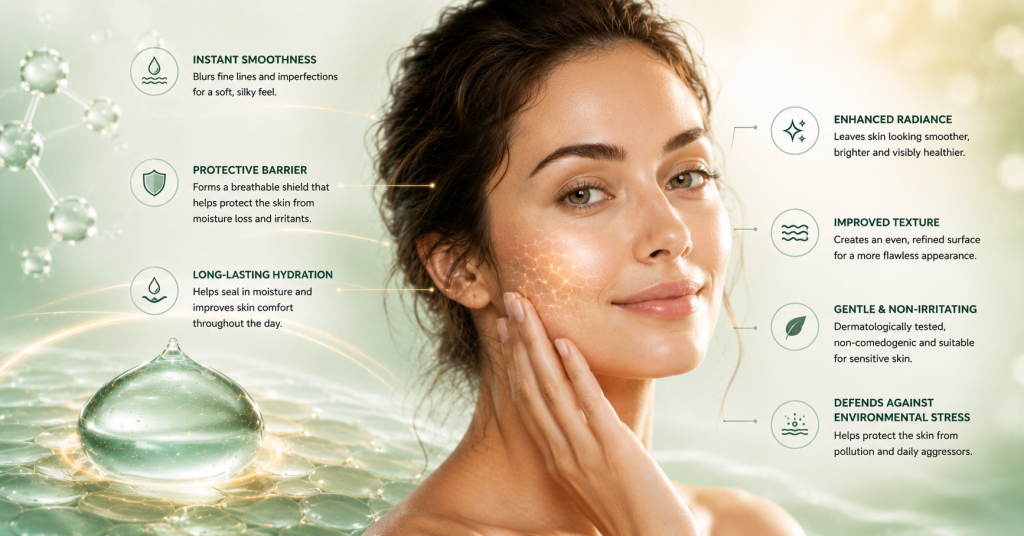
Dimethicone helps limit the evaporation of water from the epidermis. This action may promote a greater sense of hydration, particularly in individuals with dry or compromised skin.
In daily practice, it is often incorporated into moisturizing creams intended for colder seasons or routines designed to restore skin comfort.
Contributing to skin barrier protection
By creating a protective film, dimethicone may reduce the impact of certain environmental stressors, such as frequent washing or contact with mild irritants.
This property explains its presence in products formulated for hardworking hands or areas of the body prone to friction.
Enhancing the Sensory Experience of Skincare
Beyond its protective role, dimethicone provides a silky texture and facilitates product spreadability.
This may encourage better adherence to skincare routines, an often-overlooked aspect of sustainable health practices.
Natural sources
Dimethicone is not naturally present in foods or plants.
It is obtained through industrial synthesis using silicon-based compounds specifically processed for cosmetic and dermatological applications.
Dosage, forms & bioavailability
The concentrations used in cosmetic products generally range from 1% to 15%, depending on the intended purpose.
Available forms include:
- moisturizing creams
- restorative skincare products
- makeup primers
- protective lotions
- hair care formulations
Potential synergies:
Dimethicone is often combined with:
- glycerin
- ceramides
- hyaluronic acid
- emollient ingredients
These combinations aim to provide hydration, protection, and enhanced skin comfort.
Its systemic bioavailability following topical application appears to be extremely limited, contributing to its favorable safety profile.
Safety & precautions
Dimethicone is considered safe for most users. However, anyone experiencing persistent irritation or concerns about a skin condition should consult a healthcare professional.
Different types of acne sufferers may react differently with respect to one type or another of a cosmetic, according to its end form.
How to incorporate it into a longevity routine
When to use it
Primarily after hydration steps, to help preserve moisture within the superficial layers of the skin.
What to pair it with
Dimethicone can be integrated into routines that include:
- humectants such as glycerin;
- physiological lipids such as ceramides;
- soothing skincare products tailored to individual needs.
Example of a simple routine
- Gentle cleanser.
- Hydrating serum.
- Cream containing dimethicone.
- Daytime sun protection.
Who may find it particularly interesting?
- individuals with dry skin;
- individuals with sensitive skin;
- people exposed to frequent handwashing;
- situations requiring additional support for the skin barrier.
Healthy skin starts with a strong barrier
Dimethicone works in a simple but effective way. By helping reduce moisture loss and support the skin barrier, it helps the skin stay hydrated, comfortable, and better protected against everyday environmental stressors. While it does not directly influence the biological processes of aging, maintaining a healthy skin barrier remains an important part of long-term skin health. In that sense, dimethicone reflects a more practical approach to skin longevity supporting the skin’s natural defenses day after day.
Sometimes, the most effective skincare ingredients are not the ones that transform the skin overnight but the ones that quietly help it stay balanced, comfortable, and resilient over time.
Sources
- Maibach HI, et al. A bioengineering study on the efficacy of a skin protectant lotion in preventing SLS-induced dermatitis. Skin Pharmacology and Applied Skin Physiology. 2001. https://pubmed.ncbi.nlm.nih.gov/11428946/
- Nair B, et al. Final report on the safety assessment of dimethicone and related ingredients. International Journal of Toxicology. 2003. https://pubmed.ncbi.nlm.nih.gov/14555417/
- Johnson W Jr, et al. Safety Assessment of Dimethiconol and Its Esters and Reaction Products as Used in Cosmetics. International Journal of Toxicology. 2017. https://pubmed.ncbi.nlm.nih.gov/29243542/
- Voegeli D, et al. A controlled, three-part trial to investigate the barrier function and skin hydration properties of six skin protectants. Ostomy Wound Management. 2005. https://pubmed.ncbi.nlm.nih.gov/16439809/