Key takeaways
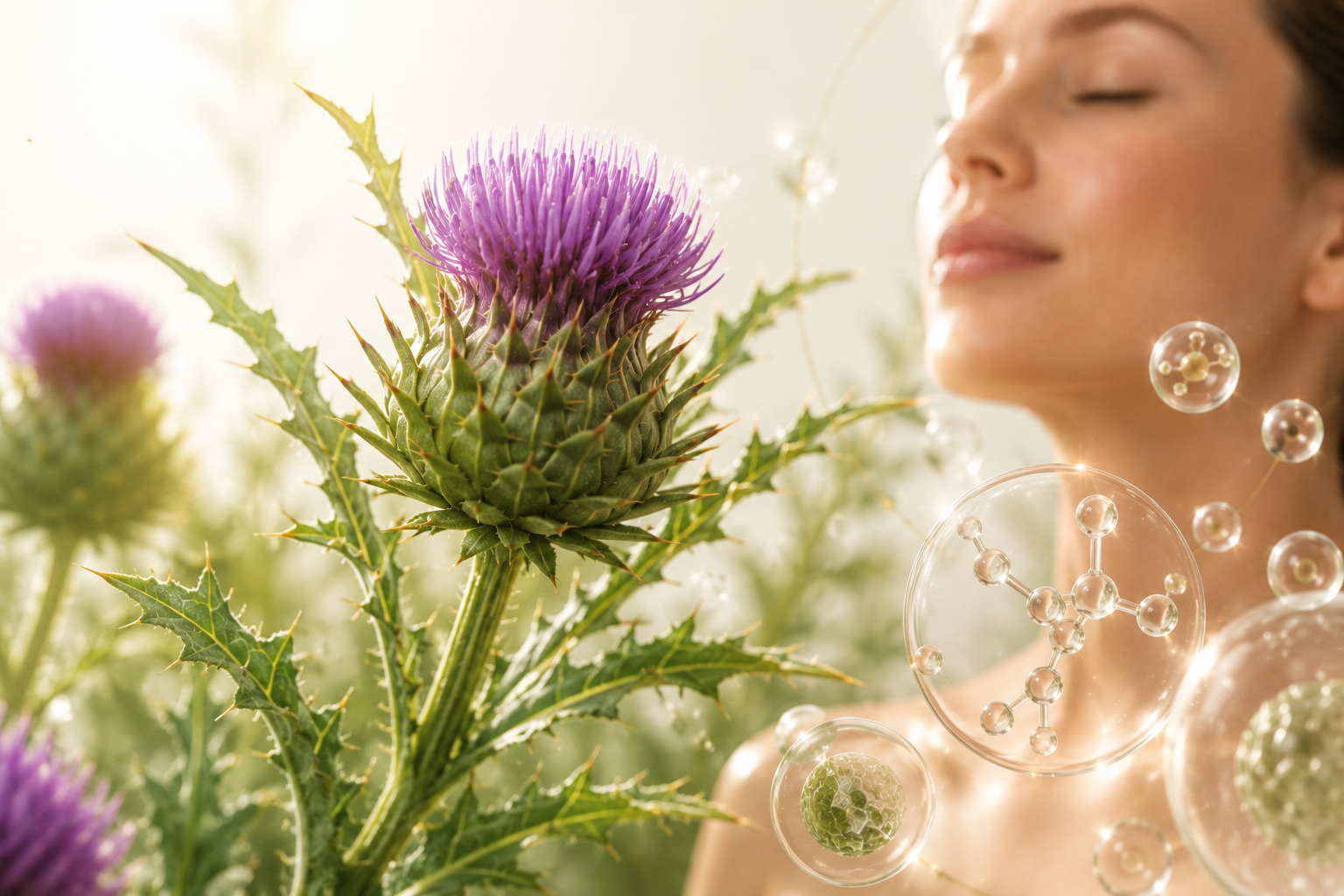
- Cardosine is a natural enzyme produced by the cardoon flower (Cynara cardunculus).
- It comes from the aspartic protease family, a group of enzymes that break down proteins.
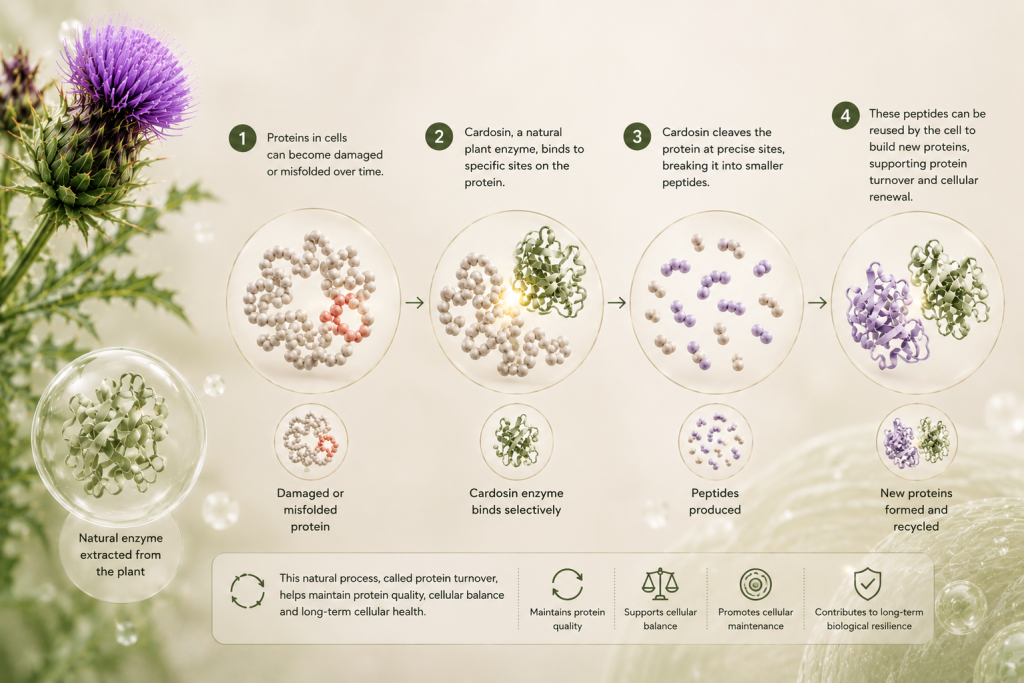
- Its primary mechanism of action involves splitting specific proteins at highly selective sites.
- Cardosine is currently being studied primarily for its uses in food biotechnology, particularly in traditional cheese production.
- Recent research has also explored its role in cellular aging processes and the mechanisms of plant senescence.
Cardosine remains relatively unknown outside scientific circles, yet it has attracted sustained interest in plant biochemistry for several decades. This cardoon enzyme is naturally produced by Cynara cardunculus, a Mediterranean plant.
Unlike many compounds commonly discussed in the context of longevity, cardosine is neither a nutrient nor an antioxidant. Instead, researchers are interested in its role in protein metabolism.
Discover Cardosine characteristics, mechanisms of action, and current areas of scientific interest
What is Cardosine?
Cardosine is an aspartic protease naturally produced by cardoon, a plant in the Asteraceae family that is native to the Mediterranean region.
The two main forms identified are cardosine A and cardosine B. From a biological perspective, these enzymes help break down proteins in a controlled way.
Did You Know?
Cardossins are one of the most studied plant-based proteases and have been used for centuries as natural milk coagulants in traditional Iberian cheese-making.
How does Cardosine work?
Primary mechanism of action
Cardosine acts as a biological enzyme that breaks specific proteins into smaller fragments by cleaving targeted peptide bonds within their structure. This high degree of selectivity explains its importance in both food biotechnology and plant biology research.
Effects at the tissue level
Among plants, cardosins appear to contribute to:
- Ripening seeds
- Plant aging mechanisms
- Reactions to environmental stress
- These processes help maintain the plant’s physiological balance and aid in cell growth during its entire life cycle.
These functions are linked to cellular maintenance and protein regulation; researchers have explored whether studying cardosine may offer broader insights into biological aging processes.
What this may mean for longevity
Currently there is no scientific evidence to indicate that Cardiosin directly increases human lifespan.
However, studying these enzymes may lead to a deeper understanding of protein turnover, a biological process closely linked to cell maintenance, healthy aging, physiological functions, and long-term biological resilience.
These processes are recognized as important areas of aging research.
Study spotlight
Year: 2005
Study Type: Experimental biochemical study
Study Link:
https://pubmed.ncbi.nlm.nih.gov/15677463/
Key Finding:
Researchers demonstrated that Cardosine A exhibits high enzymatic specificity and shares several functional characteristics with proteases involved in cellular protein renewal mechanisms.
What longevity research reveals
Benefit 1: advancing understanding of protein turnover
Proteins are constantly renewed to help cells function properly. By studying enzymes such as cardosine, researchers can better understand protein turnover, a process increasingly recognized as important for cellular maintenance and healthy aging.
Benefit 2: a valuable tool for biotechnology research
Cardosine shows extremely selective enzymatic properties.
This feature explains its use in traditional food production and its growing role in biotechnological applications involving plant-derived enzymes.
Benefit 3: a window into plant aging mechanisms
Researchers showed how cardosins act at different stages of cardoon growth.
These insights could lead to a better understanding of the basic mechanisms for biological processes that govern cellular aging and tissue renewal in living organisms.
Natural sources
Cardosine is primarily found in:
- Cardoon flowers (Cynara cardunculus)
- Floral stigmas of the cardoon plant
- Traditional vegetable rennet extracts
- Plant cell cultures developed for research purposes
Current research and applications
Unlike many nutritional ingredients, cardosine is not commonly used as a dietary supplement.
Current research focuses primarily on:
- Plant extraction methods
- Enzymatic applications
- Biotechnological production
- Biochemical properties
Currently, no specific dosage has been established to improve human health, and the scientific research does not provide any validated dosing protocols.
Safety & precautions
Available safety data mainly concern food and industrial applications.
To date:
- No validated health benefits have been established in humans.
- No recognized supplementation protocol currently exists.
- Any potential use should be evaluated individually by a qualified healthcare professional.
A cautious and evidence-based approach therefore remains appropriate.
What this means for a longevity-oriented lifestyle
When to take it
There are currently no official recommendations regarding timing or supplementation.
What to combine it with
The scientific literature does not describe established nutritional synergies for human use.
Example of a simple longevity routine
Within a longevity-focused approach, it may be more meaningful to prioritize:
- A plant-rich diet
- Regular physical activity
- Restorative sleep
- Balanced stress management
These lifestyle strategies currently benefit from a much stronger body of scientific evidence.
Who may find Cardosine interesting?
Cardosine may be of particular interest to:
- Plant biology researchers
- Enzymology specialists
- Food science professionals
- Individuals curious about the mechanisms underlying living systems
Could plant enzymes offer new perspectives on healthy aging?
Cardosine illustrates how studying specialized plant enzymes can improve our understanding of protein turnover involved in protein metabolism and cellular maintenance. Although it is not currently considered a longevity ingredient for human use, its role in protein processing makes it a relevant subject in research focused on biological function and adaptation.
As our understanding of aging continues to evolve, investigations into these fundamental mechanisms may help provide valuable insights into how living systems maintain balance over time.
Sources
- Castanheira, P., et al. (2005). Activation, proteolytic processing, and peptide specificity of recombinant cardosin A. Journal of Biological Chemistry.
https://pubmed.ncbi.nlm.nih.gov/15677463/ - Pereira, C., et al. (2008). Cardosins in postembryonic development of cardoon: Towards an elucidation of the biological function of plant aspartic proteinases. Protoplasma.
https://doi.org/10.1007/s00709-008-0288-9 - Folgado, A., & Abranches, R. (2021). Tobacco BY2 cells expressing recombinant cardosin B as an alternative for production of active milk-clotting enzymes. Scientific Reports.
https://www.nature.com/articles/s41598-021-93882-6 - Ramalho-Santos, M., et al. (1996). Action on bovine αs1-casein of cardosins A and B. Biochimica et Biophysica Acta.
https://pubmed.ncbi.nlm.nih.gov/8841384/ - Macedo, I. Q., et al. (1996). Caseinolytic specificity of cardosin. Journal of Agricultural and Food Chemistry.
https://pubmed.ncbi.nlm.nih.gov/10552626/