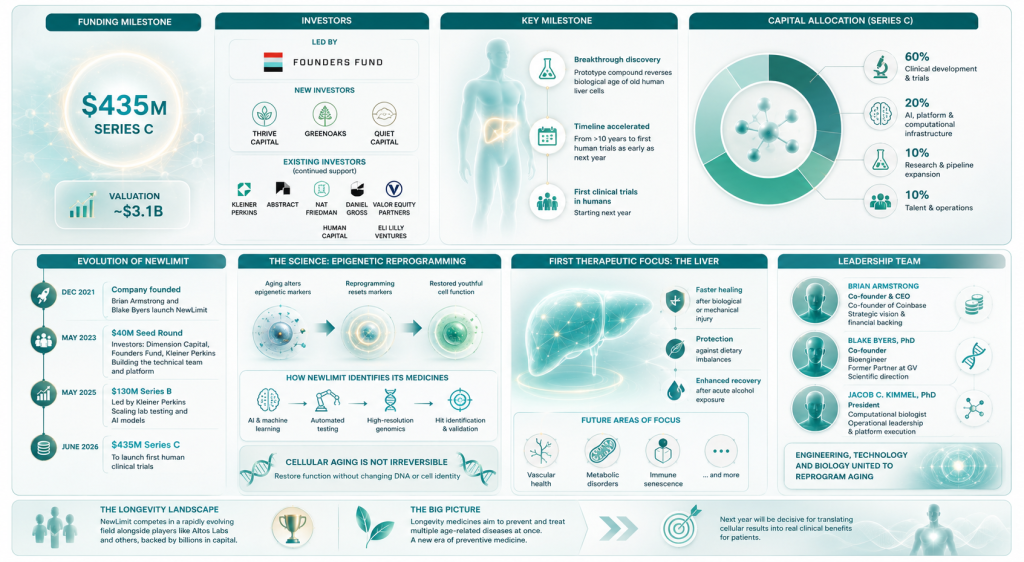
Longevity biotechnology has just reached a historic financial and scientific milestone. The startup NewLimit has officially closed a Series C funding round of $435 million, propelling its valuation to approximately $3.1 billion.
This major financial operation was led by the venture capital fund Founders Fund. It also benefits from the entry of prominent new institutional investors, including Thrive Capital, Greenoaks, and Quiet Capital.
Several historical shareholders also reaffirmed their support during this fundraising round. Among them are influential names from the tech and healthcare sectors, such as Kleiner Perkins, Abstract, Nat Friedman, Daniel Gross, Valor Equity Partners, Human Capital, as well as Eli Lilly Ventures.
Development accelerated by a major scientific discovery
NewLimit’s management initially anticipated a timeline of more than a decade before being able to test its technologies on human subjects. Breakthroughs by the startup’s research team have led to a drastic revision of these operational forecasts. The acceleration of the timeline is explained by the scientific discovery of a functional drug prototype. Laboratory data indicate that this compound successfully reversed the biological age of aged human liver cells. This major breakthrough allows the biotech company to officially announce the launch of its first human clinical trials as early as next year. This revised timeline marks a rapid transition from the stage of fundamental research to clinical development.
The scientific foundations of epigenetic reprogramming
NewLimit’s therapeutic approach relies on cellular plasticity at the epigenetic level. The developed therapies do not alter the underlying DNA sequence but modify the chemical markers that regulate gene expression. This discipline demonstrates that cellular aging is not an irreversible process. By resetting these epigenetic markers, it is possible to restore the biological functions of a young cell without erasing its initial functional identity. To identify the molecules capable of carrying out this reprogramming, the company relies on a proprietary technological platform. This platform combines advanced artificial intelligence, assay automation, and high-resolution genomics technologies.
Initial targeting of hepatic pathologies and future avenues
The startup’s first drug candidate specifically targets liver tissue. Data from internal research demonstrate that this therapy allows the liver to heal faster following biological or mechanical injury. The molecule also demonstrates an ability to protect the organ against damage related to dietary imbalances. Finally, tests indicate a significant acceleration of cellular recovery after acute exposure to alcohol consumption. Beyond this initial application, NewLimit is already deploying its computational tools toward other therapeutic areas. Fundamental research programs are underway targeting vascular health, metabolic disorders, and immune senescence.
A governance combining engineering, tech, and computational biology
NewLimit’s leadership structure reflects the intersection of tech capital and cutting-edge biological research. The startup was co-founded in 2021 by three complementary profiles from the innovation sector. Brian Armstrong, CEO and co-founder of the digital asset exchange platform Coinbase, provides initial financial and strategic support. The scientific direction revolves around Blake Byers, a bioengineer and former partner at GV. Operational management and the presidency of the company are handled by computational biologist Jacob C. Kimmel. This triumvirate seeks to apply industrial and computational processes at scale for drug discovery.
The evolution of the startup’s capitalization since 2021
NewLimit’s financial trajectory bears witness to the growing interest of investors in disruptive biotechnologies. The company’s development has been structured through several successive and progressive funding phases. December 2021: Official launch of the structure by Brian Armstrong and Blake Byers to lay the foundations of the research platform. May 2023: Securing an initial $40 million in funding from Dimension Capital, Founders Fund, and Kleiner Perkins to structure the technical team. May 2025: Completion of a $130 million Series B led by Kleiner Perkins to intensify laboratory testing and AI models. June 2026: Closing of the $435 million Series C to finance the transition to human clinical trials.
A highly competitive longevity market
NewLimit’s positioning sits within an ecosystem where entities backed by very substantial capital compete. Research into cellular rejuvenation is attracting massive investments from Silicon Valley entrepreneurs. The startup operates alongside entities like Altos Labs, a company also specialized in cellular reprogramming and funded to the tune of several billion dollars. Competition is concentrated on recruiting the best talent in biology and AI. NewLimit’s specificity lies in its choice to pivot rapidly toward human clinical trials thanks to its hepatic prototype. This decision could alter sector dynamics by providing the first concrete efficacy data in humans.
Economic prospects of aging therapies
The business model for longevity drugs differs significantly from traditional molecular therapies. The treatments being developed aim to prevent and treat a set of age-related systemic pathologies simultaneously. Institutional investors estimate that the potential market for these therapies is significantly larger than that of drugs targeting a single isolated disease. The success of a human clinical trial would pave the way for a new category of preventive medicine. The deployment of this major capital demonstrates that the private sector now views biological aging as a solvable engineering problem. Next year will be decisive in evaluating the transferability of these scientific results from the cell to the patient.
Continue exploring longevity
Explore this longevity topic