For most of human history, slowing aging belonged to mythology, philosophy, or wishful thinking. Today, it has entered a very different arena: data. Aging can now be measured, tracked, and compared. Out of this shift emerged the Rejuvenation Olympics—a global experiment where people don’t compete on strength or endurance, but on how slowly their bodies are aging.
Where the idea came from
The Rejuvenation Olympics were co-founded by entrepreneur Bryan Johnson and Dr. Oliver Zolman. What started as Johnson’s personal attempt to optimize every major system in his body—known as Project Blueprint—gradually evolved into something broader: a public leaderboard designed to compare biological aging rates using standardized metrics.
The premise was straightforward but bold. If aging can be measured, then it can also be improved—and those improvements can be objectively compared.
Why aging is now measurable
For decades, aging was viewed as an unavoidable decline rather than a biological process that could be quantified. Advances in molecular biology have challenged that assumption. Today, researchers can track changes inside the body long before disease appears, offering insight into how lifestyle, stress, sleep, and nutrition influence the pace of aging.
In practical terms, aging has shifted from an abstract concept to a biological signal that can be monitored over time.
Chronological age vs biological age
Chronological age simply counts the years since birth. Biological age, by contrast, reflects how well the body is functioning at the cellular and organ level.
Two people born in the same year may have very different biological profiles depending on genetics, environment, and daily habits. This is why biological age is increasingly viewed as a more meaningful indicator of long-term health and resilience.
The biomarkers behind the score
No single marker defines biological age. Instead, scientists rely on a combination of signals, including:
- Telomere length,
- Glycan patterns on proteins,
- Inflammatory markers such as C-reactive protein (CRP),
- Functional indicators like kidney filtration and liver enzyme levels.
Together, these markers provide a more nuanced picture of how the body is aging beneath the surface.
How the Rejuvenation Olympics work
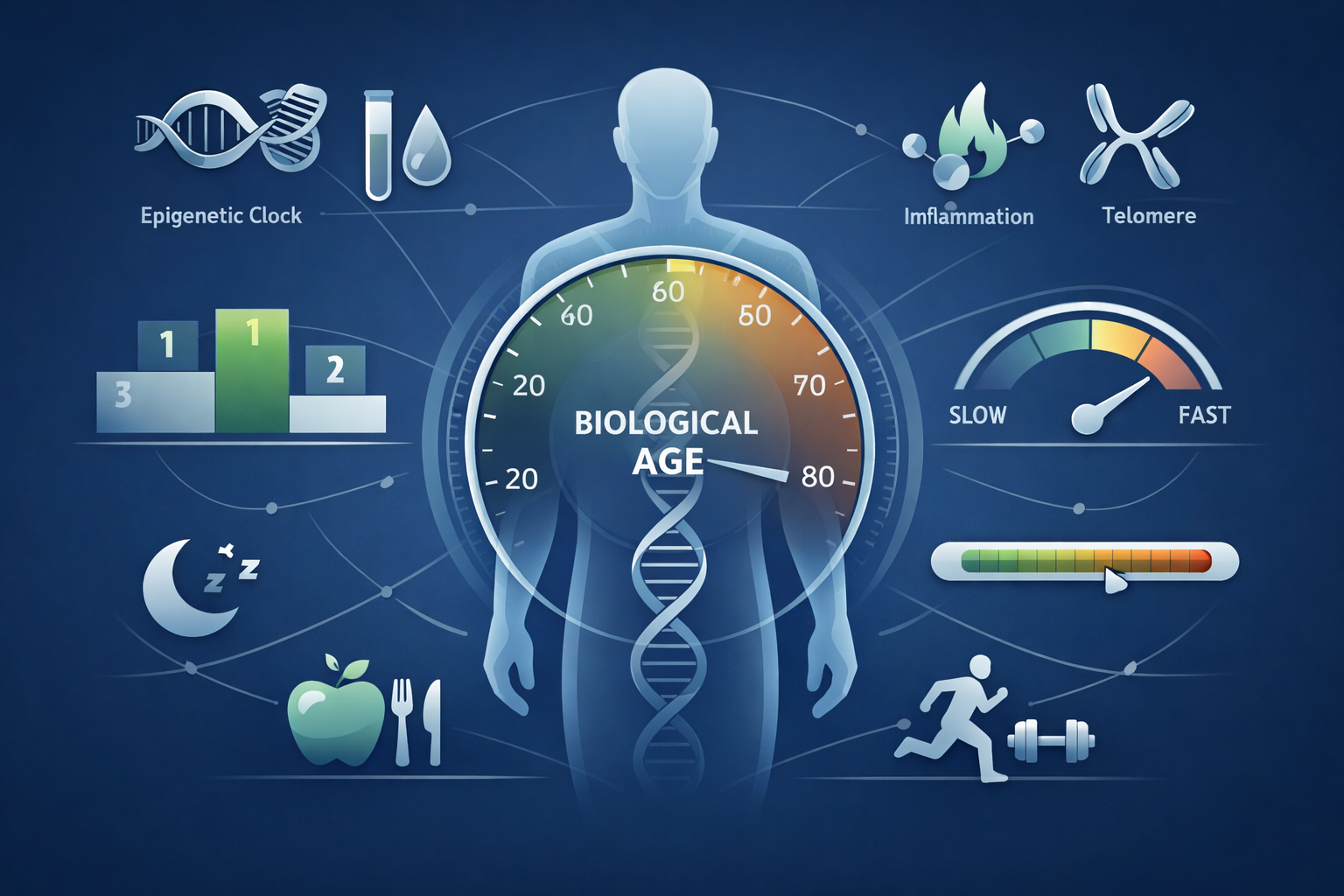
At the center of the competition are epigenetic clocks, with DunedinPACE serving as the primary metric. Unlike traditional aging tests that estimate a static biological age, DunedinPACE measures the rate of aging—essentially how fast biological wear and tear is occurring.
Participants undergo regular blood and genetic testing, allowing them to track how changes in diet, sleep, exercise, or supplementation affect their aging trajectory over time.
The role of competition
Public rankings introduce a powerful psychological element. Seeing one’s progress—or lack of it—compared to others creates accountability and motivation. For many participants, this competitive framework makes demanding health protocols easier to sustain and encourages long-term consistency.
The result is a growing community focused not on treating disease, but on delaying its onset as much as possible.
Why this matters for the future of medicine
Modern healthcare is largely reactive, intervening only once illness develops. The philosophy behind the Rejuvenation Olympics points in the opposite direction: early and proactive prevention. The aim is to preserve physiological function for as long as possible, rather than managing decline after it begins.
This data-driven approach also supports truly personalized medicine, where interventions are guided by individual biology instead of generalized guidelines.
Biohacking, without the hype
Terms like “age reversal” often make headlines, but scientifically, the goal is more grounded. The focus is on slowing epigenetic decay and improving functional biomarkers—not turning back the clock overnight.
When applied responsibly, lifestyle optimization can meaningfully extend healthspan, even if lifespan gains are more modest.
Sogevity’s perspective
At Sogevity, we see the Rejuvenation Olympics as a catalyst for broader public engagement with longevity science. But rankings are only the beginning. Our long-term vision is to make the tools used by elite bio-optimizers accessible, safe, and useful for the wider population.
We take a science-first approach. Competition can accelerate innovation, but longevity is a long game. Sustainable progress requires clinical validation, ethical boundaries, and interventions that people can maintain for decades—not months.
Our guiding principle is simple: longevity without gimmicks—grounded in evidence, balance, and long-term health.
Continue exploring longevity
Explore this longevity topic