🟦 Key takeaways
- A naturally inspired peptide complexed with copper, used in skin science
- Acts as a biological signal involved in skin renewal processes
- Associated with collagen support and overall skin structure balance
- Studied for its role in skin repair and long-term skin comfort
- Widely used in dermo-cosmetics for its high tolerance and subtle action
Copper tripeptide-1, often referred to as GHK-Cu, has become a reference ingredient in advanced skincare focused on longevity and skin balance. Rather than acting aggressively, this bioactive peptide works as a signaling molecule, supporting the skin’s natural ability to maintain structure and resilience over time. In a conscious longevity approach, copper tripeptide-1 is valued for its capacity to accompany physiological skin functions—such as repair, hydration, and firmness—while respecting the skin’s delicate equilibrium. Its scientific background and gentle profile make it particularly relevant for sustainable, long-term skin care strategies.
What is it?
Copper tripeptide-1 is a small peptide composed of three amino acids (glycine, histidine, and lysine) bound to a copper ion. This complex occurs naturally in human plasma and tissues, where it plays a role in tissue remodeling and cellular communication. In skincare, it is bioidentical to endogenous molecules, which explains its high affinity with the skin. Its defining characteristic lies in its signaling function: rather than forcing change, it helps guide natural regenerative pathways.
Did you know?
Copper peptides were first identified in human plasma and shown to be involved in tissue repair signaling.
How does it work? (mechanisms of action)
Primary action
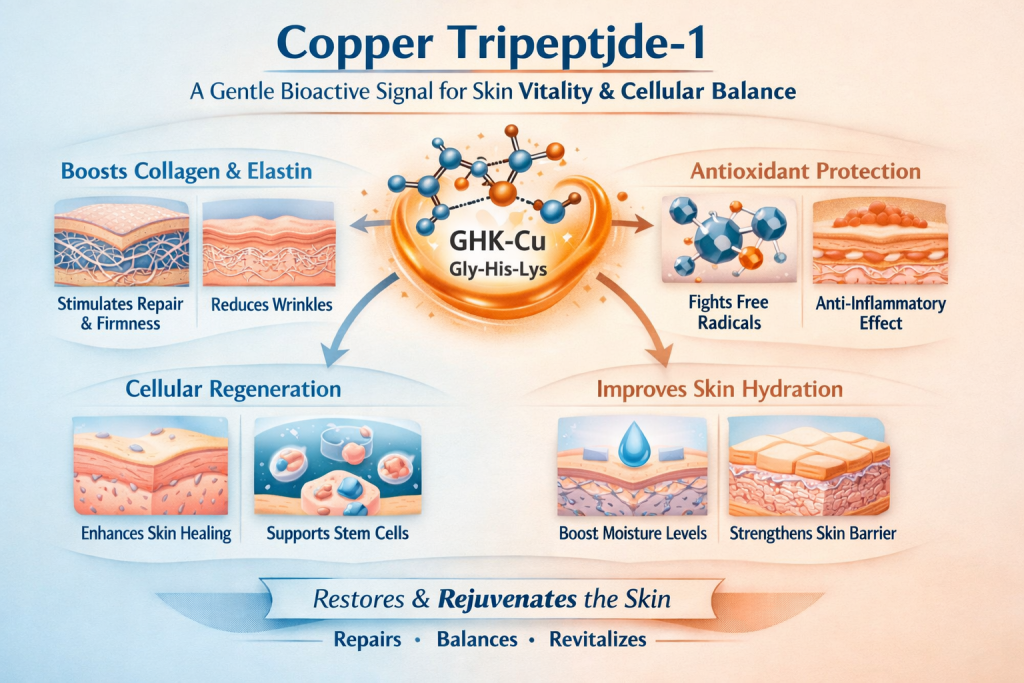
Copper tripeptide-1 acts as a cellular messenger. By delivering bioavailable copper in a peptide-bound form, it supports enzymatic systems involved in skin repair, antioxidant defense, and extracellular matrix organization.
Effects at the tissue level
At the dermal level, copper tripeptide-1 is associated with collagen and elastin balance, contributing to skin firmness and elasticity. At the epidermal level, it may support barrier recovery and overall skin comfort, particularly after environmental or cosmetic stress.
What this means for longevity
By accompanying the skin’s natural renewal mechanisms and supporting cellular communication, copper tripeptide-1 may help preserve skin quality over time. This aligns with a longevity perspective focused on maintenance, resilience, and balance rather than rapid transformation.
Study spotlight
2015 – Review of experimental and clinical studies
https://pubmed.ncbi.nlm.nih.gov/25588846/
The review highlights the role of copper peptides in skin regeneration, antioxidant activity, and extracellular matrix support.
Benefits
Support for skin structure
From a scientific standpoint, copper tripeptide-1 is associated with pathways involved in collagen synthesis and matrix organization.
In practical skincare, this may translate into improved skin firmness and a more balanced skin texture over time.
Contribution to skin repair processes
Copper plays a role in enzymatic reactions linked to tissue repair.
In topical formulations, the peptide-bound form supports gentle recovery following daily micro-stressors.
Antioxidant balance
Copper tripeptide-1 is linked to antioxidant enzyme activity, which may help support the skin’s defense against oxidative stress.
This contributes to long-term skin comfort and resilience.
Natural sources
- Naturally occurring in human plasma and tissues
- Biotechnologically synthesized for cosmetic and dermatological use
Dosage, forms & bioavailability
In skincare formulations, copper tripeptide-1 is typically used at very low concentrations (often 0.01%–0.1%).
Available in serums, creams, and targeted treatments.
Often combined with hydrating agents and soothing compounds.
Suitable for long-term, consistent use as part of a balanced routine.
Safety & precautions
Copper tripeptide-1 shows a strong safety and tolerance profile in topical use.
Transient tingling may occur on sensitive skin.
Not usually combined with strong acids or highly oxidizing actives in the same routine.
Professional advice may be useful for compromised or post-procedure skin.
How to integrate it into a longevity skin routine
When to apply it
Preferably in the evening, when natural skin repair processes are more active.
What to combine it with
Pairs well with gentle cleansers, humectants, and barrier-supporting lipids.
Example of a simple routine
Cleanse → apply copper tripeptide-1 serum → seal with a nourishing moisturizer.
Who may find it particularly interesting
Individuals concerned with skin resilience, early signs of aging, or post-stress skin recovery.
Could cellular signaling be the key to graceful skin longevity?
Copper tripeptide-1 embodies a refined approach to skin longevity—one that values communication over correction. By gently supporting repair pathways, antioxidant balance, and structural harmony, it offers a calm and intelligent way to accompany the skin through time. Integrated with patience and consistency, this peptide invites a more conscious, sustainable relationship with skin vitality.
Sources
- Pickart, L., et al. (2015). The role of GHK-Cu in skin regeneration and repair. Clinical, Cosmetic and Investigational Dermatology.
- Maquart, F. X., et al. (1993). Stimulation of collagen synthesis by copper peptides. Journal of Investigative Dermatology.
- Hostynek, J. J., & Maibach, H. I. (2006). Copper and the skin. Journal of Cosmetic Dermatology.
Continue exploring longevity
Explore this longevity topic