Key Takeaways
- AIDO Cell aims to connect biological information across scales, from molecular processes to whole-cell states and functions.
- An early demonstration examined how leukemia cells respond to the cancer drug imatinib.
- The current version focuses on two human cell lines and remains an early-stage system.
- Further testing will be needed to determine how reliably its predictions match real biology.
Could scientists one day simulate a human cell before testing their ideas in the lab? GenBio has introduced AIDO Cell, a new system designed to model how cells behave and respond to different interventions.
GenBio describes AIDO Cell as a “world model” for simulating human cells and their responses to biological interventions. Instead of using AI to study one biological feature at a time, the system aims to connect different layers of biology within a single model.
GenBio says the platform can model a cell in its natural state and simulate how it changes after an intervention, such as a drug or genetic change.
The technology is still in its early stages. Its ability to predict new biological outcomes will need to be tested through further experiments. Still, AIDO Cell offers an early look at a broader direction for AI in biology: building models that can represent how different parts of a living system interact.
Building a virtual cell
Human cells involve interconnected layers of biology, including genes, RNA, proteins, and molecular pathways. A change in one part of this system can influence cellular behavior elsewhere. For example, a drug may bind to a protein and alter a biological pathway, potentially changing cellular function.
AI has already made progress in individual areas of biology. Some models can predict protein structures, while others can analyze DNA, RNA, or gene activity. However, these models often focus on specific types of data or biological tasks.
GenBio’s approach aims to integrate multiple biological layers within a single modeling framework. AIDO Cell is designed to connect information, including gene expression, RNA, proteins, molecular interactions, and cellular states.
Key concept: Virtual cell
A virtual cell is a computational model designed to simulate how a cell behaves and responds to biological changes. It can help researchers explore hypotheses before testing them experimentally.
GenBio explains its virtual cell approach in the official video below.
How AIDO Cell models cellular changes
AIDO Cell is designed to connect different biological layers into a shared representation of the cell. This allows researchers to model a cellular state, introduce an intervention, and examine how the cell may change over time.
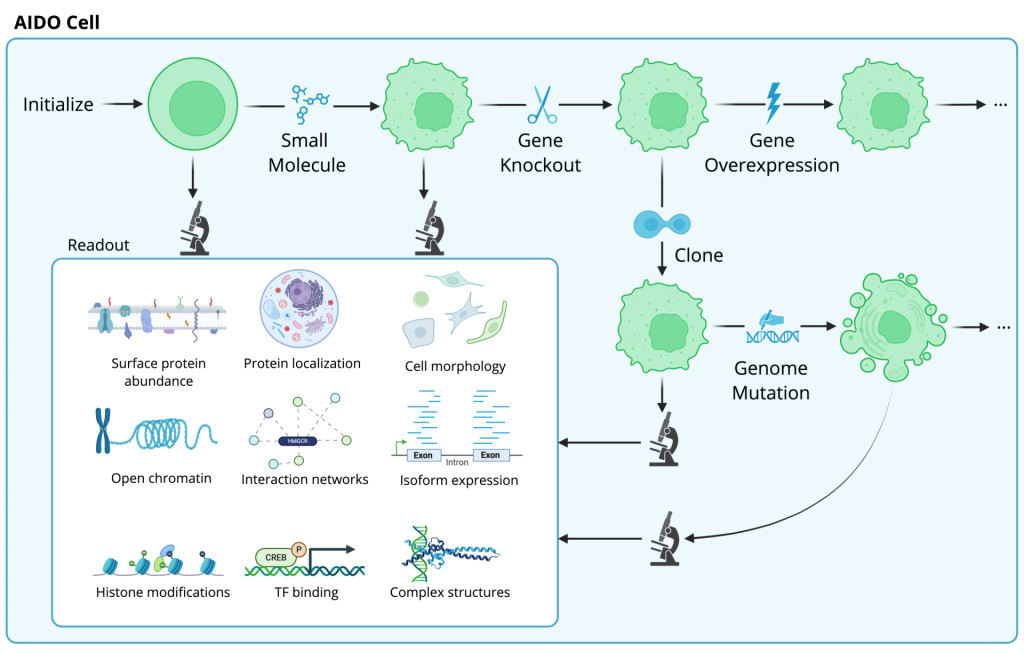
Figure 1: AIDO Cell can model a virtual cell, introduce changes such as drugs or genetic interventions, and track how its state changes over time.
Source: GenBio, “AIDO Cell: A General-Purpose Simulator for Cell Biology.”
The current version focuses on two human cell lines: K562, widely used in leukemia research, and HepG2, commonly used in studies of liver biology.
In an early demonstration, GenBio used K562 cells to examine the effects of imatinib, a drug used to treat certain forms of leukemia. According to the company, AIDO Cell reproduced known aspects of the cellular response to the drug across multiple biological levels.
These findings provide an early demonstration of AIDO Cell’s ability to model cellular responses to an intervention.
Level of evidence
AIDO Cell is still an early-stage technology. Broader experimental validation will be needed to determine how reliably it can predict biological outcomes across different diseases, therapies, and cell types.
Could virtual cells support drug discovery?
Drug development involves evaluating many potential compounds, and virtual cells could eventually provide an additional way to explore potential drug effects before experimental testing.
Researchers could use such models to compare cellular responses, generate research hypotheses, and prioritize experiments. However, virtual cells are intended to complement experimental research, not replace it. Their predictions must ultimately be validated in real biological systems.
Why this matters for longevity
Aging involves interconnected changes in gene activity, proteins, metabolism, and cellular function. AI models that integrate multiple biological layers could eventually help researchers explore how these processes influence one another.
However, AIDO Cell has not yet been specifically validated for aging or longevity research. Its relevance to the field therefore remains a potential future application rather than a demonstrated capability.
An ambitious technology still in development
AIDO Cell represents an early attempt to integrate multiple layers of cellular biology into a single AI system. Its current scope remains limited, and further validation will be needed to determine how reliably it can predict biological outcomes.
If future versions consistently match experimental results, virtual cell models could become useful tools for biological research and drug discovery, with potential applications in areas such as aging research.
FAQ
1. What is AIDO Cell?
AIDO Cell is a system developed by GenBio to simulate cellular states and responses to different biological interventions.
2. What cell lines does it currently support?
The current version focuses on the K562 and HepG2 human cell lines.
3. Has AIDO Cell been tested with drugs?
GenBio has presented an early demonstration involving imatinib and the K562 leukemia cell model.
4. Can AIDO Cell replace laboratory experiments?
No. AIDO Cell is still an early-stage system, and its predictions need to be tested experimentally.
5. Why could this matter for longevity?
More comprehensive models of cells could eventually help researchers study how different biological processes interact during aging.
Methodology
This article is based primarily on GenBio’s official announcement and technical information about AIDO Cell. Scientific context was also reviewed using a Nature Medicine Perspective on AI-driven digital organisms.
Claims about the platform’s capabilities are presented as results or statements reported by GenBio. Potential applications in drug discovery and longevity are presented as possibilities that will require further validation.
Disclaimer
This article is for informational purposes only. AIDO Cell is an early-stage research technology, its ability to predict new biological or clinical outcomes has not yet been established through broad experimental validation.
Sources
- GenBio — AIDO Cell: A General-Purpose Simulator for Cell Biology
- GenBio — World Model of the Virtual Cell
- GenBio — AIDO Cell technical paper
- Nature Medicine — Perspective on building an AI-driven digital organism