
Key Takeaways
- A Boston University study tested ABT-263 (Navitoclax), a drug that removes senescent cells.
- The treatment improved wound healing in aged mice.
- Senescent cells, also called “zombie cells,” build up with age and can affect tissue repair.
- The findings suggest that senolytic drugs may help study new ways to support healthy aging.
- The results are still limited to mice and need further research.
As the body ages, wounds usually heal more slowly. Researchers are studying whether removing damaged cells could help improve this process.
A new study from Boston University tested ABT-263 (Navitoclax), a compound designed to remove senescent cells. In aged mice, the treatment improved wound healing.
What are senescent cells?
Senescent cells are damaged cells that no longer divide or grow. “Zombie cells”: Scientists refer to them as “Zombie Cells” because while they no longer develop, they are not inactive either.
Over time, their accumulation has been linked to:
- Chronic inflammation.
- Slower tissue repair.
- Changes associated with aging.
How ABT-263 improved wound healing
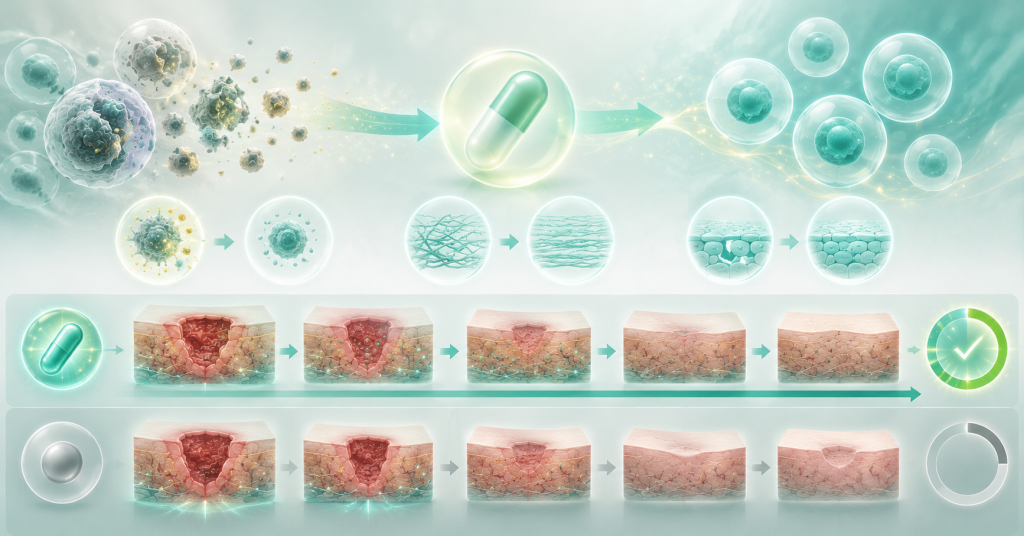
Researchers treated aged mice with ABT-263 and observed how their wounds healed. The treatment reduced senescent cells and improved tissue repair.
The newfound ABT-263 worked, even in older mammals. Compared with untreated mice:
- Treated mice had fewer senescent cells.
- Inflammatory signals were reduced.
- Tissue repair markers improved.
At the end of the study, 80% of treated wounds were fully closed, compared with 56% in untreated mice.
Why this study matters
By removing these cells, senolytic drugs aim to reduce their harmful effects on tissues. However, this study does not show that senolytics can slow or reverse aging
By removing these cells, senolytic drugs aim to reduce their harmful effects on tissues.
However, this study does not show that senolytics can slow or reverse aging. More research is needed, especially in humans.
Senolytics vs. cellular reprogramming
Researchers are exploring different approaches to target aging.
| Senolytics | Cellular reprogramming |
| Remove senescent cells | Make aged cells younger |
| Eliminate damaged cells | Reset cell functions |
| Target cellular senescence | Target cellular aging changes |
Both approaches are still under study.
Limits of the study
This research was performed in mice; results from mice do not always apply to humans.
Future clinical studies will be needed to evaluate safety and effectiveness.
Level of evidence
This is a preclinical study in mice. It provides early evidence, but human studies are still needed.
Conclusion
The study suggests that removing senescent cells may improve wound healing in aged mice. However, senolytic therapies remain experimental and require further research before possible human applications.
Methodology
Researchers treated aged mice with ABT-263 and measured changes in senescent cells, inflammation, and wound healing.
Disclaimer
This article is for informational purposes only and does not replace medical advice. The study was conducted in mice, and the results do not prove that senolytic treatments can improve aging in humans.
Sources
- Shvedova M., et al. (2024). Topical ABT-263 treatment reduces aged skin senescence and improves subsequent wound healing. Aging.
- López-Otín C., et al. (2013). The Hallmarks of Aging. Cell.
- Kirkland J. L., Tchkonia T. (2020). Senolytic drugs: from discovery to translation. Journal of Internal Medicine.