Key takeaways
- Major pharmaceutical companies, including Pfizer, GSK, AstraZeneca, Novartis and Eli Lilly, are increasingly exploring how to target the biological processes of aging rather than treating age-related diseases separately.
- The 13th Aging Research and Drug Discovery (ARDD) conference took place at Harvard University in Boston from October 1 to 3, 2026, bringing together pharmaceutical executives, researchers and US regulators.
- The FDA’s participation signals growing regulatory interest in longevity therapeutics, although clear approval pathways and standards for clinical trials targeting aging remain to be established.
- Data presented by Eli Lilly and Novo Nordisk suggest that GLP-1-based medications may influence biological aging markers, but further research is needed to establish whether these changes translate into longer, healthier lives.
- Biological age tests, artificial intelligence and new clinical trial initiatives could help researchers measure the effects of future longevity treatments more precisely.
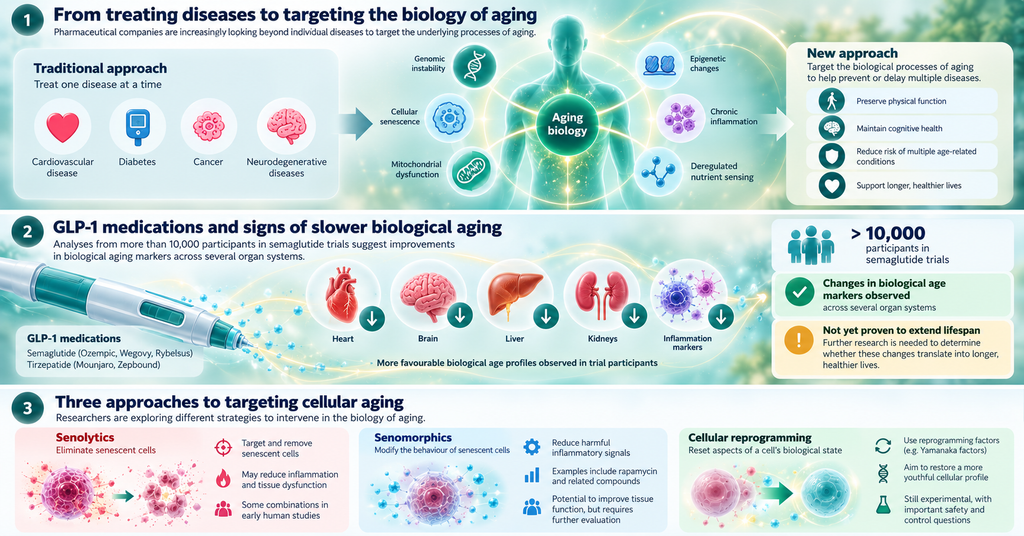
For decades, the pharmaceutical industry has largely approached aging through the diseases associated with it. Treatments have been developed for cardiovascular disease, diabetes, cancer and neurodegenerative conditions, while the underlying biological processes connecting these illnesses have received comparatively less attention as therapeutic targets.
That approach is beginning to change. At the 13th Aging Research and Drug Discovery (ARDD) conference, held at Harvard University in Boston from October 1 to 3, 2026, representatives from major pharmaceutical companies joined longevity researchers and US regulators to discuss how interventions targeting aging could move closer to clinical application. The event marked the conference’s first North American edition after years in Europe.
The presence of companies such as Pfizer, GSK, AstraZeneca, Novartis and Eli Lilly reflects growing industrial interest in a field once regarded by much of mainstream medicine as speculative. For Eli Lilly, the opportunity is closely linked to the needs of an aging population. Thomas Marron, the company’s associate vice president of healthy aging, described the field as an important area of investment because it is where future patients will be.
Yet the shift is about more than commercial opportunity. Researchers are increasingly asking whether medicine can intervene earlier in the biological processes that contribute to multiple diseases, preserving physical function and independence for longer. The central challenge is to turn promising discoveries into treatments supported by reliable clinical evidence.
The FDA enters the longevity conversation
One of the most significant developments at ARDD 2026 was the participation of officials from the US Food and Drug Administration (FDA). Their presence highlighted a central obstacle for longevity research: how to evaluate a treatment designed to influence aging when aging itself does not yet have an established, generally accepted regulatory pathway as a drug indication in the United States.
The traditional drug development model is built around specific diseases, measurable outcomes and defined patient populations. A medicine for hypertension, for example, can be evaluated through its effects on blood pressure and, in appropriate trials, cardiovascular outcomes. A treatment intended to slow aging presents a more complicated question. Researchers must determine which biological changes are meaningful, how long patients need to be followed and whether improvements in laboratory measurements translate into better health.
At the conference, FDA clinical pharmacologist Justin Penzenstadler encouraged longevity developers to work toward shared approaches to clinical trial design and data presentation. He described the agency’s role as that of an umpire rather than a coach, emphasizing that researchers and companies must help establish a common scientific basis for evaluating their treatments.
The conference discussions also pointed to further regulatory guidance as a priority for the coming year. Such guidance could help clarify which endpoints and study designs are appropriate for therapies intended to preserve health with age.
Why it matters?
Without clear standards, promising findings from small studies or biological markers may be difficult to translate into approved treatments. Greater regulatory engagement could help distinguish interventions that produce measurable changes in aging-related biomarkers from those that demonstrably improve health.
The FDA’s participation should not, however, be interpreted as approval of longevity drugs as a category. Regulatory interest is an important step, but any individual treatment will still need to demonstrate safety and efficacy for its proposed use.
GLP-1 medications raise new questions about biological aging
Among the most closely watched developments at ARDD 2026 were presentations from Eli Lilly and Novo Nordisk concerning GLP-1-based medications. Originally developed for metabolic conditions, including type 2 diabetes and obesity, these medicines have attracted growing scientific interest because of their effects on body weight, blood glucose, inflammation-related pathways and cardiovascular risk.
The question now is whether some of these effects could also influence biological aging.
Novo Nordisk presented analyses of blood samples from more than 10,000 participants in semaglutide trials. Semaglutide is the active ingredient in medicines including Ozempic, Wegovy and Rybelsus. According to the findings discussed at the conference, measurements of biological age suggested more favourable profiles across several organ systems among participants receiving the treatment.
Eli Lilly presented findings concerning tirzepatide, marketed as Mounjaro and Zepbound. The analyses suggested changes in aging-related measurements involving several organs, including the heart, brain, liver and kidneys.
These results are attracting attention because they move the discussion beyond weight loss alone. If medications that improve metabolic health also influence broader markers of biological aging, they could offer researchers a way to investigate the relationship between metabolism, age-related decline and long-term health.
However, the distinction between a promising signal and a proven longevity effect remains essential. Biological age estimates depend on the measurements used, and a change in a molecular or organ-age score does not automatically mean that a person will live longer or avoid disability.
The participants in the underlying studies also matter. Evidence from people with obesity or diabetes cannot simply be transferred to healthy older adults, whose potential benefits and risks may differ. Further research will need to establish whether these effects persist, which patients may benefit and whether the changes correspond to meaningful clinical outcomes.
For now, GLP-1 medications are not approved specifically to slow aging. Their possible role in longevity remains an active research question rather than an established treatment indication.
Biological age clocks move closer to clinical use
Progress in longevity therapeutics depends partly on the ability to measure aging reliably. Researchers cannot confidently determine whether an intervention slows aging if they lack suitable tools to assess biological changes over time.
Chronological age provides an obvious starting point, but it does not capture the differences in health and physiological function seen among people of the same age. Biological age measurements attempt to provide additional information about those differences by examining molecular patterns associated with aging and disease risk.
Epigenetic clocks are one example. They analyse patterns of DNA methylation, chemical modifications that help regulate gene activity, to estimate biological age or related aspects of aging. Other approaches use blood proteins and clinical measurements to assess the condition of particular organs.
These technologies are becoming increasingly important in research because they may help investigators identify changes that are not immediately visible through conventional clinical assessments. They can also provide a way to compare responses to an intervention over a defined period.
Nevertheless, not all biological clocks measure the same thing. Some estimate age, while others are designed to predict mortality risk, disease susceptibility or the pace of biological change. Their usefulness depends on how well they have been validated for the population and outcome being studied.
A treatment that improves a biological age score may still fail to improve mobility, cognition or survival. For that reason, researchers will need to combine molecular measurements with clinical outcomes rather than treating any single clock as definitive proof of rejuvenation.
The broader research agenda reflects this shift toward measurable healthspan. At ARDD 2026, discussions also explored how large biological datasets, advanced computational models and artificial intelligence could help researchers identify therapeutic targets and interpret complex aging processes.
Three approaches to targeting cellular aging
Beyond GLP-1 medications, longevity research is investigating several strategies that aim to intervene in the biology of aging. Three broad approaches illustrate how differently scientists are trying to address cellular decline.
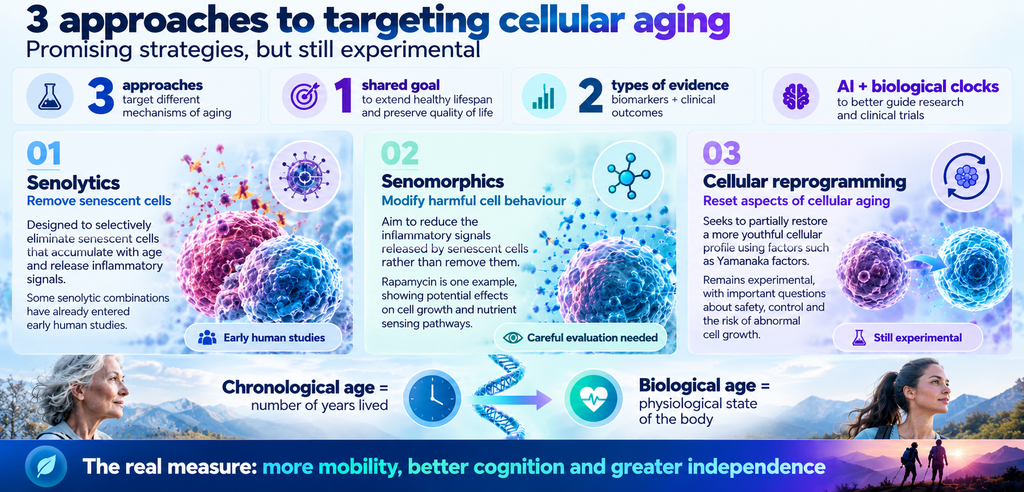
Senolytics are designed to selectively eliminate senescent cells. These cells have stopped dividing but can remain metabolically active, releasing inflammatory signals and other substances that may affect surrounding tissues. Their accumulation has been associated with several age-related conditions. Some senolytic combinations have entered early human studies, but their safety, effectiveness and appropriate clinical uses remain under investigation.
Senomorphics aim to modify the harmful behaviour of senescent cells rather than remove them. Researchers are particularly interested in compounds that reduce the inflammatory signals released by these cells. Rapamycin, a drug originally developed for immunosuppression, has attracted attention in aging research because of its effects on pathways involved in cell growth and nutrient sensing. However, its potential use to promote healthy aging requires careful evaluation, including its effects on immune function and other risks.
Cellular reprogramming seeks to reset aspects of a cell’s biological state toward a more youthful profile. Some experimental approaches use factors involved in the discovery of induced pluripotent stem cells, often called Yamanaka factors. Partial reprogramming aims to change selected features of cellular aging without fully erasing a cell’s identity. The approach remains experimental, with important questions about safety, control and the risk of abnormal cell growth.
These strategies do not offer interchangeable solutions. They target different mechanisms, and their clinical prospects will depend on whether researchers can identify the right targets, achieve effects in relevant tissues and avoid unwanted consequences.
Their shared objective is to understand whether biological aging can be modified in ways that preserve function, rather than merely changing laboratory measurements.
The healthspan gap is driving the search for new treatments
The growing interest in longevity medicine reflects a demographic challenge: living longer does not necessarily mean spending more years in good health.
The distinction between lifespan and healthspan is central to this field. Lifespan describes how long a person lives, while healthspan refers to the period spent in relatively good health, without major disease-related limitations or loss of function. The two are connected, but they do not always increase together.
Age-related conditions can affect several systems at once. Cardiovascular disease, metabolic disorders, declining mobility and cognitive impairment may combine to reduce independence during later life. Treatments that address each condition separately remain essential, but researchers are also exploring whether shared biological mechanisms could offer opportunities for earlier intervention.
The economic implications are substantial. An aging population places growing demands on healthcare services, long-term care and families supporting older relatives. Extending the number of years people remain active and independent could therefore have benefits beyond individual health.
However, estimates of the longevity market vary widely depending on what they include. Some count only biotechnology and therapeutic development, while others incorporate diagnostics, nutrition, fitness, preventive medicine and broader healthcare services. Market projections should consequently be treated as estimates rather than evidence that a particular medical approach will succeed.
For the pharmaceutical industry, the opportunity is clear enough to attract investment. The scientific challenge is more demanding: demonstrating that interventions can extend healthy life, not simply create new products around the desire to live longer.
What comes next for longevity therapeutics?
The next phase will depend on clinical evidence. One important question is whether treatments such as semaglutide can produce meaningful benefits in older adults who do not have the conditions for which these medicines are currently prescribed.
The federal PROactive Solutions for Prolonging Resilience (PROSPR) initiative is part of the effort to develop clinical research focused on healthy aging and resilience. Research programmes in this area aim to establish how potential interventions affect biological markers, physical function and other outcomes relevant to older adults.
Longer and carefully designed trials will be essential. Researchers need to determine not only whether a treatment changes biological measurements, but also whether it helps people maintain mobility, cognitive abilities and independence, and whether those benefits outweigh potential harms.
Artificial intelligence may help accelerate parts of this process. By integrating molecular, clinical and other biological data, computational systems can support the identification of candidate drug targets, the analysis of biomarkers and the prioritisation of compounds for further testing. Yet AI-generated predictions still need to be validated experimentally and clinically. Better models cannot replace the evidence required to establish that a medicine works safely in people.
The broader direction is becoming clearer. Longevity research is moving toward a more coordinated model in which pharmaceutical development, aging biology, advanced diagnostics and regulatory science inform one another. The participation of major drugmakers and regulators at ARDD 2026 illustrates how much the field has changed.
Whether that momentum produces treatments capable of extending healthy human life remains an open question. The next several years of clinical research will help determine which approaches deliver meaningful benefits and which remain promising hypotheses.
Discover how pharmaceutical research, biological age testing and emerging therapies are reshaping the science of healthy longevity.
What this means for longevity?
The growing involvement of major pharmaceutical companies marks an important development for longevity science, but it should not be confused with proof that aging can already be treated as a medical condition in its own right.
For researchers, the priority is to develop reliable measures of biological aging and connect them to outcomes that matter to patients. For regulators, the challenge is to establish appropriate standards for evaluating therapies whose intended benefits may extend across several diseases and many years of life.
For the public, the key distinction is between an intervention that changes an aging-related marker and one that has been shown to improve health or extend life. The former can provide a valuable research signal, but it does not establish the latter.
The most meaningful advance would not simply be a lower biological age score. It would be evidence that people can remain healthier, more mobile and independent for longer, with treatments whose benefits and risks are clearly understood.
Level of evidence
Emerging clinical evidence and expert discussion. This article draws on presentations and discussions at the 2026 Aging Research and Drug Discovery conference, including analyses of GLP-1-based medications and biological age measurements. These findings provide promising research directions but do not establish that the medications reverse aging or extend lifespan. The clinical significance of biological age clocks varies according to the method used and the outcomes measured. Senolytics, senomorphics and cellular reprogramming also remain at different stages of research and development.
FAQ
Are pharmaceutical companies developing drugs specifically to slow aging?
Several major pharmaceutical companies are exploring the biology of aging and potential interventions that could preserve health with age. However, research activity and commercial interest do not mean that an approved drug specifically designed to slow aging is already available.
What did the FDA contribute to ARDD 2026?
FDA officials participated in discussions about clinical trial design and the evidence needed to evaluate longevity therapeutics. Their involvement highlighted the importance of developing appropriate standards, but it did not constitute approval of any longevity drug.
Can Ozempic or Wegovy slow biological aging?
Analyses presented by Novo Nordisk suggest that semaglutide may influence certain biological age measurements. Further studies are needed to determine whether these changes translate into meaningful improvements in health or longer life. Semaglutide is not approved specifically as an anti-aging treatment.
What is the difference between biological age and chronological age?
Chronological age is the number of years a person has lived. Biological age estimates aspects of the body’s physiological or molecular condition. Different biological age tests measure different features, and none should be interpreted as a definitive measure of how long an individual will live.
What are senolytics?
Senolytics are experimental treatments designed to eliminate senescent cells, which can accumulate in tissues and release inflammatory signals. Researchers are investigating whether removing these cells could help address certain age-related conditions, but more evidence is needed to establish their safety and clinical value.
Could artificial intelligence accelerate longevity research?
AI can help researchers analyse complex biological data, identify potential drug targets and prioritise candidates for testing. Any resulting discoveries must still be validated through laboratory research and clinical trials before their safety and effectiveness can be established.
Methodology
This article is based on the 2026 Aging Research and Drug Discovery conference held at Harvard University from October 1 to 3, 2026, with additional context from published reporting on pharmaceutical companies’ longevity research. Conference information and programme details were cross-checked against the official ARDD 2026 programme. The discussion of biological age measurements and GLP-1 medications reflects findings reported at the conference and should be interpreted in light of the limitations of preliminary analyses. Claims about potential treatments are distinguished from established clinical uses.
Disclaimer
This article is for informational and educational purposes only and does not constitute medical advice. Medicines such as semaglutide and tirzepatide should be used only according to approved indications and under appropriate medical supervision. They should not be started, stopped or used for anti-aging purposes without consultation with a qualified healthcare professional.
Sources
- Business Insider. “I spent 3 days with pharma executives. They’re suddenly taking longevity seriously.” October 8, 2026.
- Aging Research and Drug Discovery. Official ARDD 2026 programme.
- Longevity.Technology. “Reflections from ARDD 2026.” October 2026.
- EurekAlert! “ARDD 2026 signals a new era for longevity biotechnology as frontier AI, big pharma, and scientific pioneers converge at Harvard.” October 12, 2026.
- Business Insider. “GLP-1 drugs and biological aging: emerging research and open questions.” Related reporting on longevity research.
Continue exploring longevity
Explore this longevity topic