
Key takeaways
- Centella’s triterpenes are believed to support collagen production and normal inflammatory processes.
- From a longevity aspect, this may promote the integrity of bodily tissues and cellular health as time goes on.
- Centella asiatica extracts are used in supplements and skincare, and some compounds may stimulate fibroblasts, the cells that produce collagen.
For centuries, Centella asiatica, also known as Gotu Kola, has been valued in traditional Asian wellness practices. Today, scientists are exploring its potential to support collagen production, tissue resilience, and cellular health.
However, it’s not a magical elixir, it seems. Early trials suggest that Centella asiatica may contribute to healthy skin and the factors essential for the aging process in maintaining levels of balance in the inflammation system and connective tissue structure.
Could this humble botanical offer meaningful support for long-term vitality? Here’s what the science says.
What is it?
Centella asiatica extract is a perennial herbaceous plant that belongs to the family of Apiaceae. Originally from South and Southeast Asia, the plant thrives in wet environments and is traditionally used as tea, in tinctures and is an important ingredient in local cuisine. This plant is interesting to scientists due to its high content of pentacyclic triterpenoids like
- Asiaticoside
- Madecassoside;
- Asiatic acid;
- Madecassic acid.
Centella asiatica has the potential to work on the junction of 3 domains that are connected by long and good-healthy skin, connective tissue, and the cell domain.
What makes Centella asiatica particularly interesting is the fact that it may possess the ability to function at the intersection of three dimensions linked together with a long and healthy life: the dimension of skin, the dimension of connective tissue, and the dimension of the cell.
Did you know?
Standardized extracts of Centella asiatica have been investigated for several decades for their potential influence on collagen synthesis and extracellular matrix remodeling.
How does it work?
Primary mechanism of Action
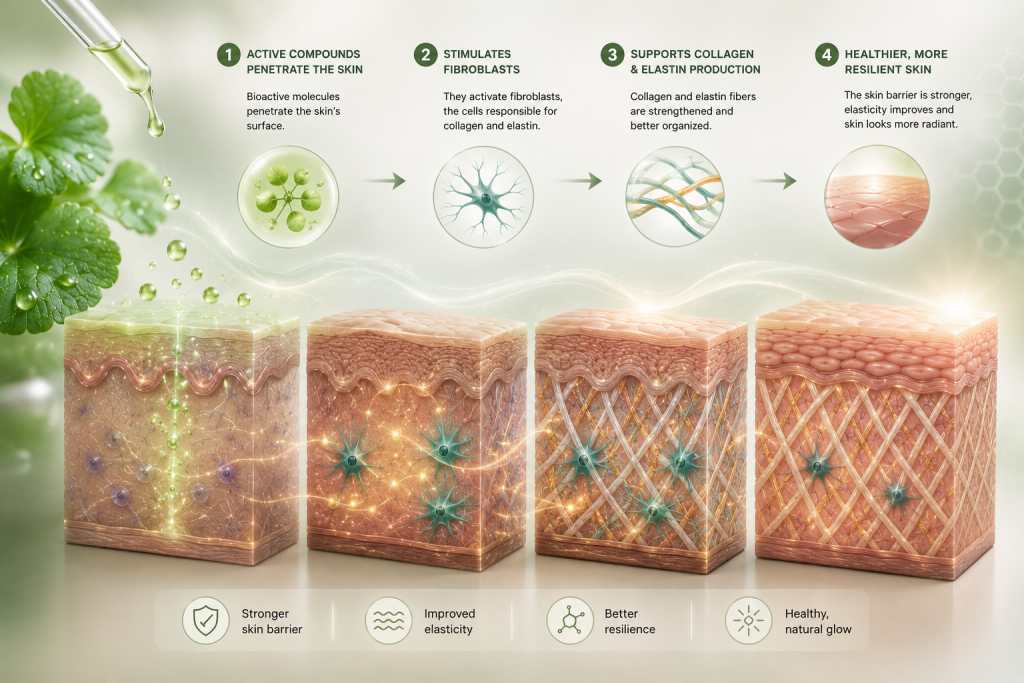
Triterpenes in Centella asiatica are also thought to influence signaling pathways involved in fibroblast activity. A fibroblast is a cell in the body that produces collagen and structural elements. These are essential for the strength of tissue.
Effects at the Tissue Level
At the skin level, experimental evidence suggests a potential role in supporting:
- Collagen synthesis;
- Tissue elasticity;
- Balanced local inflammatory responses;
- Physiological repair processes.
Emerging research has also explored its interactions with antioxidant defense systems, which may influence mitochondrial function and overall cellular resilience.
What this could mean for longevity
Centella asiatica is not a wrinkle reducer. It may, however, help the body maintain connective tissue health, cellular resilience, and physiological balance over time. Centella asiatica may support healthy aging through effects on extracellular matrix maintenance, inflammatory signaling, and cellular energy metabolism.
Study Spotlight
2023 – Scientific Review
Centella asiatica and Its Metabolite Asiatic Acid: Wound Healing Effects and Therapeutic Potential
https://pubmed.ncbi.nlm.nih.gov/36837896/
Key finding: The authors reported that active compounds from Centella asiatica may promote fibroblast proliferation and support collagen synthesis during natural tissue repair processes.
Benefits
Supporting skin health
Fibroblasts maintain skin structure and resilience. Some compounds in Centella asiatica extract may influence fibroblast activity, helping support skin firmness, skin elasticity, and recovery. This is why it is often used in spa and skincare treatments aimed at revitalizing tired skin.
Accompanying natural tissue renewal
This might be of interest to someone looking at the long-term support of their connective tissue health as part of a long-term wellness strategy. . This process is believed to be linked with the organization of components in the extracellular matrix.
Contributing to cellular balance
This is interrelated to a lifespan focus in which being alive in a good way necessitates the continuance of the cellular process.
This aspect connects with a concept focusing on lifespan maintenance, where maintaining cellular activity constitutes one of the core requirements to maintaining life with good vitality.
Natural sources
Centella asiatica may be found in several forms, including:
- Fresh gotu kola leaves;
- Traditional herbal infusions;
- Dried plant powders;
- Hydroalcoholic extracts;
- Standardized triterpene-rich extracts.
Dosage, forms & bioavailability
A variety of doses have been used in clinical trials dependent on the endpoints under investigation.
It is usual to use a standardized extract to ensure a defined concentration of triterpenes.
As a general reference:
- Daily intakes ranging from 60 to 180 mg of standardized extract are commonly mentioned in the scientific and professional literature;
- Specific clinical protocols may employ different dosages according to the context studied.
Potential synergistic combinations may include:
- Vitamin C;
- Antioxidant-rich polyphenols;
- Nutrients involved in collagen metabolism.
The duration of treatment can be tailored and discussed with a healthcare professional if being used for long-term therapy. Safety & Precautions All in all, Centella asiatica is safe when used properly.
Safety & precautions
Overall, Centella asiatica extract is well tolerated when used at recommended doses.
Although the following side effects have been reported in some instances:
- Mild digestive discomfort;
- Headaches;
- Skin reactions in sensitive individuals.
Additional caution may be appropriate:
- During pregnancy and breastfeeding;
- In individuals with a history of liver disorders;
- When used alongside certain medications.
Professional medical advice remains advisable before initiating long-term supplementation.
How to Incorporate It into a Longevity Routine
When to Take It
Centella asiatica extracts are often taken alongside meals, which may support digestive comfort.
What to combine it with:
Under the broader healthy aging approach, it could be recommended that you adopt:
- A nutrient-rich, plant-based eating pattern.
- Eat enough protein
- Regular, Restorative Sleep Habits
- Regular physical activity adapted to individual needs.
Example of a simple routine
- Start your day with a healthy breakfast rich in essential nutrients.
- Use a high-quality Centella asiatica extract as directed by a professional or as recommended on the product label.
- Add daily physical activity, such as a walk outdoors.
- Have a regular skincare routine that focuses on hydration and strengthening the skin barrier.
Who may find it particularly relevant?
Centella asiatica extract may appeal to people who:
- Want to encourage skin health through natural means;
- Aim to benefit the health of connective tissues;
- Prefer a preventative approach centered on lasting vitality and healthy aging.
Could this ancient botanical support modern longevity?
Centella asiatica extract, also known as Gotu Kola, is an ancient plant that continues to attract scientific interest. Research suggests it may support collagen production, skin health, and the body’s natural repair processes.
While more studies are needed, Centella asiatica may be viewed as a complementary longevity supplement that supports connective tissue health, cellular resilience, and healthy aging when combined with a well-rounded lifestyle.
Alongside good nutrition, regular exercise, quality sleep, and stress management, it may offer gentle support for long-term vitality.
Sources
- Maquart, F. X., et al. (1990). Stimulation of collagen synthesis in fibroblast cultures by a triterpene extracted from Centella asiatica. PubMed: https://pubmed.ncbi.nlm.nih.gov/2354631/
- Maquart, F. X., et al. (1999). Triterpenes from Centella asiatica stimulate extracellular matrix accumulation in rat experimental wounds. PubMed: https://pubmed.ncbi.nlm.nih.gov/10356407/
- Diniz, L. R. L., et al. (2023). Centella asiatica and Its Metabolite Asiatic Acid: Wound Healing Effects and Therapeutic Potential. PubMed: https://pubmed.ncbi.nlm.nih.gov/36837896/
- Rachpirom, M., et al. (2023). Preparation, development, and scale-up of standardized pentacyclic triterpenoid-rich extract from Centella asiatica and study of its wound healing activity. PubMed: https://pubmed.ncbi.nlm.nih.gov/37539271/
- Bahrin, R., et al. (2011). Triterpene Composition and Bioactivities of Centella asiatica. PubMed: https://pubmed.ncbi.nlm.nih.gov/21278681/