
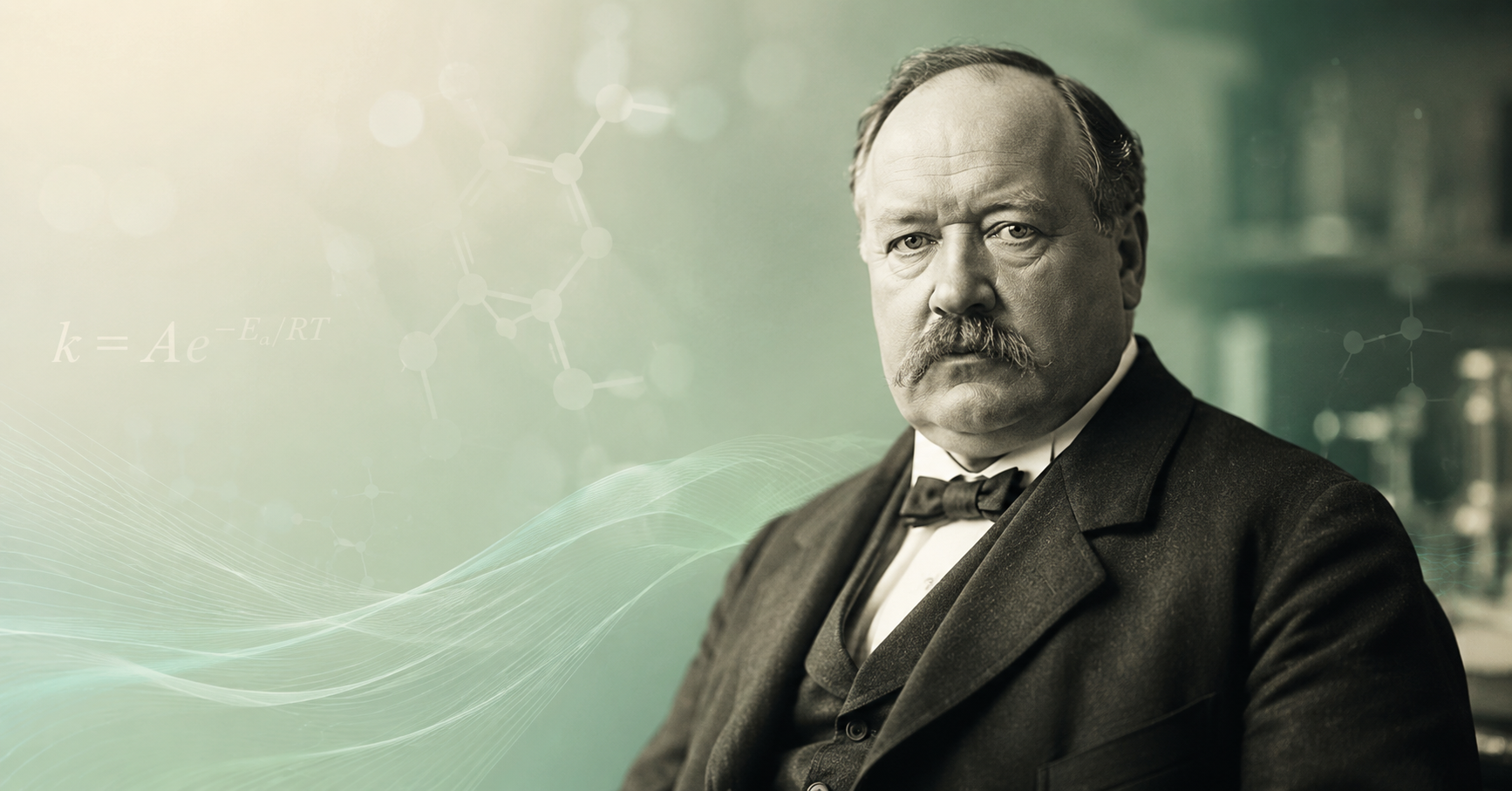
Svante Arrhenius was a Swedish chemist and physical chemist,whose work shaped the emergence of modern physical chemistry and the earliestt models of Earth’s climate system. Known for establishing a relationship between carbon dioxide and global temperature, he occupies a foundational place in the history of atmospheric science. His research remains an essential reference point for understanding the scientific foundations of contemporary debates surrounding environmental longevity and the stability of natural systems.
His career
Svante Arrhenius was born in 1859 in Sweden, at a time when natural sciences were becoming increasingly structured as acamedic disciplines. From an early age, he demonstrated a strong ability to connect mathematics with the observation of physical phenomena. He later studied at the University of Uppsala, where he developed ideas that would forever change the way we understand chemical solutions. His doctoral research introduced a controversial theory that salts dissolved in water separate into electrically in charged particles known as “ions”. This theory of electrolytic, initially rejected by many parts of the scientific community, would later become one of the foundations of modern chemistry. Arrhenius received the Nobel Prize in Chemistry in 1903 for this work.
Following this period of scientific controversy, he continued his research and gradually gained academic recognition. His studies were discussed and replicated in several major European scientific centers, contributing to the establishing of his international reputation. By the end of the nineteenth century, he expanded his field of inquiry toward atmospheric physics. He then developed a mathematical model designed to quantify the impact of carbon dioxide on Earth’s temperature. This approach represented a major intellectual shift because it directly connected the chemical composition of the atmosphere with global climate dynamics. Supported intellectually by figures such as Wilhem Ostwald, Svante Arrhenius secured a lasting place in the history of fundamental science.
His vision of longevity
Svante Arrhenius’s approached longevity not from an individual biological perspective, but through a systemic understanding of planetary balance. He considered climate stability to be a determining condition for the continuity of life on Earth. By modeling the effect of carbon dioxide on global temperature, he introduced the idea that relatively small atmospheric variations could produce long lasting consequences for the planet’s habitability. This approach placed long term temporal dynamics at the center of scientific analysis and opened an early reflection on the durability of natural environments.
His work relied on a logic of interdependence between chemistry, physics, and climate science. Arrhenius did not seek to formulate an environmental doctrine. Instead, he aimed to quantify the relationships between atmospheric variables and global temperature. In his publications on climate, he argued that carbon dioxide concentration influenced Earth’s thermal equilibrium across extended time scales. Another reccuring idea in his scientific work emphasized the role of atmospheric composition in regulating planetary temperature. One of his publicy documented reflections illustrates this long term perspective:
“Humanity stands… before a great problem of finding new raw materials and new sources of energy that shall never become exhausted. In the meantime we must not waste what we have, but must leave as much as possible for coming generations.”
This perspective anticipates many contemporary issues related to ecosystem stability and the ability of natural systems to sustain favorable conditions for human life over time.
His influence and impact
Svante Arrhenius left a scientific legacy that extends across two major fields. First, his work on chemical solutions helped consolidate physical chemistry as a rigorous quantitative discipline. On the other hand, his research on climate some of the earliest foundations for the scientific modeling of the role of atmospheric gases in global warming. This dual contribution explains the singular place he occupies in the history of modern science.
Today, his legacy is discussed both for the remarkable foresight of his ideas and for the limitations of his original models. The mathematical tools available during his lifetime could not incorporate all the climate mechanisms identified by contemporary science, particularly the complexity of certain feedback systems. Nevertheless, his central intuition regarding the influence of carbon dioxide on Earth’s temperature remains a foundational reference in modern climate science. His influence can still be seen in the way current researchers approach the interactions between human activity and long term natural systems. By connecting atmospheric chemistry with planetary equilibrium, Arrhenius helped establish a scientific framework that continues to shape discussions surrounding environmental stability, sustainability, and the future conditions of life on Earth.
From chemistry to planetary thinking
Svante Arrehnius remains a pioneering figure in the history of science, representing a transition between classical chemistry and a systemic understanding of climate. His work introduced a quantitative interpretation of the interactions between the atmosphere and Earth’s temperature, helping lay the foundations of modern climate science. This contribution continues to inform contemporary reflections on the stability of natural environments and the long term viability of living systems. As climate related challenges become increasingly complex, his early models appear as one of the first attempts to formalize the dynamics of an interconnected world whose equilibrium are still being explored today.


