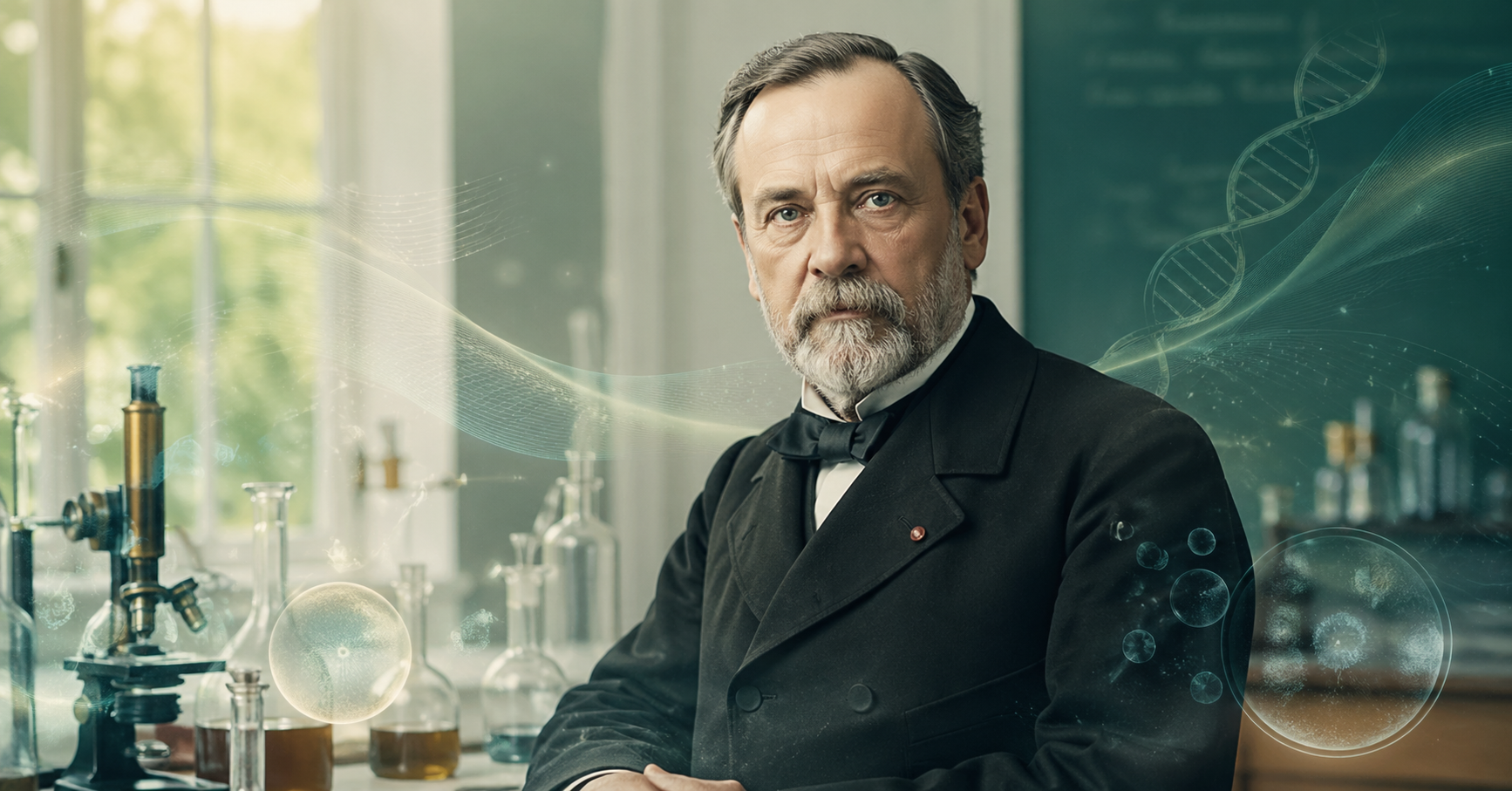
Louis Pasteur was a French 19th-century chemist and microbiologist, considered as one of the fathers of modern microbiology. His focused on the study of microorganisms in fermentation and infectious diseases. He also developed the process of pasteurization and the main principles of vaccination. His contribution is seen as a turning point for public health and human longevity establishing the scientific foundations of infection prevention.
Louis Pasteur occupied a central position in the transformation of medicine and life sciences. His accomplishments are based on a strict experimental method, where each hypothesis has to be tested through observation and the controlled reproduction of phenomena. In a scientific context still marked by speculative explanations, he introduced logic of evidence directly linked to laboratory and public health applications. His work on microorganisms redefined the understanding of the invisibles causes of diseases and progressively transformed medical practices. In that context, contamination becomes a measurable scientific subject, which opens the way toward a new model of public health of organization. It was a time where biology ceased to be purely descriptive and became interventional.
His career
Louis Pasteur was born in 1822 in Dole and initially trained in physical chemistry at the École Normale Supérieure, a teachers’ college in Paris. His first research focused on crystallography and molecular structure, a field in which he discovered molecular asymmetry, the fundation of stereochemistry. Soon, he focused his studies on fermentation, observing the transformation of wine and beer. He established that these processes are not spontaneous but related to the activity of microorganisms, which challenged dominant scientific concepts.
His research took a decisive turn when he addressed the theory of spontaneous generation. Through experiments of sterilization and controlled exposure to air, especially with swan-neck flasks, he demonstrated that microorganisms came from external contaminations rather than spontaneous generation. These results structured modern microbiology and reinforce notion of “biogenesis”.
Over the years, Louis Pasteur applied his discoveriess to industrial and public health problems. He also saved entire economic sectors, such as wine production, beer production, and silk, by identifying microbial causes of contamination. His work, first on animal diseases, then human diseases, contributed to developing principles of vaccination based on attenuated pathogenic agents. He also worked on rabies, which contributed to international recognition of his work and to the consolidation of his experimental method applied to the medical field.
His vision of longevity
Louis Pasteur’s contribution was not based an a explicit theory of longevity, but rather on a structural transformation of public health conditions. By proving that infectious diseases are causes by identifiable microorganisms, he introduced a logic of prevention that became fundamental to public health. This approach helped to significantly reduce infectious causes of death, which were a major cause of death during the 19th century.
His work on pasteurization reflects this, by making food safer through the destruction of pathogenic microorganisms. Furthermore, his research on vaccines developed a model in which the organism can resist infection before it appears. In that way, it significantly modify medicine, by anticipating biological risks instead of focusing solely on treatment.
Louis Pasteur insisted on the importance that science is fundamental, but required concrete application. In that way, a better understanding on invisible life mechanisms allows direct action on life expectancy and quality of life. Health therefore became a field structured by microbiology, where controlling infectious agents became a key factor in life expectancy.
His influence and impact
Louis Pasteur’s influence is significant for modern biomedical sciences. His research established the foundations of microbiology, immunology and public health. He proved that microorganisms as causes of infectious diseases could profoundly transform medical practices and public health policies. Sterilization, asepsis and vaccination progressively became fundamental standards of medicine.
His impact was not only scientific and also extended to economic and industrial sectors. A better understand better of fermentation improved food conservation and food safety. His experimental methods also influenced biomedical research, requiring strict validation of protocols. Louis Pasteur therefore became a pioneer in his methods and his scientific discoveries.
Scientific debates at that time also demonstrated the importance of his research by challenging established theories. The refutation of spontaneous generation constituted a major change, which consolidated modern biology. His influence still has an impact today in research on vaccines, infectious diseases and public heath prevention systems worldwide.
A legacy that transformed life and medicine
Louis Pasteur is a key figure in the history of human health, who transformed the understanding of diseases into experimental science. His work established that longevity directly depends on the ability to identify and control microbial agents.
Still today, is legacy structures prevention systems and healthcare systems. Legacy of Louis Pasteur continues to open new perspectives on how to control living and its implications on life expectancy.