“Research is about dedicating oneself to others.”
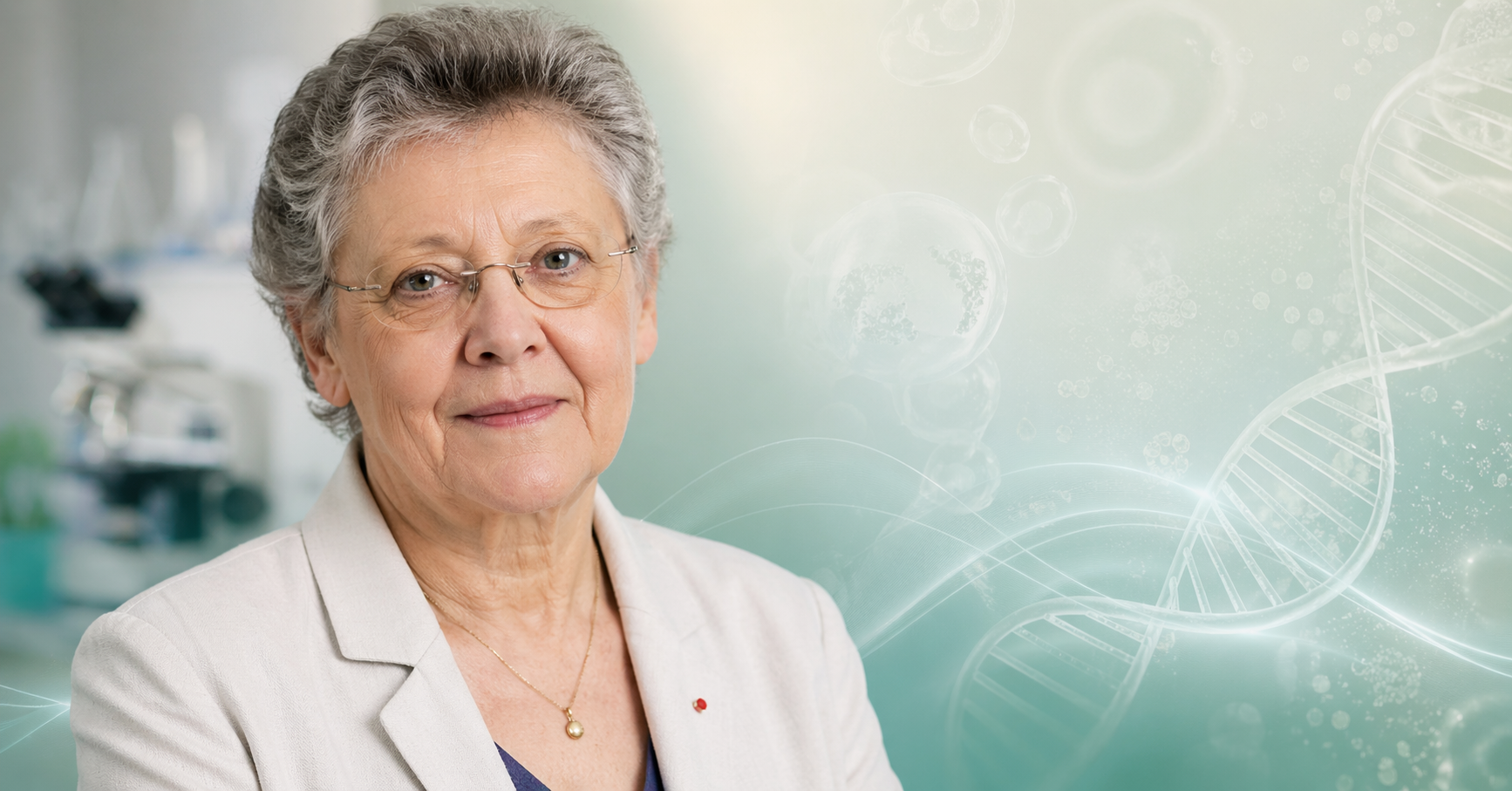
It is with this striking quote that the portrait of Françoise Barré-Sinoussi, a French virologist who co-discovered the human immunodeficiency virus (HIV) and was awarded the Nobel Prize in Physiology or Medicine in 2008. Her scientific work has profoundly changed the understanding of HIV and enabled the development of antiretrovirals therapies.
She is considered a pioneer in contemporary medicine, especially in the fields of virology and immunology. Her influence extends beyond academia, as her research has contributed to significantly improving the expectancy of people living with HIV and top shaping international public health policies.
Her career
Françoise Barré-Sinoussi devoted her career to the development of virology. Trained in biomedical research at the Pasteur Institute, she joined in 1970s a specialized team studying retroviruses. She began this work in a context where viral diseases becoming better understood, although they still remained largely unexplored. In the early 1980s, a previously unknown immunological syndrome emerged, and she actively participated in the research that led to the identification of HIV.
This discovery became a major milestone for global medicine, as it made possible to understand the origin of AID and opened the way to the first diagnostic tools. In the following years, she continued her research, focusing on immune responses and the spread of infection. Her work has been grounded in international collaboration, especially with teams based in Africa and Southeast Asia, where the epidemic has had a particularly strong impact, as she explained: “Like everybody, I have some times in my life when I’m pessimistic. I wonder whether I should continue… Then I go and have a trip to Africa or Southeast Asia and have a small meeting with people affected by HIV, and I forget my mood. I say, “OK, let’s go on. Let’s continue. This is real life. Don’t think about yourself.”
Her career is not limited to discover only, but reflects a sustained research effort aimed at understanding the mechanisms of viral control and improving access to treatment.
Her vision of longevity
Her vision of longevity is closely linked to her understanding of infectious diseases and health inequalities. She considers that longevity cannot be separated from quality of life or equitable access to treatment. Therapeutic advances have transformed VIH from a once-fatal disease into a manageable chronic condition, profoundly changing patients’ life trajectories. In several public speeches, she has stated that “research must always be at the service of people”, emphasizing the social responsibility of science.
She also insists on the fact that “living longer means nothing without quality of life”. Her analysis goes beyond virology to include social, economic, and political factors. She advocates for a holistic approach, in which prevention, screening and universal access to treatment are essential pillars. She considers health systems to be crucial structures for the resilience of populations facing epidemics and chronic diseases.
Her influence and impact
“Even the smallest of insects could capture my attention for hours.”
Françoise Barré-Sinoussi scientific and medical influence is significant. She has contributed to structuring multiple international research networks on HIV, promoting the sharing of knowledge between countries with different level of resources. Her work has also played a role in the evolution of public health policies, especially in screening strategies and earlier access to medical care. She has participated in international scientific organizations, helping to shape global strategies to fight AIDS.
Debates around her work often concern the place of fundamental research in relation to urgent public health issues. Her approach, which closely connects science and society, has influenced many researchers in immunology and infectious diseases. She represents a vision of science as a tool for global impact, where knowledge is accompanied by collective responsibility in addressing health inequality.
Science in the service of human life
“We are not making science for science. We are making science for the benefit of humanity.”
Françoise Barré-Sanoussi represents a central figure in contemporary virology, whose work has transformed the understanding of HIV and its implications for life expectancy and longevity. Her career reflects how a scientific discovery can durably reshape global health trajectories.
By combining fundamental research, international engagement and reflection on healthcare systems, she has contributed to the transformation of modern medicine. Her work continues to influence current public health strategies and approaches to longevity, in a context where infectious diseases remain an ongoing global challenge.