Key Takeaways
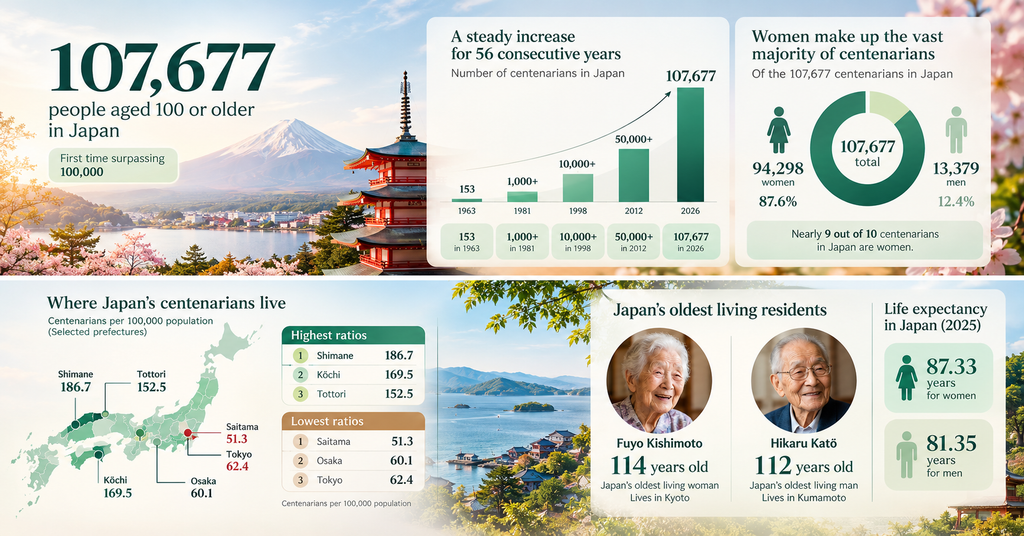
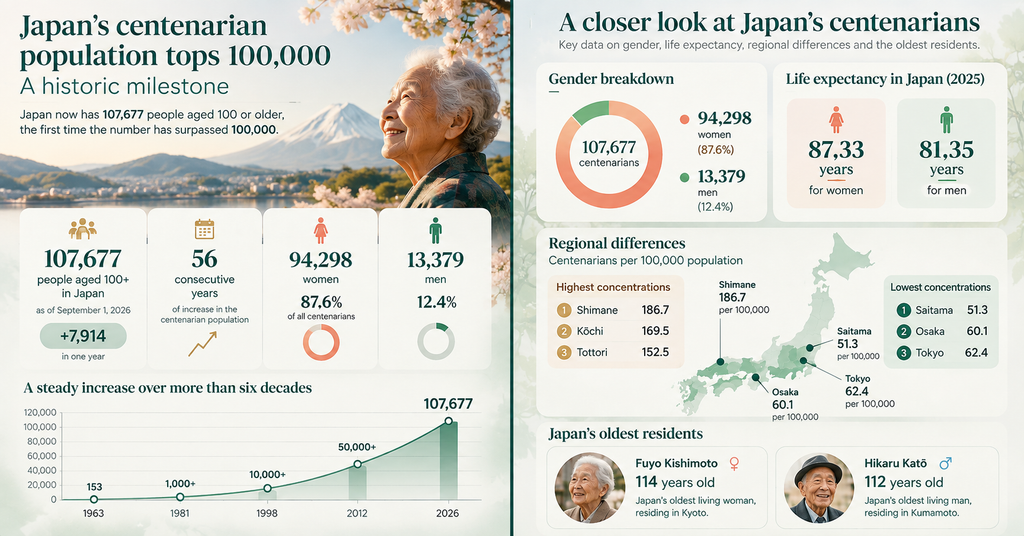
- Japan now has 107,677 people aged 100 or older, the first time the number has surpassed 100,000.
- The number of centenarians has increased for 56 consecutive years.
- Women represent 87.6% of Japan’s centenarian population, with 94,298 women compared with 13,379 men.
- Shimane has the highest concentration of centenarians relative to its population, while Saitama has the lowest.
- The record highlights Japan’s exceptional longevity, but the growing centenarian population also reflects broader demographic changes and does not by itself explain why some people age more healthily than others.
Japan has reached a historic milestone in longevity.
According to data from Japan’s Ministry of Health, Labour and Welfare, the country had 107,677 people aged 100 or older as of September 1, 2026. The figure increased by 7,914 from the previous year and is the highest recorded since national statistics on centenarians began in 1963.
The number has now risen for 56 consecutive years, passing several major milestones along the way. Japan counted just 153 centenarians in 1963. The total exceeded 1,000 in 1981, reached more than 10,000 in 1998, and passed 50,000 in 2012.
The milestone comes as Japan is also experiencing a declining overall population and a growing proportion of older adults. This makes the rise in the centenarian population an important indicator of how dramatically the country’s age structure has changed.
Key Concept: Centenarian
A centenarian is a person who has reached 100 years of age or older. People who reach 110 are sometimes described as supercentenarians.
More than 100,000 people are now aged 100 or older
Japan’s latest figure represents an increase of 7,914 centenarians in one year.
Of the 107,677 people aged 100 or older:
- 94,298 are women
- 13,379 are men
- Women account for 87.6% of the total.
The Japanese government reported that both the overall number of centenarians and the number of women and men in this age group are at record levels.
Japan has long been known for its high life expectancy. In 2025, life expectancy at birth was 87.33 years for women and 81.35 years for men, according to figures cited alongside the latest centenarian data.
However, reaching 100 is very different from simply having a high average life expectancy. Centenarians represent a much smaller group of people who have survived many decades of biological aging and accumulated health risks.
This makes them particularly interesting to researchers studying longevity.
Key Concept: Life expectancy
Life expectancy is the average number of years a person is expected to live based on mortality patterns in a given population and period. It does not predict how long any individual person will live.
Women make up the vast majority of centenarians
The gender difference is one of the most striking features of Japan’s centenarian population.
Nearly nine out of every ten centenarians are women. This pattern is consistent with the broader global tendency for women to live longer than men, although the reasons for the difference are complex and involve biological, behavioral, social, and healthcare-related factors.
The latest Japanese figures show just how pronounced this difference becomes at very advanced ages: there are more than seven women for every man among people aged 100 or older.
Researchers have proposed several explanations for the female longevity advantage, including differences in cardiovascular risk, smoking patterns, health behaviors, and biological factors. These factors should not be interpreted as a single explanation for Japan’s centenarian population.
Japan’s oldest residents are more than a century old
Japan’s oldest living woman is Fuyo Kishimoto, who is 114 and lives in Kyoto. The Ministry of Health, Labour and Welfare identified her as the country’s oldest person following the death of 115-year-old Shigeko Kagawa in August 2026.
The country’s oldest living man is Hikaru Katō, who turned 112 in May 2026 and lives in Kumamoto. His age has been verified by Japan’s Ministry of Health, Labour and Welfare and validated by the Gerontology Research Group.
These individual cases illustrate an important distinction in longevity research.
Living to 100 or beyond is an example of exceptional longevity, but a person’s age alone does not reveal how healthy they remained throughout those years.
Researchers increasingly distinguish between lifespan—how long someone lives—and healthspan, the period of life spent in relatively good health and functional independence.
Where do Japan’s centenarians live?
The distribution of centenarians is not uniform across Japan.
When the figures are adjusted for population size, Shimane has the highest concentration, with approximately 186.7 centenarians per 100,000 residents. It is followed by Kōchi at 169.5 and Tottori at 152.5.
At the other end of the distribution, Saitama has the lowest rate at approximately 51.3 centenarians per 100,000 people. Tokyo records around 62.4, while Osaka has approximately 60.1.
Centenarians per 100,000 population
Highest ratios
| Prefecture | Centenarians per 100,000 |
| Shimane | 186.7 |
| Kōchi | 169.5 |
| Tottori | 152.5 |
| Kagoshima | 148.3 |
| Nagano | 146.9 |
Lowest ratios
| Prefecture | Centenarians per 100,000 |
| Chiba | 62.9 |
| Tokyo | 62.4 |
| Osaka | 60.1 |
| Aichi | 57.8 |
| Saitama | 51.3 |
Data compiled by Nippon.com from figures published by Japan’s Ministry of Health, Labour and Welfare.
Western Japan generally records higher proportions of centenarians, while rates are lower in several prefectures around the Kantō region, including Tokyo and Saitama.
These geographical differences are interesting for longevity research, but they do not establish that a particular region, diet, lifestyle, or environment directly causes longer life.
From 153 centenarians to more than 100,000
The scale of Japan’s demographic transformation becomes clearer when viewed over time.
In 1963, only 153 people aged 100 or older were recorded nationwide.
The number then increased progressively:
- 1963: 153 centenarians
- 1981: more than 1,000
- 1998: more than 10,000
- 2012: more than 50,000
- 2025: 99,763
- 2026: 107,677
The latest increase means that Japan has now crossed the six-figure threshold for the first time.
The progression also shows that the 2026 milestone is not a sudden change. It is the continuation of a demographic trend that has been developing for more than six decades.
What this could mean for longevity research?
Japan’s centenarian milestone provides researchers with a large population in which to study exceptional longevity.
Centenarians may help researchers investigate why some individuals remain alive and, in some cases, functionally independent into very advanced ages. Areas of interest include genetics, cardiovascular health, nutrition, physical activity, social connections, healthcare access, environmental factors, and resilience to disease.
However, the existence of more than 100,000 centenarians does not mean that one specific factor explains Japanese longevity.
A population-level statistic can show how many people reach a certain age, but it cannot by itself explain the biological mechanisms behind their survival or health.
Another important question is whether people are not only living longer but also spending more of those additional years in good health.
Japan’s government has previously emphasized the importance of extending healthy life expectancy, rather than focusing only on lifespan. The distinction is central to modern longevity research: the goal is increasingly to understand how people can maintain physical and cognitive function for as long as possible, not simply increase the number of years lived.
The growing number of Japanese centenarians therefore offers researchers an opportunity to study both longevity and healthy aging on an unprecedented scale.
Level of Evidence
Population-level demographic evidence. The number of Japanese centenarians is based on resident registration data compiled by the Ministry of Health, Labour and Welfare. These statistics establish the size and distribution of the centenarian population, but they do not establish which biological, lifestyle, or environmental factors caused individuals to reach 100 or more.
FAQ
How many centenarians are there in Japan in 2026?
Japan has 107,677 people aged 100 or older as of September 1, 2026. This is the first time the country’s centenarian population has exceeded 100,000.
How many Japanese centenarians are women?
There are 94,298 women aged 100 or older, representing 87.6% of Japan’s centenarian population. There are 13,379 men.
Who is the oldest person in Japan?
Fuyo Kishimoto, aged 114, is currently Japan’s oldest living person. She lives in Kyoto.
Who is Japan’s oldest living man?
Hikaru Katō, aged 112, is Japan’s oldest living man. He lives in Kumamoto.
Does having more centenarians prove that Japanese people age more healthily?
Not by itself. The number of centenarians shows that more people are reaching 100 or older, but it does not measure how healthy or independent they remain during those years. Researchers therefore distinguish between lifespan and healthspan when studying longevity.
Methodology
This article is based primarily on the 2026 data released by Japan’s Ministry of Health, Labour and Welfare, using resident registration data as of September 1, 2026. The figures were announced in connection with Japan’s annual observance of Respect for the Aged Day. Additional demographic context was cross-checked with reporting from Nippon.com and other sources covering the 2026 centenarian statistics.
The figures for Japan’s oldest living woman and man were checked against information published by the Ministry of Health, Labour and Welfare.
Disclaimer
This article is for informational purposes only. Population statistics on centenarians do not establish that specific diets, lifestyles, regions, medical treatments, or other factors cause exceptional longevity. Individual aging outcomes vary, and further research is needed to understand the biological and environmental factors associated with long life and healthy aging.
Sources
- Japan Ministry of Health, Labour and Welfare. “令和8年度百歳の高齢者へのお祝い状及び記念品の贈呈について.” September 2026.
- Japan Ministry of Health, Labour and Welfare. “国内最高齢者 ご逝去について.” August 2026.
- Nippon.com. “Japan’s Centenarian Population Tops 100,000 for 1st Time.” September 15, 2026.
- The Japan Times. “Number of centenarians in Japan top 100,000 for first time.” September 15, 2026.
- Gerontology Research Group. Information on Hikaru Katō and Japan’s validated supercentenarians.
Continue exploring longevity
Explore this longevity topic