Key takeaways
- Ceramide AP is a naturally occurring skin-identical lipid involved in maintaining barrier structure and epidermal resilience.
- Its growing popularity reflects a broader shift in skincare—from correction and stimulation toward preservation and maintenance.
- Rather than targeting a single visible concern, Ceramide AP participates in the underlying architecture that allows skin to function effectively.
- Emerging understanding of skin longevity increasingly places barrier integrity at the centre of healthy ageing discussions.
- While ceramides rarely generate headlines, they remain among the most biologically relevant ingredients used in modern skincare.
There is an interesting paradox at the heart of modern skincare.
The ingredients that attract the most attention are often those designed to create visible change. Retinoids accelerate renewal. Acids encourage exfoliation. Antioxidants promise protection against environmental stress. Entire categories of products have been built around the idea that healthier skin comes from persuading biological systems to work harder, faster, or differently.
Yet among dermatologists and formulation scientists, another conversation has been quietly gaining momentum.
It concerns maintenance.
Not transformation.
Maintenance.
The distinction may sound subtle, but it represents a profound shift in how skin health is increasingly being understood.
After all, the skin is not a static surface. It is a living tissue tasked with performing an extraordinary balancing act every day. It must retain moisture while remaining permeable enough to function normally. It must defend against external threats without overreacting to them. It must repair itself continuously while preserving its structural integrity.
For decades, many skincare innovations focused on modifying these processes.
Now, attention is increasingly turning toward the question of what allows them to continue functioning well in the first place.
Few ingredients embody that shift more clearly than Ceramide AP.
At first glance, it hardly seems like the protagonist of a compelling scientific story. It lacks the glamour of retinol and the cultural recognition of vitamin C. Consumers rarely discuss it on social media. Beauty campaigns seldom celebrate it as a revolutionary breakthrough.
And yet, in many ways, it sits at the centre of one of the most important developments currently shaping dermatology and longevity science.
The growing recognition that resilience may matter just as much as repair.
What Is It?
To understand why Ceramide AP has become increasingly relevant, it helps to step back from skincare entirely.
Long before consumers became interested in skin barriers, scientists were fascinated by biological boundaries.
Cell membranes. Intestinal linings. Blood vessels. The lungs.
Every living system depends on structures that regulate exchange between internal and external environments. These barriers are not passive walls. They are dynamic interfaces that determine what enters, what leaves, and how tissues respond to the world around them.
The skin barrier operates according to the same principle.
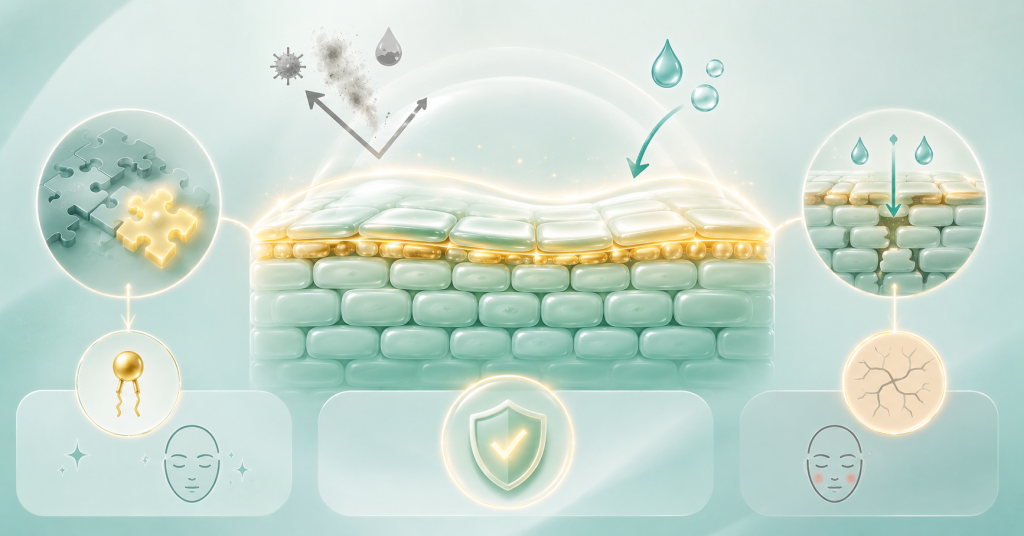
Ceramide AP belongs to a family of lipids naturally present within the outermost layers of human skin. These lipids occupy the spaces between skin cells, contributing to the highly organised architecture that helps maintain barrier integrity.
The famous “brick and mortar” analogy remains useful despite its age. Skin cells form the bricks. Lipids, including ceramides, form the mortar.
Without effective mortar, the wall weakens.
What makes Ceramide AP particularly interesting is that it is not an external intervention imposed upon the skin. It is part of the skin’s native design.
That distinction increasingly matters in an era where many consumers are reassessing what they expect from skincare.
Perhaps the future lies not in constantly overriding biology, but in helping biology perform the functions it evolved to perform.
Did you know?
Ceramides account for roughly half of the lipid content found within the stratum corneum, the skin’s outermost protective layer. Their organisation appears to be just as important as their quantity.
How does it work?
The question may be more interesting than the answer
Ask a cosmetic chemist how Ceramide AP works and the explanation will likely begin with barrier function.
Ask a longevity researcher why barrier function matters and the conversation becomes considerably broader.
Because barriers are ultimately about stability.
And stability, in biological systems, is rarely accidental.
The skin is continuously exposed to ultraviolet radiation, airborne pollutants, fluctuations in temperature, changes in humidity, mechanical friction, and microbial interactions. Despite this relentless exposure, healthy skin generally manages to maintain a remarkable degree of equilibrium.
When that equilibrium begins to deteriorate, the consequences often extend beyond dryness.
Sensitivity can increase. Recovery may slow. Visible irritation can become more frequent. Water retention becomes less efficient. The skin appears less adaptable. Less resilient.
Ceramide AP contributes to the lipid matrix involved in preserving this equilibrium. Its role is not to stimulate dramatic activity. Instead, it participates in maintaining the organised structures that allow normal physiological processes to unfold efficiently.
That may sound less exciting than accelerating collagen synthesis.
But excitement is not always the most useful metric in biology.
A different way of thinking about ageing
The skincare industry has spent years framing ageing as a story of loss.
Loss of collagen. Loss of elasticity. Loss of firmness.
There is truth in that narrative. Yet it can also be limiting.
Increasingly, researchers are approaching ageing through the lens of declining adaptability. The issue is not simply that tissues change over time. It is that their capacity to respond effectively to stress may gradually diminish.
Interestingly, skin barrier function appears to follow a similar trajectory.
Changes in lipid organisation have been documented in ageing skin. Recovery from disruption can become less efficient. Water retention dynamics may shift.
Ceramide AP becomes relevant within this context not because it reverses ageing but because it participates in systems closely linked to functional preservation.
The distinction is important. One approach attempts to erase the consequences of time. The other seeks to maintain biological competence despite it.
The rise of barrier thinking
Spend time reviewing dermatological literature from twenty years ago and a pattern emerges. Barrier function was certainly recognised, but it rarely occupied centre stage.
Today, that is no longer the case. Barrier integrity has become one of the defining concepts of modern dermatology.
This reflects a broader intellectual shift. Rather than asking how aggressively skin can be modified, scientists increasingly ask how effectively it can be protected from unnecessary disruption.
Ceramides sit directly at the heart of that conversation.
Zoom study
Year: 2018
Study Type: Scientific review of epidermal barrier biology and ceramide function
Study Link: https://pubmed.ncbi.nlm.nih.gov/30061568/
Key Finding: Alterations in ceramide composition were associated with impaired barrier performance, reinforcing the importance of balanced epidermal lipid structures in maintaining healthy skin function.
Potential benefits
What makes Ceramide AP intriguing is not necessarily any individual benefit. It is the cumulative effect of several small contributions.
Skincare often encourages consumers to think in terms of visible outcomes. Brighter skin. Smoother skin. Firmer skin. Barrier biology rarely behaves that way.
Instead, improvements tend to emerge gradually through enhanced physiological efficiency. Skin retains moisture more effectively. Environmental changes become less disruptive. Recovery following irritation may feel less dramatic. Comfort improves.
The skin simply appears better equipped to cope with everyday life.
There is something revealing about the fact that many users struggle to describe exactly what ceramides do while simultaneously insisting they notice when they stop using them.
Perhaps that reflects the nature of infrastructure. Most people rarely think about foundations when a building is standing. Only when stability begins to disappear.
Natural sources
Unlike many cosmetic ingredients developed entirely through synthetic innovation, Ceramide AP belongs to a family of molecules already present within healthy skin. Similar ceramide-related compounds can also be found in various plant sources, including wheat germ, rice bran, soybeans, and sweet potatoes.
However, the relationship between dietary ceramides and epidermal ceramide content remains complex. The skin is not merely a reflection of nutritional intake.
Its biology follows its own rules.
Dosage, bioavailability & formulation considerations
Ceramide AP rarely works alone.
That observation says something important about both formulation science and biology itself.
Skin barriers are cooperative systems. Ceramides interact with cholesterol, fatty acids, proteins, and water-regulating molecules in highly organised structures. Formulators increasingly attempt to replicate these relationships.
As a result, Ceramide AP often appears alongside cholesterol, free fatty acids, glycerin, panthenol, and humectants designed to reinforce complementary pathways. Visible changes generally develop progressively rather than immediately.
That timeline occasionally disappoints consumers. Scientists tend to view it as reassuring.
Biological maintenance is usually slower than biological stimulation.
Safety & precautions
Ceramide AP benefits from an unusually favourable tolerability profile.
Because it resembles compounds naturally found within the skin, adverse reactions appear relatively uncommon.
This does not mean every product containing Ceramide AP will suit every individual. Formulations remain complex systems involving numerous ingredients.
Yet among active skincare ingredients, ceramides are generally considered remarkably well tolerated. Their purpose is not to challenge the skin. It is to help support the structures that already exist.
Longevity routine
There is a temptation within longevity-focused skincare to constantly search for the next breakthrough.
The next pathway.
The next technology.
The next molecule capable of changing everything.
Ceramide AP offers a useful reminder that longevity often depends less on innovation than on preservation.
A routine centred around barrier resilience may include antioxidants, photoprotection, and targeted actives. Yet increasingly, many dermatologists view barrier-supportive ingredients as the foundation that allows those interventions to function effectively.
Without resilience, optimisation becomes difficult.
Without structure, performance becomes fragile.
When to use it
Morning or evening.
Consistency matters more than timing.
What to combine it with
Ceramide AP integrates particularly well with:
- Cholesterol
- Fatty acids
- Niacinamide
- Hyaluronic acid
- Panthenol
Who may benefit most?
Individuals experiencing dryness, sensitivity, environmental stress exposure, barrier disruption, or those interested in preserving long-term skin quality may find Ceramide AP particularly relevant.
What if skin longevity is really about resilience?
Perhaps the most interesting thing about Ceramide AP is that it challenges conventional skincare storytelling.
It does not promise transformation.
It does not promise acceleration.
It does not promise dramatic change.
Instead, it reflects a growing appreciation for something quieter.
The idea that healthy skin may depend less on forcing biological systems to behave differently and more on helping them continue functioning well.
That perspective feels increasingly aligned with broader conversations taking place throughout longevity science. Whether the subject is muscle, metabolism, cognition, or skin, the emphasis is gradually shifting toward maintenance of function rather than endless intervention.
Ceramide AP is not a miracle ingredient. Its role is more modest. And perhaps more important because of it. Sometimes the future belongs not to the ingredients that change biology, but to those that help preserve it.
Sources
- Elias PM. The skin barrier as an innate immune element. PubMed: https://pubmed.ncbi.nlm.nih.gov/30061568/
- van Smeden J, Bouwstra JA. Stratum corneum lipids and skin barrier function. PubMed: https://pubmed.ncbi.nlm.nih.gov/26816701/
- Bouwstra JA et al. Skin barrier lipid organisation and ceramide biology.
- Contemporary dermatology literature on epidermal lipids, barrier resilience, healthy ageing, and skin longevity.