
Key takeaways
- Palmitoyl Hexapeptide-12 is a peptide inspired by natural fragments of elastin.
- It may help support the production of elastin, collagen, and other components of the extracellular matrix.
- Its mechanism is based on cellular signaling directed at fibroblasts, the cells responsible for maintaining skin structure.
- It is mainly used in skincare formulations aimed to improve the appearance of firmness, elasticity, and overall skin quality.
- Recent research also suggests a potential role in supporting skin barrier function and hydration.
Among the growing number of peptides used in skincare, Palmitoyl Hexapeptide-12 stands out for its unique connection to elastin, a key protein involved in skin elasticity and resilience
Discover palmitoyl hexapeptide-12, its origin, mechanisms of action, potential benefits for skin health, and how it fits into a routine designed to keep our skin healthy and resilient.
What is Palmitoyl Hexapeptide-12?
Palmitoyl-Hexapeptide-12 is a synthetic peptide composed of six amino acids linked to palmitic acid. It is derived from a peptide sequence neturally found in elastin, a structural protein that contributes to skin elasticity and resilience.
In skincare, it is primarily valued for its potential to support fibroblast activity, which plays a key role in maintaining collagen, elastin, and the extracellular matrix.
How does it work?
Main action
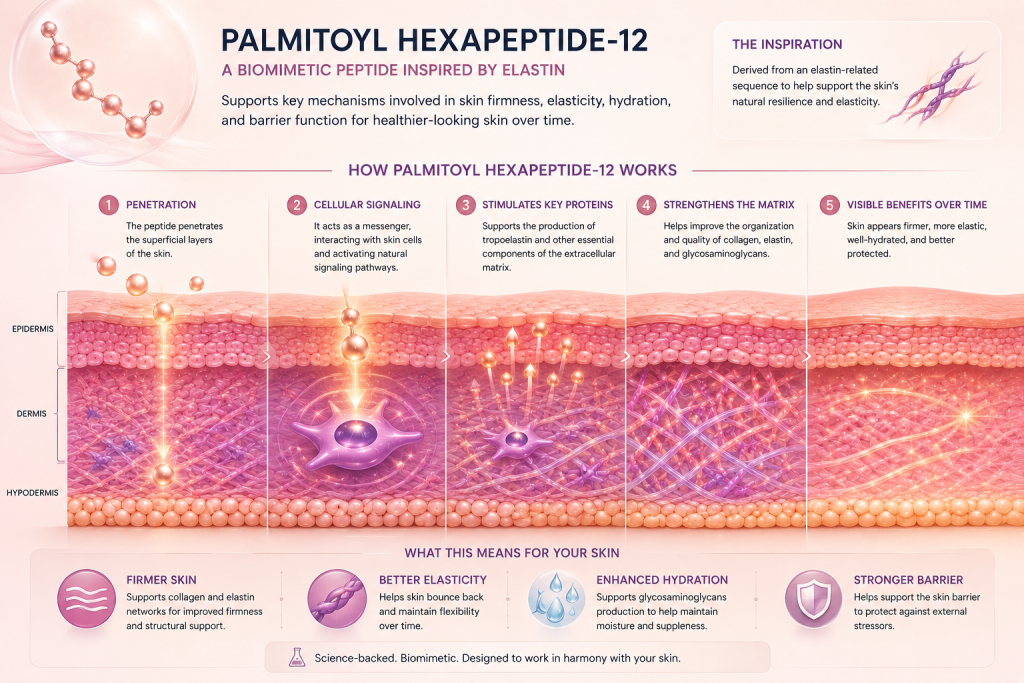
Once you apply palmitoyl hexapeptide-12, it is believed to interact directly with cellular signaling pathways involved in skin maintenance. Which helps to regulate the activity of fibroblasts, the cells responsible for producing key structural components of the skin, including collagen and elastin.
Effects on skin structure
Skin firmness and elasticity
Palmitoyl Hexapeptide-12 helps by supporting mechanisms involved in collagen and elastin maintenance; it improves skin firmness and elasticity.
Support for the extracellular matrix
Experimental results suggest that this may stimulate the production of substances. These molecules are important for hydration. They help to organize and maintain the structure of tissues.
Skin barrier function
Recent studies show that the peptide can help keep the skin barrier working and that it also helps to keep the skin hydrated.
What this means for longevity
From a skin longevity perspective, palmitoyl hexapeptide-12 is being studied for its potential to support the biological processes involved in tissue maintenance. By helping maintain extracellular matrix integrity and skin resilience, it represents a biomimetic approach to supporting healthy skin aging over time.
Study spotlight
Year: 2025
Study type: Ex vivo human skin study and biophysical analysis – ACS Applied BioMaterials
Key finding: Palmitoyl Hexapeptide-12 showed penetration into superficial skin layers and potential support for skin barrier function and mechanical properties.
Potential benefits:
Support for skin firmness
Skin firmness depends largely on the quality of collagen and elastin networks. By helping mechanisms related to their refresh, palmitoyl hexapeptide-12 could lead to a better-structured tissue in the long term.
Improves skin elasticity
Elastin allows the skin to regain its shape after stretching and contributes to overall skin flexibility.
It is derived from an elastin-related sequence; palmitoyl hexapeptide-12 is being studied for its potential role in supporting mechanisms associated with skin elasticity.
Support for hydration and tissue quality
Recent studies have shown that palmitoyl hexapeptide-12 helps the skin produce glycosaminoglycans, which are substances that help the skin improve its appearance and make it more elastic and healthy.
This effect can complement a routine aimed at preserving softness, radiance, and resilience.
Natural sources
Palmitoyl hexapeptide-12 is obtained through biotechnological synthesis from:
- To produce Palmitoyl Hexapeptide-12, people use:
- purified amino acids
- palmitic acid
- controlled peptide synthesis processes
- cosmetic-grade precision manufacturing technologies
How to use (dosage & forms)
Available studies mainly focus on topical use.
Concentrations in cosmetic formulations are typically low, ranging from ppm levels to small fractions of a percent depending on the product.
Available forms:
- anti-aging serums
- firming creams
- eye contour treatments
- multi-peptide formulations
Potential synergies:
- other signaling peptides
- ceramides
- hyaluronic acid
- niacinamide
- antioxidants
Usage duration:
Regular use over several weeks is generally recommended in formulations and studies.
Safety & precautions
Palmitoyl hexapeptide-12 is considered to be well tolerated when it is used in concentrations typically found in cosmetic products.
Reported side effects are rare and mainly include:
- mild irritation
- temporary redness
- individual sensitivity reactions
People with highly sensitive skin may consider performing a patch test beforehand.
As with any cosmetic active, professional advice may be useful in case of specific dermatological conditions.
How to integrate it into a longevity routine
When to use it
Palmitoyl Hexapeptide-12 is usually used once or twice a day as part of a skin care routine.
What to combine it with
Common combinations include:
- hyaluronic acid
- ceramides
- complementary peptides
- niacinamide
- antioxidants
Simple routine example
Morning
- Gentle cleansing
- Hydrating serum
- Product containing Palmitoyl Hexapeptide-12
- Sunscreen
Evening
- Cleansing
- Repair serum
- Peptide-enriched moisturizer
Who it is particularly interesting for
This ingredient may be relevant for:
- mature skin
- skin exposed to environmental stress
- loss of firmness
- those seeking a gradual, biomimetic approach to skin aging
Could skin firmness also depend on cellular signaling?
Palmitoyl Hexapeptide-12 is part of a growing category of biomimetic peptides inspired by the skin’s natural biology. Although research is still evolving, available findings suggest that it may play a role in supporting mechanisms associated with skin firmness, elasticity, hydration, and barrier function.
Sources
- Senior, R. M., Griffin, G. L., Mecham, R. P. et al. Val-Gly-Val-Ala-Pro-Gly, a repeating peptide in elastin, is chemotactic for fibroblasts and monocytes. Journal of Cell Biology.
- Floquet, N. et al. Elastin-derived peptides and fibroblast signaling pathways.
- Ligorio, C. et al. (2025). Noninvasive Monitoring of Palmitoyl Hexapeptide-12 in Human Skin Layers… ACS Applied Bio Materials. https://pubmed.ncbi.nlm.nih.gov/39964201/