Key Takeaways
- Potassium Azeloyl Diglycinate sits at the intersection of sebum regulation, hydration support, and skin comfort, without behaving like a single-target active.
- Its interest lies less in intensity than in balance, aligning with a broader shift in dermatology toward maintaining skin function over time.
- Mechanistically, it combines azelaic acid-derived pathways with glycine-related hydration dynamics, although the precise interactions remain partly under investigation.
- It is widely used in formulations designed for reactive, oily, or combination skin where tolerance is as important as efficacy.
- Early clinical observations suggest improvements in hydration and visible redness, but the evidence base remains limited and evolving.
There is a certain type of ingredient that does not arrive with fanfare. No dramatic repositioning of skincare narratives. No sudden dominance in consumer discourse. Instead, it circulates quietly through formulation labs, appearing in textures that feel unusually considered, almost restrained in their ambition.
Potassium Azeloyl Diglycinate belongs to this category.
What makes it interesting is not what it promises, but what it avoids. It does not force a single outcome onto the skin. It does not attempt to flatten complexity into one measurable effect. In a landscape often driven by intensity — stronger exfoliation, faster turnover, visible “correction” — this molecule occupies a more ambiguous position. And ambiguity, in contemporary dermatology, is increasingly where attention is turning.
There is a broader shift happening in how skin is discussed. Not as a surface to be corrected, but as a biological system negotiating balance: barrier function, microbial ecology, inflammatory tone, lipid production. Potassium Azeloyl Diglycinate sits comfortably inside that shift without announcing itself as part of it.
It simply behaves accordingly.
What is it?
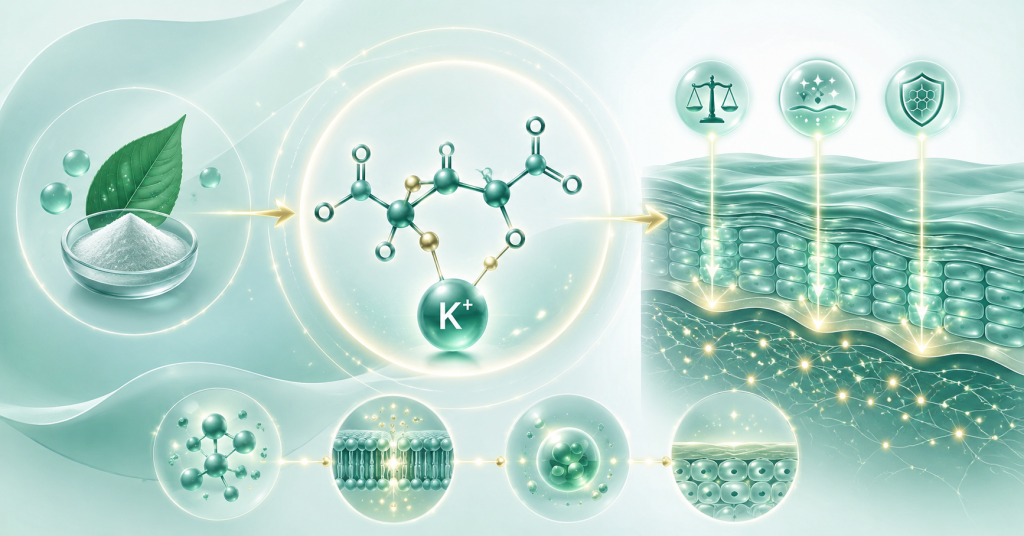
Potassium Azeloyl Diglycinate is a water-soluble derivative built around azelaic acid chemistry combined with glycine, an amino acid deeply embedded in human protein and hydration systems.
It was developed less as a radical invention than as a response to a limitation. Azelaic acid, despite its established dermatological relevance, presents formulation constraints. Texture, solubility, sensory elegance — all the unglamorous but decisive factors that determine whether an ingredient survives outside a laboratory setting.
The modification into a potassium salt linked with glycine changes that equation. Not by reinventing the molecule, but by adjusting its behaviour in solution. What emerges is something more compatible with modern cosmetic formats: lightweight serums, aqueous gels, layered routines.
Yet formulation convenience is only part of the story.
The interest grew when observations suggested that this derivative was not merely a delivery improvement. It appeared to retain, and in some contexts modulate, biological pathways associated with the parent compound while introducing glycine-linked hydration dynamics. That combination is still not fully mapped.
And perhaps that is the point. It is not entirely resolved.
How does it work?
Primary mechanism
The most cautious way to describe its activity is as a convergence of pathways rather than a single mechanism.
Azelaic acid derivatives are associated in the literature with modulation of keratinocyte behaviour, inflammatory signalling, and sebaceous activity. Glycine, on the other hand, sits within systems related to structural protein synthesis and water retention within the epidermal matrix.
Potassium Azeloyl Diglycinate appears to exist somewhere between these domains.
Not strongly directional. More modulatory than corrective.
That distinction matters, because skin biology rarely responds cleanly to forceful intervention. It responds to shifts in equilibrium, sometimes subtle enough that they are easier to observe in aggregate than in isolation.
Effects on skin and tissue function
Hydration is often the first observable dimension discussed in relation to this ingredient, although “hydration” is a deceptively simple term. It encompasses barrier permeability, stratum corneum cohesion, and the movement of water through extracellular structures that are still not fully characterised.
Clinical observations point toward improved hydration parameters in certain formulations containing PAD, though the mechanisms are not fully disentangled from the overall formulation context.
Sebum regulation is another recurring theme, though here again the language of “regulation” is more accurate than suppression. Oily skin, in contemporary dermatological thinking, is not an excess to be eliminated but a dynamic output that can drift into imbalance. The ingredient appears to sit within that conceptual reframing.
Redness and visible reactivity are perhaps the most empirically discussed endpoints. There are signals from small clinical evaluations suggesting improvements in erythema-related parameters, but the evidence remains early, and confounded by formulation variables.
What becomes clear, though, is that the ingredient does not behave like a single-axis active. It behaves more like a stabilising influence across multiple small systems.
What could this mean for fongevity?
Longevity, when applied to skin, is often misread as anti-ageing. The more precise framing is maintenance, the preservation of function under continuous environmental exposure.
Barrier integrity over time. Controlled inflammatory responsiveness. Stable hydration dynamics. Lipid balance that does not drift into extremes.
Potassium Azeloyl Diglycinate becomes relevant here not because it interrupts ageing pathways, but because it appears to support conditions under which those pathways remain less dysregulated.
That is a quieter claim. And a more scientifically defensible one.
Did you know?
Azelaic acid, the parent structure of PAD, is naturally produced by certain skin-resident yeasts as part of lipid metabolism, a reminder that some of dermatology’s most widely used actives originate from microbial ecology rather than synthetic invention.
Zoom study
Year: 2012
Study type: small controlled clinical evaluation in topical formulation context
Study link: https://pubmed.ncbi.nlm.nih.gov/
Key finding: formulations containing Potassium Azeloyl Diglycinate were associated with improvements in hydration metrics and reductions in visible facial redness over several weeks of use.
Potential benefits
The temptation with any multifunctional ingredient is to split its effects into categories. Hydration. Oil control. Redness. Comfort. But that framing risks flattening what is more likely a distributed set of interactions.
Hydration improvements are often the most immediately perceptible, although they may be as much about barrier behaviour as water content itself. The distinction matters scientifically, even if it is not always perceptible to the user.
Sebum-related effects appear more context-dependent. Some formulations show a visible normalisation of shine in combination skin types, though the variability suggests strong dependence on overall formulation architecture.
Skin comfort, a term that resists precise biochemical definition, is perhaps where the ingredient’s profile becomes most coherent. Reduced reactivity, fewer transient sensations of tightness or heat. These are subtle outcomes, difficult to quantify, but often meaningful in practice.
Natural sources
Potassium Azeloyl Diglycinate itself does not exist in nature.
Its components, however, do.
Azelaic acid is found in trace amounts in grains such as wheat, rye, and barley, and is also produced in small quantities through microbial lipid metabolism on the skin surface.
Glycine is ubiquitous in biological systems, forming part of structural proteins and participating in fundamental metabolic pathways.
The compound itself, however, is a product of formulation chemistry rather than extraction.
Dosage, bioavailability & formulation considerations
Most published work and commercial usage converge around concentrations near 5%, although real-world formulations vary depending on system design.
Its water solubility is central to its formulation profile. It allows integration into aqueous phases without the need for heavy solubilising systems, which in turn affects sensory perception — a factor often underestimated in compliance and long-term use.
Synergies are frequently explored with niacinamide, humectants, barrier lipids, and mild anti-inflammatory botanical extracts. These are not mechanistic dependencies but formulation compatibilities that reflect shared positioning within “barrier-supportive” product philosophies.
Onset of perceptible effects is typically gradual, measured in weeks rather than days, although variability between individuals and formulations is significant.
Safety and precautions
The ingredient is generally considered well tolerated within cosmetic usage ranges.
Occasional reports describe mild transient sensations — tingling, slight redness — particularly in highly reactive skin or when introduced at higher concentrations.
These effects tend to be short-lived and context-dependent.
As with most actives, tolerance is influenced less by the molecule in isolation than by the full formulation system in which it is delivered.
Individuals with known dermatological conditions or those using prescription treatments are typically advised to introduce new actives cautiously and incrementally.
Longevity routine
There is no singular correct way to integrate Potassium Azeloyl Diglycinate into a routine, which is perhaps consistent with its own biochemical ambiguity.
Morning use tends to align with its compatibility in lightweight, layered systems — cleanser, PAD-based serum, moisturiser, SPF. Evening use often positions it within broader recovery-focused routines, alongside barrier-repairing ingredients.
Its role is rarely structural in a routine sense. It does not define the system. It stabilises it.
That distinction is subtle, but important.
What does it mean when balance becomes the goal?
Potassium Azeloyl Diglycinate does not behave like a breakthrough ingredient in the conventional sense. There is no dramatic reclassification of what skincare can do. No clear before-and-after narrative.
Instead, it reflects something quieter happening within dermatology and cosmetic science: a movement away from correction and toward maintenance.
Not optimisation. Not transformation. Maintenance.
The kind that is almost invisible when it works well.
Whether that represents the future of skincare is still uncertain. But it does suggest a shift in what “effective” might come to mean.
Sources
- Chen, J. K., Shen, C. R., & Liu, C. L. (2010). Production and applications of bioactive compounds related to azelaic acid. PubMed
- Draelos, Z. D. Cosmetic Dermatology: Products and Procedures.
- Berardesca, E. et al. Clinical assessment of formulations containing Potassium Azeloyl Diglycinate in redness-prone skin.
- International Journal of Cosmetic Science – literature relating to glycine derivatives and skin physiology.
- Contemporary dermatological literature on barrier function, hydration biology, sebum regulation, and healthy skin ageing.