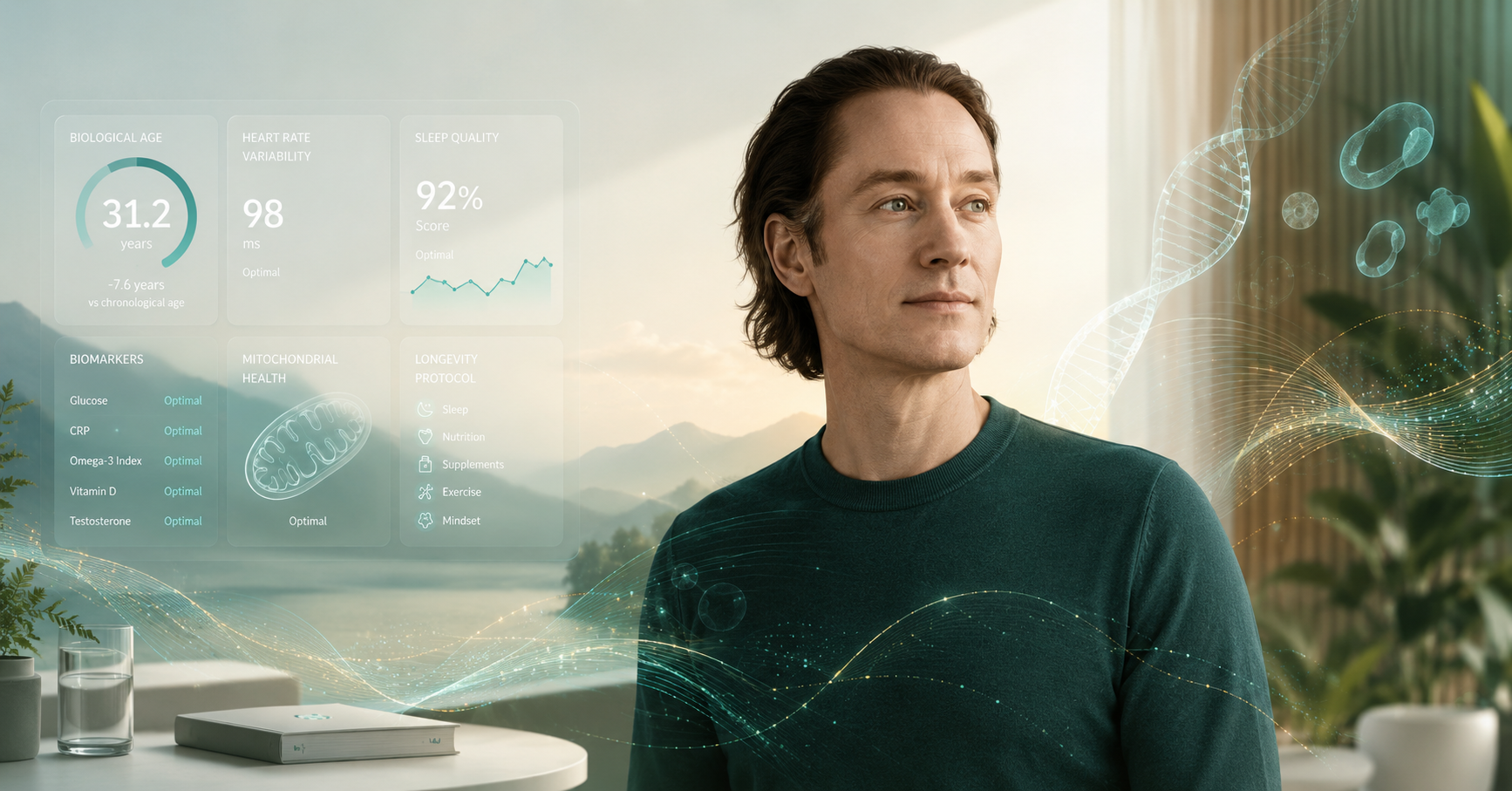
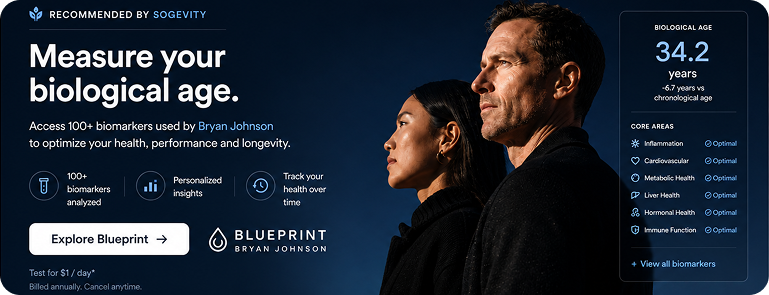
Through his platform Blueprint, the American entrepreneur Bryan Johnson is taking his quest for immortality to the next level. With the launch of “Biomarkers”, an annual subscription program that allows users to track their health for just one dollar a day, Johnson is attempting to turn what was once an elite scientific experiment into a mass-market consumer product. A major turning point in the longevity industry.
For the past three years, Bryan Johnson’s name has become synonymous with a certain form of technological asceticism. The former founder of Braintree, which was sold to PayPal for 800 million dollars, became widely known for spending millions of dollars each year on optimizing his own body. His stated goal is: “Don’t Die”. Until recently, Johnson’s Blueprint project resembled a lonely expedition to the frontiers of human biology. However, recent developments mark a major shift in this strategy. With the launch of the “Biomakers” program, Johnson no longer wants to remain “the most measured human in history”. He is now inviting the general public to join his algorithm.
From a simple intuition to measurable mata: the end of gut feeling?
At the core of this new offering lies a simple premise: subjective feelings are a poor indicator of health. In the manifesto accompanying the launch of the program, Johnson is explicit: “Trust data, not opinions.”
According to the entrepreneur, human beings are incapable of perceiving the day-to-day micro-variations in systemic inflammation, homocysteine level, or thyroid function.
The program offers an unprecedented range of tests for the advertised price of 365 dollars per year. With more than 160 measurements covering over 100 biomarkers, Blueprint is positioning itself as a direct competitor to traditional diagnostic labs and high-end preventive medical clinics. Users undergo two comprehensive complete check-ups per year, including blood and urine testing, with all results centralized on a secure platform.
The real innovation lies not in the tests themselves, but in their interpretation. Blueprint relies on an AI-powered “a healthcare companion” to transform raw biological data into actionable recommendations. The aim is to move away from reactive medicine, where people seek medical help only after symptoms appear, toward a data-driven model of biology, where every dietary or supplement adjustment is validated through measurable biological responses.
The storytelling of biological redemption
To sell this concept, Bryan Johnson relies on a powerful narrative tool: his own past vulnerability. Far from presenting himself as a naturally gifted athlete, he describes himself as a “broken” 42-year-old man at the time Blueprint was launched. Chronic depression, excessive sugar consumption, sleep deprivation, and overweight: Johnson openly exposes his former self to reinforce the credibility of his method.
This redemption narrative is essential to the democratization of the product. By claiming that his body was able to recover despite 20 years of unhealthy decisions, he removes the sense of inevitability often associated with aging. The commercial argument is clear: if the algorithm could fix an exhausted millionaire, it could optimize anyone. At this point, the product moves beyond the realm of healthcare and enters the world of personal performance and technological empowerment.
The scientific architecture of this project
Behind the marketing claims, the project is supervised by figures in functional medicine, such as Dr. Mike Mallin. He explains that the team has spent thousands of hours identifying the biomarkers that are truly relevant for longevity.
Among the measured indicators are common ones such as cortisol, omega-3 and omega-6 levels, as well as complex biomarkers related to cardiovascular risk and inflammation. A key feature of the platform is its ability to import historical laboratory data. By building a consolidated medical history, the user no longer sees a static snapshot of their health, but rather a dynamic “film” of their biological evolution.
As Johnson states that the service costs less than 1% of the market price for such in-depth testing, the question of cost efficiency arises: how is Blueprint able to offer such pricing? The answer appears to lie in economies of scale and vertical integration of the value chain, as well as in the idea that data is the new oil of healthcare. The larger the user base becomes, the more Blueprint’s AI can refine its recommendations.
Ethical challenges and the limits of the “everything measurable” approach
This mathematical approach to human existence has not gone without criticism from the medical and sociological communities. The first identified risk is orthorexia, or anxiety related to measurement, by being an obsessive focus on numerical health indicators. Living with constant attention on magnesium levels, for example, may negatively affect mental health, which is itself a crucial factor in longevity.
Moreover, although Blueprint emphasizes data protection (“We always protect your data”), the centralization of highly detailed biological profiles on a private platform raises concerns about digital sovereignty. In a future where insurance companies might adjust pricing based on such health scores, the transparency of these algorithms becomes a political issue.
Finally, there is an ongoing scientific debate regarding the relevance of certain markers. While medicine widely agrees on the importance of cholesterol and blood sugar, the interpretation of fatty acid ratios or trace elements levels remain contested. The shift from evidence-based medicine to a model driven by private AI systems is a boundary that Bryan Johnson crosses with confidence, but not without controversy.

Toward a new social norm: the “Don’t Die” movement
The launch of the Biomarkers program is part of a broader movement led by Johnson: “Don’t Die.” What began as a Silicon Valley joke is now evolving into a philosophy of life, and potentially as a new social norm.
In this vision of the world, failing to monitor one’s biology could be soon seen as a form of personal negligence, in the same way as not brushing one’s teeth or smoking. Johnson is betting on a cultural shift in which individuals become the CEOs of their own bodies. By making affordable tests, the financial argument disappears, leaving only questions of discipline and personal commitment.
A bet on the future of humanity?
By offering “Biomarkers” for 365 dollars a year, Blueprint is not simply selling blood tests and urine analyses. It is selling access to a way of thinking. It offers the delegation of health management to an automated system, freeing individuals from the mental burden of daily health choices: what to eat, when to sleep, which supplements to take.
Whether one agrees with Johnson’s vision or not, it should be noted that Blueprint is reshaping public expectations around preventive health. A luxury product is being reframed as a basic standard. If the promise of becoming biologically younger again through an algorithm is fulfilled, then Johnson will not only have built a successful business, he will have initiated a historical shift in which human biology is no longer seen as fate, but as an ongoing engineering project.
The real question now is: are we ready to let AI set the rules for our own survival? For one dollar a day, thousands of people already seem to have answered yes.