The world of biohacking and hormonal optimisation regularly sees unusual trends emerge. They promise spectacular vitality benefit through ancestral or unconventional methods. Among them, “testicle tanning”, or the deliberate exposure of the scrotum to ultraviolet (UV) rays, has particularly captivated social media and other men’s lifestyle media.
While the relation between natural light and hormonal health is scientifically grounded, the specific exposure of this area raises important questions. Is it a revolution in men’s health or a risky practice based on misinterpretation of science? This article explores the origins of the myth, the real mechanisms of testosterone production and the potential dangers of this trend.
Debunking the myth
The widespread trend claims the benefits that a scrotum exposure to sunlight would increase significantly the production of testosterone. This belief appears to stem from a paper published by Abraham Myerson and Rudolph Neustadt in 1939 “Influence of ultraviolet irradiation upon excretion of sex hormones in the male”. It was conducted on a sample of institutionalised men at Boston State Hospital showing signs of depression and undergoing psychoactive treatment and electroconvulsive therapy. These men had lifestyles different from normal living conditions, making the results questionable.
Levels of testosterone were measured through urinary excretion rather than serum levels. The study has not been a replicated in the last 85 years.
Moreover, this myth pretends an increase of “nearly 200% of the testosterone production”, yet this figure has been promoted by wellness influencers and official data of the study does not support such claim.
Although the results are questionable given the quality of the testing methods, it is important to highlight the reasons of such trend. It has been particularly highlighted by a well-known Fox News presenter claiming that this technique could help resolve the “crisis of modern masculinity”.
Real benefits of sun exposure
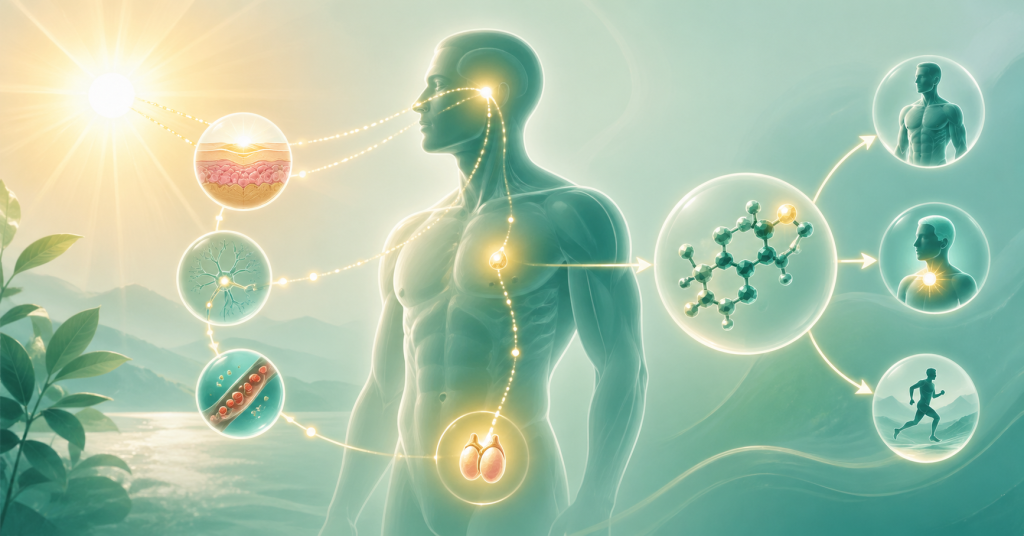
Recent scientific studies indeed identify a relation between UV exposure and testosterone production. In 2021, a study published in Cell Reports has described how UVB light activates a “skin-to-brain-to-gonad” pathway which stimulates the testosterone production. Large population datasets also show signs of important seasonal peak in testosterone production during summer, an obvious sign of a clear relationship between testosterone production and sun exposure.
However, this increase works via a general exposition of the skin, regardless of the area, and not only through exposure of the scrotal skin. No study has identified any clear advantage to exposing the scrotum skin rather than the skin of the torso, the back or the arms.
Key points
- Systematic exposure: the exposure of the genitalia does not matter but rather the total surface of skin exposed. The body reacts to UV absorption through keratinocytes across the skin.
- Seasonality matters: public health data do show a natural peak of testosterone in summer. This phenomenon is related to the increase of vitamin D and the global stimulation of the endocrine system by light, and not to localised exposure.
Risk related to this exposure
As noted above, sun exposure may have real benefits such as the increase of testosterone in cases of hormonal deficiency. But this involves risks. Although scrotal skin, like other skin area, may contribute to the production of testosterone, this skin is thinner which makes its exposure particularly exposed to UV-related damages such as sunburn, skin cancer and premature ageing of the skin. This area is also rarely exposed to UV radiation which makes it even more susceptible to burning.
In order to maintain proper testicular function, the tissues need to remain between 1 to 3°C below the body temperature. Localised exposure of the scrotum may raise the temperature of the tissues, which may disrupt sperm production and may lead to a testicular inflammation in cases of chronic exposure.
Healthier alternative to naturally boost testosterone
If the objective is to support the hormonal system, it is preferable to focus on health alternative approved by sports medicine and endocrinology, rather than following marginal trends.
- Moderate sun exposure: prefer 15 to 20 minutes of exposure on the arms, back or legs each day. It is sufficient to synthetised vitamin D necessary for testosterone production.
- Training: strength training (polyarticular exercises such as squats or deadlifts) remains one of the most effective ways to naturally stimulate the secretion of growth hormones and testosterone.
- Sleep management: the main production of testosterone is made during deep sleep. A lack of sleep may lower significantly the production which could not be compensate by sun exposure.
- Nutrition and micronutrients: ensure adequate intake of zinc, magnesium and healthy fats (cholesterol is a precursor of steroid hormone).
- Targeted supplementation: if you live in a area with low sun exposure, a cure of vitamin D3 under medical supervision is an option way more interesting and effective than artificial or localised tanning.
Testicle tanning: a dangerous trend for your health?
Several professionals have proved that testicle tanning does not provide any specific benefits. At least no greater than exposing any other body area to sunlight. Scrotal skin presents more risks than benefits. If what you are looking for is a hormonal support based on UV exposure, it is preferable to choose moderate exposure over a larger skin surface, while taking standard precaution to protect your skin from the sun, and if necessary, vitamin D supplement. Risks such as severe sunburn of the scrotum, disruption of the sperm production or even cancer are not worth any potential benefits that such sun exposure may have on the testosterone production.
Sources
Myerson A, Neustadt R. Influence of ultraviolet irradiation upon excretion of sex hormones in the male. Endocrinology, 1939.
Ottwell R, et al. Evaluating the Public’s Interest in Testicle Tanning: Observational Study. JMIR Dermatology, 2022.
Parikh R, et al. Skin exposure to UVB light induces a skin-brain-gonad axis and systemic solar effects. Cell Reports, 2021.
Healthy Male (Australia). Will tanning my balls increase testosterone?
https://healthymale.org.au/ask-the-doc/will-tanning-my-balls-increase-testosterone
Continue exploring longevity
Explore this longevity topic