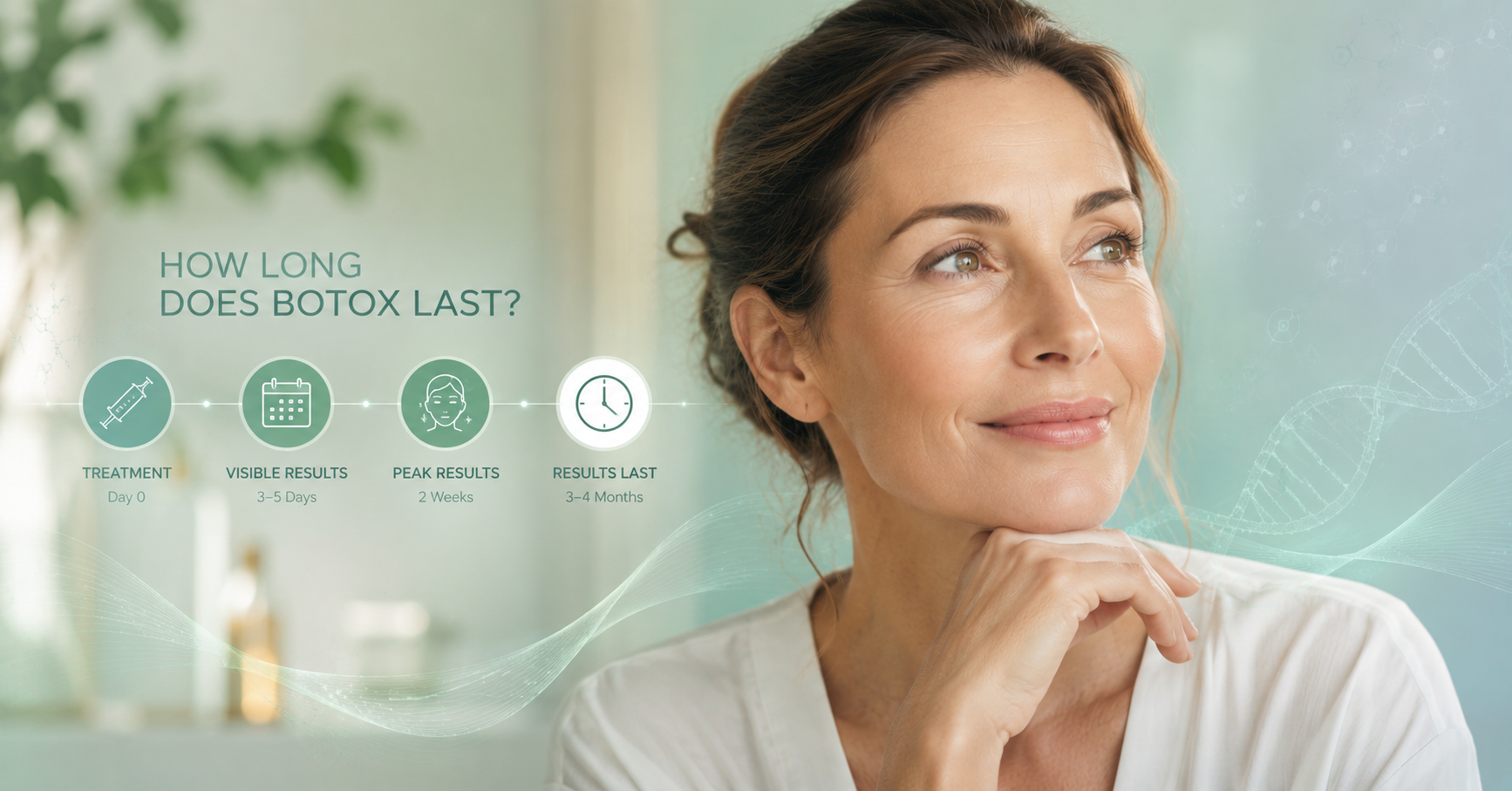
The question how long does botox last goes far beyond the lifespan of a single treatment. People also want to know what happens after years of injections, why some practitioners talk about the “rule of 3,” and why part of Gen Z seems less interested in Botox than previous generations. These questions reflect a broader shift in aesthetic medicine: patients are looking for natural-looking results just as much as wrinkle reduction.
While Botox remains one of the most popular cosmetic treatments worldwide, its long-term effects, limitations, and changing public perception deserve a closer look.
What to expect
The Botox results timeline
Results build gradually — patience in the first two weeks pays off
Days 1–2
Injection day
The toxin begins blocking nerve signals to targeted muscles; visible changes are minimal
Days 3–5
First signs appear
Treated muscles start to relax; early, subtle smoothing becomes noticeable
Days 7–10
Noticeable improvement
Most patients see a clear reduction in the targeted lines and wrinkles
Day 14
Peak effect
Full results are visible — the ideal time for a follow-up to assess symmetry
Months 1–3
Results hold steady
Smoothing typically stays consistent through this peak window
Months 3–4
Gradual fading
Muscle activity slowly returns as the effect wears off — time to plan your next session
How long does botox last?
For most patients, Botox results last between 3 and 6 months.
However, that answer only tells part of the story. The duration of Botox depends on several factors, including:
- The treatment area;
- Facial muscle strength;
- Individual metabolism;
- Previous treatment history.
For example, someone receiving their first treatment for frown lines may notice movement gradually returning after three or four months. Another person who has maintained treatments for several years may continue seeing results for five or six months.
Why isn’t Botox permanent?
Botox works by interrupting communication between nerves and muscles.
After treatment:
- The targeted muscle relaxes;
- Expression lines become less visible;
- The body gradually rebuilds the nerve connections.
This natural regeneration process is why muscle movement eventually returns.
When are Botox results at their best?
Most patients notice:
- Initial effects after 3 to 5 days;
- Visible improvement after about one week;
- Peak results between 10 and 14 days.
A well-treated forehead does not necessarily become completely frozen. When performed correctly, Botox softens movement while preserving natural facial expressions.
What happens after 10 years of Botox?
One of the most common concerns involves long-term Botox use.
Do the muscles become weaker?
After years of regular treatment, certain facial muscles often become less active.
In practical terms:
- Repetitive contractions decrease;
- Wrinkles deepen more slowly;
- Some areas may require fewer units than they did initially.
For example, someone receiving injections every four months at age 35 may eventually stretch treatments to five or six months after a decade of maintenance.
This does not mean the muscles disappear. Instead, they become less conditioned to repetitive movement.
Does the skin age differently?
The main long-term benefit is preventative.
Over ten years:
- The forehead creases less frequently;
- Frown lines tend to deepen more slowly;
- Crow’s feet may become less pronounced than they otherwise would.
As a result, two people of the same age can show noticeable differences if one has spent years minimizing repetitive facial movements.
What happens if you stop after 10 years?
Contrary to popular myths, your face does not suddenly collapse or age dramatically.
When treatments stop:
- Muscles gradually regain their normal activity;
- Facial expressions return;
- Natural aging continues.
Wrinkles do not become worse because Botox was discontinued.
In fact, many people still benefit from years during which facial creasing was reduced.
Duration varies by area
How long results typically last, by area
Smaller, more expressive muscles tend to wear off faster
Lips
2–3 monthsCrow’s feet
3–4 monthsFrown lines
3–5 monthsForehead
3–4 monthsMasseter (jaw)
4–6 monthsAre there long-term side effects?
When treatments are performed appropriately, long-term complications are uncommon.
Problems are more likely to arise from:
- Excessive injections;
- Overly frequent treatments;
- Pursuing an unnaturally frozen appearance.
This is one reason many practitioners now favor a more conservative approach than was common a decade ago.
What is the rule of 3 in Botox?
The “rule of 3” is a term often used in aesthetic medicine, although its meaning can vary.
The three-month rule
The most common interpretation involves treatment timing.
Many practitioners recommend:
- Waiting at least 3 months between appointments;
- Allowing the product to work fully;
- Avoiding unnecessary touch-ups.
This approach helps maintain natural-looking results while reducing the risk of overtreatment.
The three most commonly treated areas
Some providers also use the rule of 3 to refer to the three classic Botox treatment zones:
- Forehead lines;
- Frown lines (glabellar lines);
- Crow’s feet.
These areas account for the majority of cosmetic Botox procedures.
Why does this rule matter?
Consider a common scenario.
A patient notices slight movement returning after two months and immediately wants another treatment. In reality, Botox often continues providing benefits for several additional weeks.
Following a recommended schedule helps:
- Create more balanced results;
- Avoid an overdone appearance;
- Maintain healthier muscle activity over time.
Why are Gen Z saying no to Botox?
Botox remains highly popular, but part of Gen Z is approaching aging and cosmetic treatments differently.
A growing preference for authenticity
Many younger adults prioritize:
- Healthy skin;
- Consistent skincare routines;
- Natural facial expressions.
On social media, heavily frozen faces are increasingly viewed as less appealing than subtle, expressive features.
The rise of “prevention fatigue”
For years, social platforms promoted the idea of preventative Botox.
The concept was simple: start injections in your twenties to stop wrinkles before they appear.
Today, some younger consumers are questioning that philosophy.
Their reasoning often includes:
- Not every wrinkle needs treatment;
- Aging is a natural process;
- Early intervention is not always necessary.
The influence of the skin-first movement
Gen Z frequently invests more in:
- Skincare products;
- Serums;
- Dermatological treatments;
- Daily sunscreen use.
The goal is often to improve skin quality before considering injectables.
For example, a 25-year-old with dehydration lines may see significant improvement from a targeted skincare routine without immediately turning to Botox.
Cost considerations
Financial factors also play a role.
Botox involves:
- Ongoing appointments;
- Recurring expenses;
- Long-term maintenance.
For many young adults, investing in skincare or occasional treatments feels more practical than committing to a continuous injection schedule.
Have expectations changed?
Absolutely.
In the past: erase wrinkles
For years, the primary goal was to eliminate as many wrinkles as possible.
Today: preserve expression
Current trends emphasize:
- Natural movement;
- Subtle enhancement;
- Looking refreshed rather than transformed.
Many practitioners now talk about “soft Botox” or customized treatments designed to soften wrinkles without completely freezing facial expressions.
Is Botox still as popular as ever?
Despite ongoing debates online, the answer is yes.
Botox remains one of the most commonly performed cosmetic procedures worldwide.
Its popularity comes from several advantages:
- Quick treatment sessions;
- No surgery required;
- Predictable results;
- Minimal downtime.
What is changing is not the treatment itself, but how people choose to use it.
Conclusion
When asking how long does botox last, the immediate answer is usually between three and six months. However, the more interesting questions often involve the long term. After ten years of Botox, muscles remain functional, although certain wrinkles may have progressed more slowly. The so-called “rule of 3” highlights the importance of spacing treatments appropriately and avoiding overtreatment.
At the same time, Gen Z’s growing skepticism does not necessarily represent a rejection of Botox. Instead, it reflects a shift in priorities: less focus on eliminating every wrinkle and more emphasis on skin health, prevention, and natural-looking results. This evolving mindset is already reshaping the future of aesthetic medicine.
What changes the timeline
Factors at play, and how to make results last
Some variables are personal, others are within your control
What influences duration
Metabolism
Muscle activity
Dosage used
Treatment history
Tips to help results last longer
Avoid touching or massaging the treated area for at least 24 hours after injection
Skip strenuous exercise and heat exposure on the day of treatment
Use daily sunscreen — UV exposure accelerates skin aging around treated areas
Stay consistent with treatments — regular sessions can train muscles to relax more over time
Continue exploring longevity
Explore this longevity topic