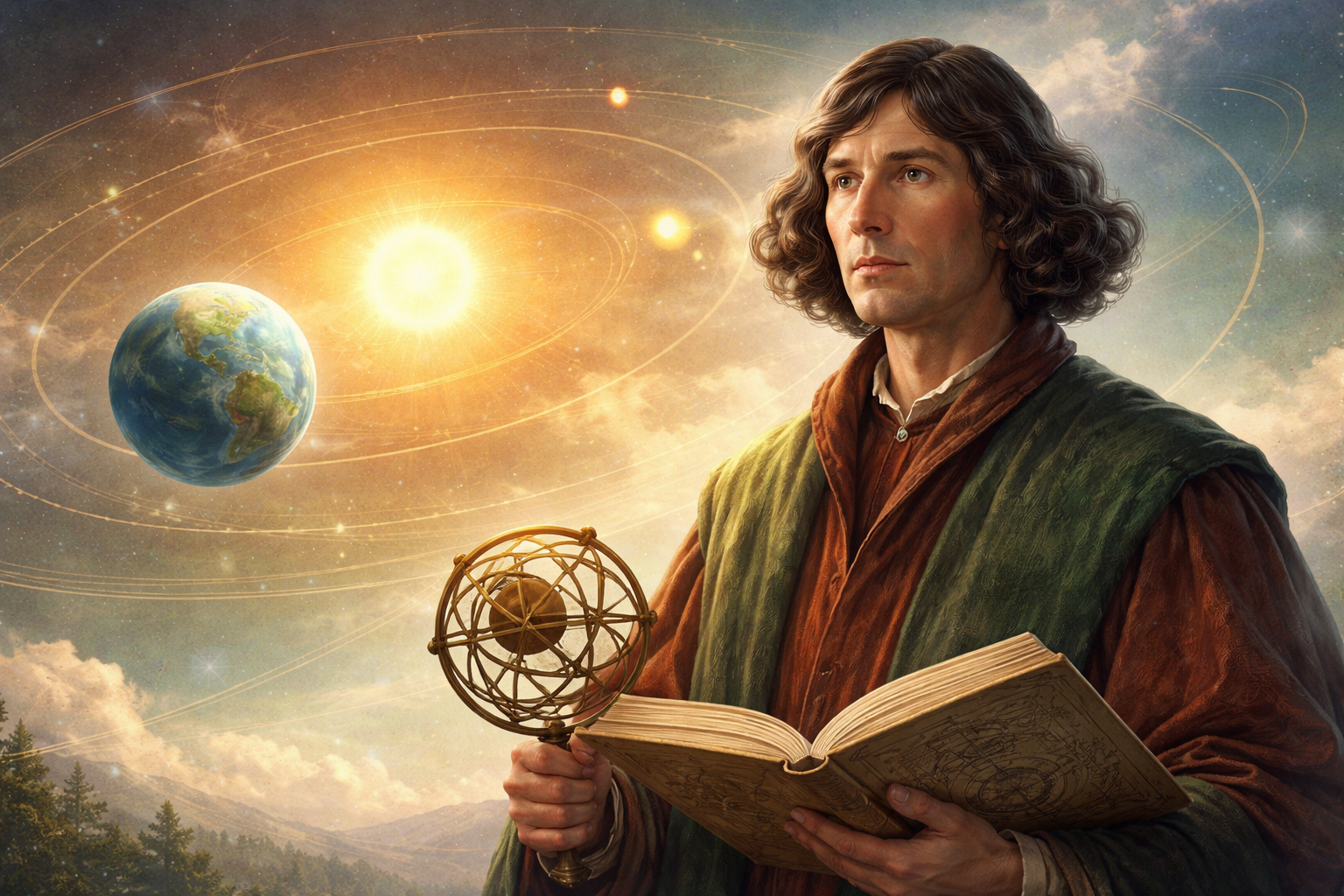
Nicolaus Copernicus was a Renaissance astronomer and mathematician best known for formulating the heliocentric model, a theory that placed the Sun at the center of the planetary system. Published in 1543 in De revolutionibus orbium coelestium, his work marked a decisive turning point in the history of science. This intellectual rupture helped establish a scientific mindset grounded in observation, an approach that still structures research in health and longevity today.
At the beginning of the sixteenth century, Nicolaus Copernicus did not present himself as a revolutionary. He was a discreet scholar, trained in mathematics, canon law and medicine, living in a world still dominated by certainties inherited from Antiquity. Yet his scientific intuition would profoundly transform the way humanity understands time, movement and its own place in the universe. What he defended was not only an astronomical model, but a method. Observe before asserting. Verify before transmitting. This intellectual posture, still rare in his time, became one of the foundations of modern science. In the field of longevity, the same logic now underlies approaches based on data and scientific validation.
The path
Nicolaus Copernicus’ journey took place in a Europe undergoing deep intellectual transformation. Born in 1473 into a merchant family, he grew up in an environment that valued education and intellectual rigor. Very early on, he turned toward mathematics and astronomy, but his path was not that of an isolated scholar. He studied in Kraków, then in Bologna and Padua, where he encountered a scientific culture based on the observation of reality rather than the simple transmission of ancient knowledge. At the same time, he trained in medicine, a field where observation of the body and practical experience already played a central role.
For years, he worked in relative silence. He observed the sky, recorded variations, corrected calculations and refined an intuition that went against what most scholars considered obvious. His moment of visibility came only at the very end of his life, when De revolutionibus orbium coelestium was published in 1543. The book did not aim to provoke, but it permanently changed the way science was organized. It introduced a simple and radical idea: scientific truth does not depend on authority, but on the coherence of observation.
His vision of longevity
Nicolaus Copernicus’ vision was based on one central idea: understanding the world requires questioning what seems obvious. His heliocentric model did not simply move the Earth in space. It introduced a new way of thinking about time and duration. If the Earth is no longer immobile, then everything becomes movement, transformation and evolution. This idea, which may appear abstract, is one of the foundations of modern scientific thinking, particularly in fields related to health and aging.
In De revolutionibus orbium coelestium, he wrote: “The Earth moves around the Sun,” a phrase that summarizes a major intellectual rupture. It did not only overturn a cosmological model; it transformed the way knowledge itself was built. Science was no longer meant to confirm what people already believed, but to explain what could actually be observed. That same logic now underlies modern scientific approaches to longevity, where researchers seek to understand the mechanisms of aging rather than accept it as something fixed and inevitable.
His vision of the future implicitly relied on a powerful idea: knowledge progresses when certainty is challenged. That same logic appears today in contemporary research on aging, which questions assumptions that were long considered definitive. Copernicus’ legacy is therefore not medical but methodological. He established a way of thinking that made possible a science based on experimentation, observation and continuous questioning.
His influence and impact
Nicolaus Copernicus’ influence extends far beyond astronomy. His work triggered what would later be called the scientific revolution, an intellectual transformation that opened the way for Galileo, Kepler and Newton. By challenging a model that had dominated for more than a thousand years, he demonstrated that no form of knowledge is permanent. This idea deeply shaped modern science, including fields related to health.
His impact is not measured only by the acceptance of the heliocentric model. He also introduced a new relationship to scientific proof. In the centuries that followed, this logic made possible the development of modern medicine, grounded in observation and experimental validation. Even today, longevity research is based on the same requirement: understand before acting, measure before asserting. Copernicus did not try to transform medicine, but he helped transform science itself.
A scientific revolution that reshaped how humanity understands time and knowledge
Nicolaus Copernicus never worked on human longevity, but he profoundly transformed the way science understands time, movement and knowledge. By placing observation at the center of research, he opened the way to a modern scientific approach capable of understanding the mechanisms of the human body and aging. His legacy is not limited to an astronomical theory, but to an intellectual method that still structures scientific research today. And if the longevity revolution rests on one idea, it may still begin with a fundamental act of questioning.
Continue exploring longevity
Explore this longevity topic