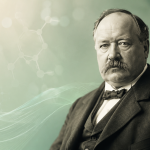
Gregor Mendel was a 19th-century Austrian monk and scientist now recognized as the founder of modern genetics. He is known for demonstrating the laws of heredity through experiments on plants. His work, ignored during his lifetime, later became fundamental to understanding biological aging, genetic diseases, and the mechanisms that influence human longevity. His influence remains central today in health research and in the biology of aging.
A discreet and methodical figure, Gregor Mendel never sought recognition or scientific disruption. Yet his approach profoundly changed the way life itself is understood. In a small monastery in Brno, he developed a rigorous method based on observation, repetition, and measurement. Where many scientists saw nature as complex and impossible to model precisely, he defended a simple but radical idea for his time: living characteristics follow clear and predictable laws. That conviction has become one of the pillars of longevity research today, because understanding why some individuals live longer than others inevitably requires the study of heredity. Mendel never spoke about longevity directly, but he made its scientific understanding possible.
His journey
Gregor Mendel’s path does not resemble that of a scientist destined to transform biology. Born in 1822 into a modest rural family, he grew up in an environment where observing nature was part of everyday life. Entering a monastery in Brno gave him access to education and to a setting that allowed him to conduct research. He was neither a public figure nor an influential academic. He taught science while quietly conducting his experiments with pea plants. For several years, he observed how characteristics were transmitted from one generation to another. He recorded shapes, colors, structures, and most importantly their reappearance according to precise patterns. In 1866, he published his findings in a scientific paper that went almost unnoticed. It was only at the beginning of the 20th century that his work was rediscovered and finally recognized. From that moment on, Mendel became a foundational figure. Modern genetics was born, along with a completely new way of understanding human health.
His vision of longevity
The vision of longevity associated with Gregor Mendel is not one he formulated directly, but rather the natural consequence of his scientific work. By demonstrating that biological characteristics are transmitted according to precise laws, he opened the door to a crucial question: to what extent is lifespan determined by heredity. Today, longevity research relies heavily on this idea. Scientists aim to identify the genes that influence aging, resistance to disease, and the body’s capacity to regenerate. Without Mendel’s work, this approach would not exist. His scientific legacy rests on a simple yet transformative idea: biology is not shaped only by the environment, it is also organized by internal mechanisms. This perspective challenged the long-standing belief that aging was simply a natural and unavoidable decline. Instead, it opened the possibility of understanding and eventually influencing biological aging. Today, research in aging genetics, personalized medicine, and longevity science continues to build on this foundation. Mendel never spoke about anti-aging or lifespan optimization, but he made those questions scientifically accessible. His work represents one of the true starting points of modern biology, and therefore of modern longevity research.
His influence and impact
Gregor Mendel’s influence goes far beyond the field of biology. He has become a central reference across disciplines related to health, genetics, and aging. His impact is visible in medical research, in the understanding of hereditary diseases, and in current work on longevity. At the same time, his legacy still fuels debate. Some researchers emphasize the dominant role of genetics in lifespan, while others stress the importance of environment, lifestyle, and prevention. This debate would not exist without the laws of heredity he identified. Even today, every major advance in understanding biological aging relies, directly or indirectly, on his work. He was never a public figure in the modern sense, but his influence structures the entire field of longevity research.
Mendel’s legacy and the future of longevity
Gregor Mendel never aimed to transform medicine or to influence how humans might live longer. Yet by revealing the fundamental laws of heredity, he laid the scientific foundations of modern longevity. His work reminds us that major transformations do not always come from the desire to revolutionize a field, but sometimes from patient and rigorous observation. Today, as genetics becomes central to the future of medicine, the question is no longer only how to understand biological inheritance, but how far it will be possible to modify it. And that is precisely where Mendel’s legacy continues to open new perspectives.
Continue exploring longevity
Explore this longevity topic