Key takeaways
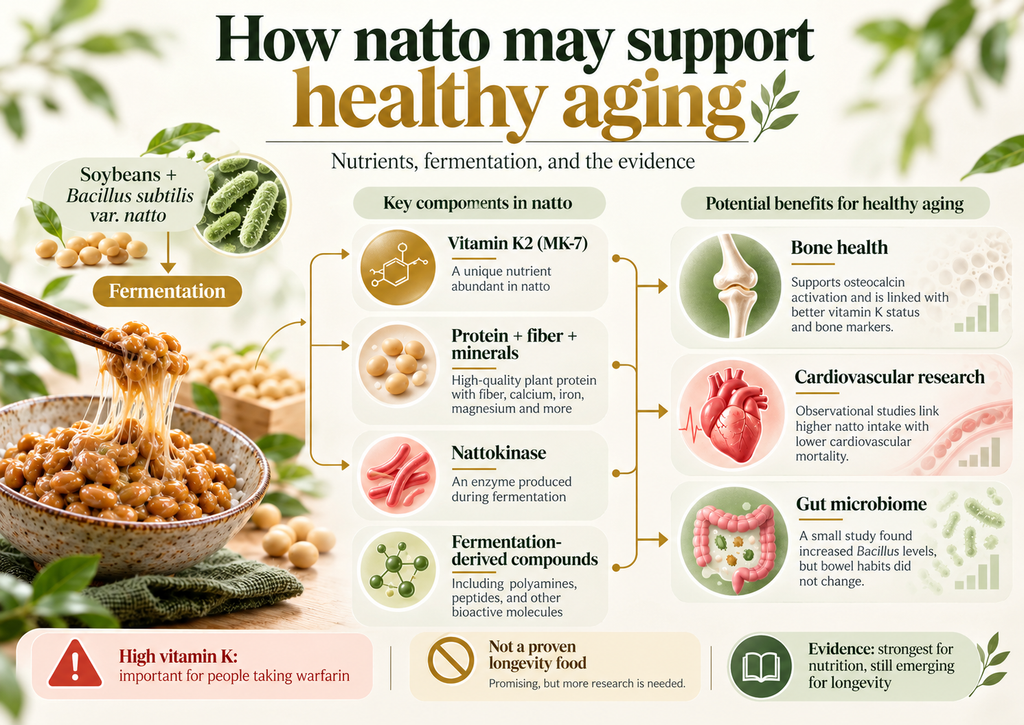
- Natto, a traditional Japanese food made from fermented soybeans, provides plant protein, fiber, minerals, and vitamin K2, a nutrient involved in bone metabolism.
- Large observational studies in Japan have linked regular natto consumption with lower cardiovascular mortality. Some long-term research has also found an association between habitual intake and lower all-cause mortality.
- Emerging research suggests that natto may influence bone health and the gut microbiome, while scientists are investigating how fermentation transforms its molecular composition.
- These findings are promising, but they do not establish that natto directly extends lifespan or prevents disease. Much of the evidence remains observational.
- Natto can be a nutritious addition to a balanced diet, although its high vitamin K content is important for people taking warfarin.
Why Is Natto becoming a longevity food?
Some foods earn their place in everyday life through familiarity. Others attract attention because researchers begin to uncover the science behind traditions that have existed for generations. Natto, Japan’s distinctive fermented soybean dish, belongs to the second category.
Known for its pungent aroma and sticky, stringy texture, natto is a familiar breakfast food in Japan, often served with rice, soy sauce, and mustard. Its appeal may take some getting used to, but interest in its nutritional properties is growing well beyond its country of origin. According to New Atlas, Japan exported 5,248 tonnes of natto in 2025, nearly three times the volume recorded in 2017.
What makes this traditional food particularly interesting to longevity researchers is not one miraculous ingredient, but the combination of its nutritional profile, fermentation process, and possible relationship with long-term health.
Studies have linked natto consumption to cardiovascular outcomes and bone health, while newer laboratory research is exploring the compounds produced during fermentation. The central question is whether these findings can help explain why certain dietary habits may support healthier aging.
The evidence is worth examining, provided we distinguish a promising association from a proven health benefit.
What makes Natto nutritionally different?
Natto is made by fermenting cooked soybeans with a specific bacterium, Bacillus subtilis var. natto. This process gives the beans their characteristic aroma and texture while changing their chemical composition.
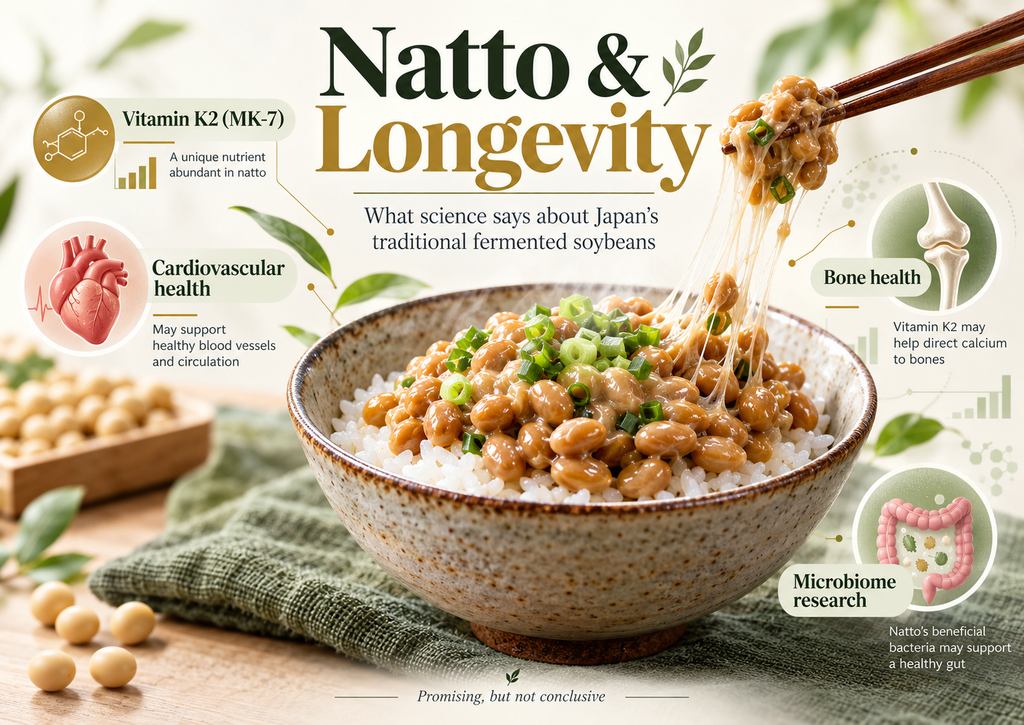
Like other soybean foods, natto supplies plant-based protein and fiber. It also contains minerals such as magnesium and potassium. One of its most distinctive nutritional features, however, is its concentration of vitamin K2, particularly menaquinone-7 (MK-7).
Vitamin K is essential for normal blood clotting. It also participates in bone metabolism by helping activate proteins involved in the handling of calcium in bone tissue. One of these proteins, osteocalcin, is associated with the process of bone mineralization.
This connection matters as people age. Bone density can decline over time, increasing vulnerability to fractures, particularly after menopause. A food that supplies vitamin K2 alongside protein and other nutrients may therefore be relevant to dietary strategies for maintaining bone health.
Natto is not the only food that supports this goal, and vitamin K2 is not a substitute for adequate calcium, vitamin D, physical activity, or appropriate medical care. Its nutritional value lies in how it can contribute to an overall dietary pattern.
Natto and cardiovascular health: What do long-term studies show?
The cardiovascular findings are among the most compelling reasons scientists have investigated natto.
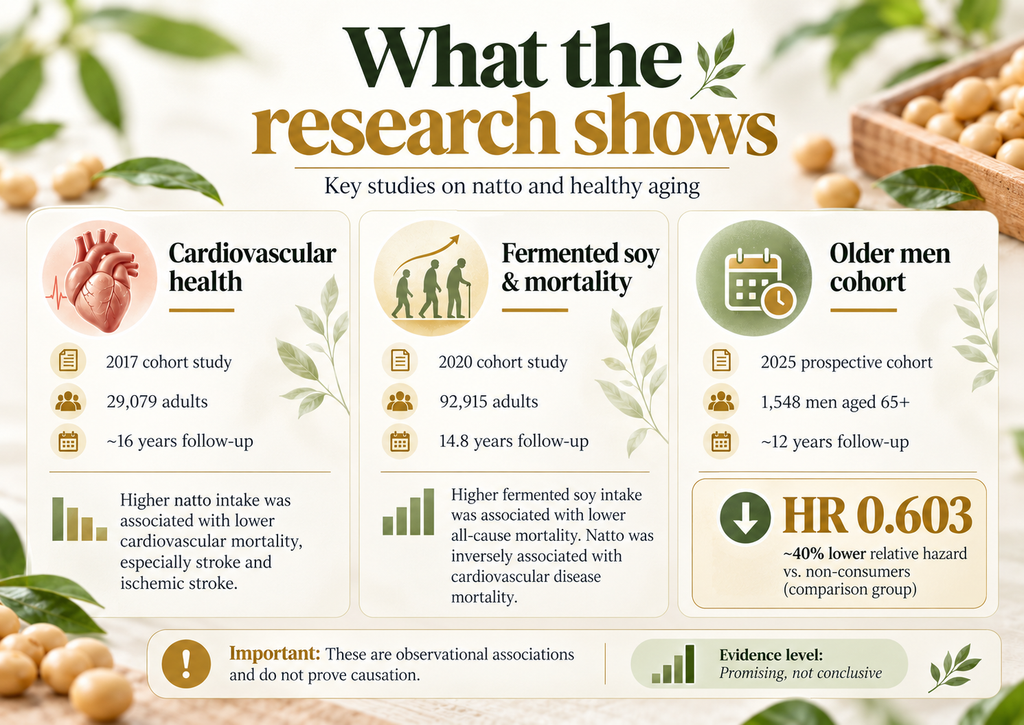
A study published in the American Journal of Clinical Nutrition in 2017 examined dietary habits and cardiovascular mortality among 29,079 adults in Japan. Participants were followed for approximately 16 years. Researchers found that people with higher natto intake had a lower risk of cardiovascular death than those with lower intake, after accounting for several potential confounding factors.
The findings were particularly notable for stroke-related outcomes. Higher natto consumption was associated with lower mortality from total stroke and ischemic stroke. However, the study was observational: it tracked what people ate and what happened to them, rather than randomly assigning participants to consume natto.
A larger study published in The BMJ in 2020 followed 92,915 Japanese adults for an average of 14.8 years. It found that higher consumption of fermented soy products, including natto and miso, was associated with lower all-cause mortality. Natto consumption was also inversely associated with cardiovascular disease mortality.
The distinction is important. The overall mortality finding applied to fermented soy products as a group, while the cardiovascular findings included specific analyses of natto. These results should not be interpreted as proof that natto alone accounts for every observed benefit.
Still, the consistency of the cardiovascular associations across studies makes natto an interesting subject for further research. It also raises a broader question: could the way soybeans are fermented influence their relationship with health?
What about nattokinase and blood pressure?
Natto contains nattokinase, an enzyme produced during fermentation that has attracted interest for its effects on fibrin, a protein involved in blood clot formation. Researchers have also investigated whether nattokinase supplements can influence blood pressure.
A systematic review and meta-analysis of clinical trials found modest reductions in systolic and diastolic blood pressure among people taking nattokinase supplements. However, the number of participants was limited, and the trials varied in their doses and methods. These results do not demonstrate that eating natto prevents heart attacks or strokes, nor do they establish nattokinase as a replacement for blood pressure medication.
It is also important to distinguish the food from concentrated supplements. Nattokinase products may affect blood clotting and can increase bleeding risk, particularly when combined with anticoagulant or antiplatelet medicines. Natto itself is rich in vitamin K, which can interfere with warfarin treatment.
For these reasons, nattokinase supplements should not be treated as a simple extension of the benefits associated with a traditional food.
Could Natto help preserve bone health as we age?
Bone health is another area where natto has attracted sustained scientific interest.
In late 2025, a meta-analysis examined six observational and quasi-experimental studies involving 2,327 participants. The researchers assessed habitual natto consumption in relation to vitamin K2 status, markers of bone metabolism, and bone mineral density.
The analysis found that regular natto intake was associated with higher circulating MK-7 levels and more favorable measures of osteocalcin activation. It also reported associations with modestly greater bone mineral density across several sites.
These findings offer a plausible nutritional explanation for why natto has been studied in relation to osteoporosis. They also suggest that the food may influence more than vitamin intake alone: its regular consumption could be associated with measurable differences in the biological processes involved in maintaining bone tissue.
However, the authors noted that the evidence was limited by the small number of eligible studies and their predominantly observational nature. The certainty of evidence ranged from moderate for serum MK-7 levels to low or very low for some bone-related outcomes.
In other words, the research supports continued investigation, not a definitive claim that eating natto prevents osteoporosis. More rigorous studies are needed to determine whether the observed differences translate into fewer fractures or clinically meaningful improvements in bone health.
A 15-Year study adds to the longevity conversation
One of the more striking findings comes from a prospective cohort study published in 2025 that followed older Japanese men over an extended period.
Researchers initially recruited more than 2,000 men aged 65 and older. The final analysis included 1,548 participants, among whom 430 deaths were recorded during an average follow-up of 12 years.
Compared with men who reported no natto consumption, those who reported eating several packs per week had a lower estimated risk of all-cause mortality. The association corresponded to a hazard ratio of 0.603, or approximately 40% lower relative hazard in that comparison.
That figure deserves attention, but also careful interpretation. It does not mean that natto was shown to extend life by 40%, nor that everyone who eats it will experience the same effect. The association for the group consuming at least one pack per day was not statistically significant when compared with non-consumers.
The researchers also relied on self-reported dietary information, and the study involved older men in Japan. Its findings may not apply in the same way to women, younger adults, or populations with different dietary habits.
Nevertheless, the study adds a valuable long-term perspective to the existing research. Rather than focusing solely on individual biomarkers, it examines the relationship between a habitual dietary practice and mortality over many years.
The next challenge is to understand whether natto itself contributes to the observed difference, which biological pathways might be involved, and how much other lifestyle factors explain the association.
Fermentation may be part of the story
The nutritional profile of natto is only one part of its scientific appeal. Researchers are also examining what happens to soybeans during fermentation and how these changes might influence their biological activity.
A study published in Nitric Oxide in 2026 investigated the transformation of sulfur-containing compounds known as supersulfides during natto fermentation. These molecules are involved in cellular chemistry and have attracted interest because of their potential roles in biological processes related to health.
Using detailed molecular analyses, the research team found that supersulfide content increased as soybeans were fermented with Bacillus subtilis var. natto. The process altered the profile of sulfur-containing molecules, suggesting that fermentation does more than change a food’s taste and texture.
This is an important step in understanding natto at the molecular level. It gives scientists a more detailed picture of how fermentation transforms plant-derived compounds and creates a food with a distinct chemical composition.
But there is a substantial gap between identifying a molecule in a food and demonstrating that eating it improves human health. The study did not establish that natto’s supersulfides extend lifespan, prevent disease, or produce measurable longevity benefits in people.
For now, the findings provide a foundation for future research rather than a new health claim.
What do we know about Natto and gut health?
As interest in the gut microbiome has grown, fermented foods have become a prominent part of discussions about healthy aging. Natto is particularly interesting because its fermentation process involves a specific bacterium, but the presence of microorganisms in a food does not automatically mean that eating it will produce a particular health outcome.
A small study involving 44 women compared daily consumption of natto with boiled soybeans over two-week periods. Natto consumption increased fecal levels of Bacillus, suggesting that it influenced the microbial profile measured in the participants. However, the study did not find a corresponding change in bowel habits.
This distinction illustrates an important challenge in microbiome research. A change in the abundance of a particular bacterium can be scientifically meaningful, but its clinical significance depends on what else changes and whether those changes improve health.
Larger and longer studies are needed to determine whether regular natto consumption produces lasting changes in the gut microbiome and whether those changes affect digestion, inflammation, metabolic health, or aging-related outcomes.
The microbiome may ultimately help explain some of the differences observed between fermented and non-fermented foods. At present, however, natto-specific evidence remains preliminary.
How can Natto fit into an everyday diet?
For someone unfamiliar with natto, the first challenge may be its distinctive texture and aroma rather than its nutritional value. Traditionally, it is stirred and served with warm rice, soy sauce, and Japanese mustard. Spring onions, sesame seeds, seaweed, or avocado can also help balance its flavor.
It can be added to savory bowls or served alongside vegetables and other protein sources. There is no need to approach it as a special longevity treatment or to consume large amounts in pursuit of a particular outcome.
The more useful question is whether natto fits into a varied, sustainable eating pattern. It provides plant protein and fiber, contributes vitamin K2, and offers a way to include fermented soybeans in the diet. People who enjoy it can benefit from these nutritional qualities without assuming that it will prevent disease or slow aging on its own.
Those taking warfarin should speak with their healthcare professional before introducing natto, because its high vitamin K content can affect anticoagulation management. People with soy allergies should also avoid it.
Ultimately, a food does not need to be exotic or marketed as a superfood to have a place in healthy eating. Natto’s strongest case is its distinctive nutritional composition and the growing body of research examining its relationship with long-term health.
What this means for longevity?
Natto offers a useful reminder that longevity research does not always begin with a new drug, a sophisticated biomarker, or an expensive intervention. Sometimes, researchers return to everyday foods and ask whether longstanding dietary habits can help explain differences in health as people age.
The current evidence is encouraging in several respects. Large Japanese cohort studies have found associations between natto consumption and lower cardiovascular mortality, a long-term study in older men reported an association with lower all-cause mortality, and a recent meta-analysis linked habitual intake with improved vitamin K status and bone metabolism markers.
Yet the evidence is not equally strong across all these outcomes. Much of it is observational, the populations studied are largely Japanese, and the molecular findings have not yet translated into demonstrated longevity benefits in human trials.
Natto should therefore be viewed as a potentially valuable component of a balanced diet, not a food proven to extend lifespan. Its nutritional qualities are established more clearly than its specific effects on longevity.
For researchers, the next steps include better understanding the biological mechanisms involved, conducting stronger studies of bone and cardiovascular outcomes, and determining whether the associations observed in Japan hold across other populations.
For readers, the takeaway is simpler: healthy aging is unlikely to depend on a single ingredient. Natto may have a role to play, but it belongs within the broader picture of dietary quality, physical activity, sleep, preventive healthcare, and other habits that support health over time.
Discover more research and perspectives on nutrition, preventive health, and the science of healthy aging on Sogevity.
Level of evidence
Overall assessment: Promising, but not conclusive.
Evidence for natto’s nutritional composition, including its vitamin K2 content, is well established. Observational studies provide consistent signals linking natto or fermented soy consumption with certain cardiovascular outcomes and, in some populations, lower mortality. A recent meta-analysis also found associations with vitamin K status and bone metabolism markers.
However, observational studies cannot establish causation, and the evidence for specific longevity effects remains limited. Research on supersulfides and gut microbiome changes is still emerging. Findings from nattokinase supplements should also be interpreted separately from evidence on eating natto as a food.
FAQ
Does natto help you live longer?
Some observational studies have found that people who regularly consume natto have lower mortality rates than people who consume little or none. These studies do not prove that natto itself extends lifespan, because other dietary, lifestyle, and health factors may contribute to the findings.
What makes natto different from other fermented foods?
Natto is fermented soybeans produced using Bacillus subtilis var. natto. It provides plant protein and fiber and is particularly rich in vitamin K2, especially MK-7. Its fermentation process also produces a distinctive chemical profile that researchers are continuing to investigate.
Is natto good for bone health?
Natto supplies vitamin K2, which participates in the activation of proteins involved in bone metabolism. Research has associated habitual natto consumption with improved vitamin K status and certain bone metabolism markers. However, stronger evidence is needed to determine whether it reliably reduces fractures or prevents osteoporosis.
Can natto improve heart health?
Japanese observational studies have linked higher natto consumption with lower cardiovascular mortality. Researchers have also studied nattokinase, an enzyme produced during fermentation, for its potential effects on blood pressure and clotting. These findings do not establish natto as a treatment for cardiovascular disease or a substitute for prescribed medication.
Is natto safe for everyone?
Natto is a traditional food, but it is not appropriate for everyone. People with soy allergies should avoid it. Because it contains substantial amounts of vitamin K, it can interfere with warfarin treatment. Anyone taking warfarin should consult their healthcare professional before making significant changes to natto or vitamin K intake.
Do you have to eat natto every day to benefit from it?
There is no established daily intake proven to extend lifespan or prevent disease. Studies have examined different consumption patterns, but they have not established an optimal dose for longevity. Natto can be one option within a varied diet, rather than a daily requirement.
Methodology
This article draws on the New Atlas report published on October 20, 2026, and supporting scientific literature on natto consumption, cardiovascular mortality, bone metabolism, nattokinase, and soybean fermentation. Priority was given to peer-reviewed cohort studies, systematic reviews, and primary research. Observational findings are described as associations, and laboratory findings are not presented as demonstrated clinical benefits.
Disclaimer
This article is for informational and educational purposes only and is not intended to replace medical advice, diagnosis, or treatment. Research on natto and longevity is ongoing, and the findings discussed do not establish that natto prevents disease or extends lifespan. Consult a qualified healthcare professional before making dietary changes that could affect a medical condition or prescribed medication.
Sources
- Frontiers in Nutrition — Habitual natto intake, vitamin K2 status, bone metabolism, and bone density: A meta-analysis (2025).
- Nitric Oxide — Dynamic transformation of the sulfur metabolome during natto fermentation: Supersulfide omics study (2026).
- Memorial Sloan Kettering Cancer Center — Nattokinase: Potential benefits, evidence, and safety considerations.
- Systematic review and meta-analysis — Nattokinase supplementation and cardiovascular risk factors.
Continue exploring longevity
Explore this longevity topic