Key points
- Some skin care ingredients can help support skin hydration, flexibility, and vitality.
- Their action often lies in the support of the skin, cellular balance, and mild inflammation.
- A balanced skin is associated with better resilience against time-related oxidative stress
- The effectiveness depends on the formula, bioavailability, and frequency of use
- Clinical studies suggest that active ingredients such as niacinamide or retinoids can visibly improve skin texture and barrier function after several weeks of supervised use.
The Skin is a living organ constantly interacting with its environment. Over time, its balance can be influenced by oxidative stress, sun exposure, mild inflammation, and hormonal fluctuations. In this context, skincare ingredients create increasing interest as sustainable skin health support. Understanding their role enables a more mindful approach to beauty. Skin that is supported at the cellular level and respected in its biological rhythms can contribute to visible vitality and harmonious skin longevity. This article will therefore explore their mechanisms, benefits, and how they can be integrated into a balanced skincare routine.
What are they ?
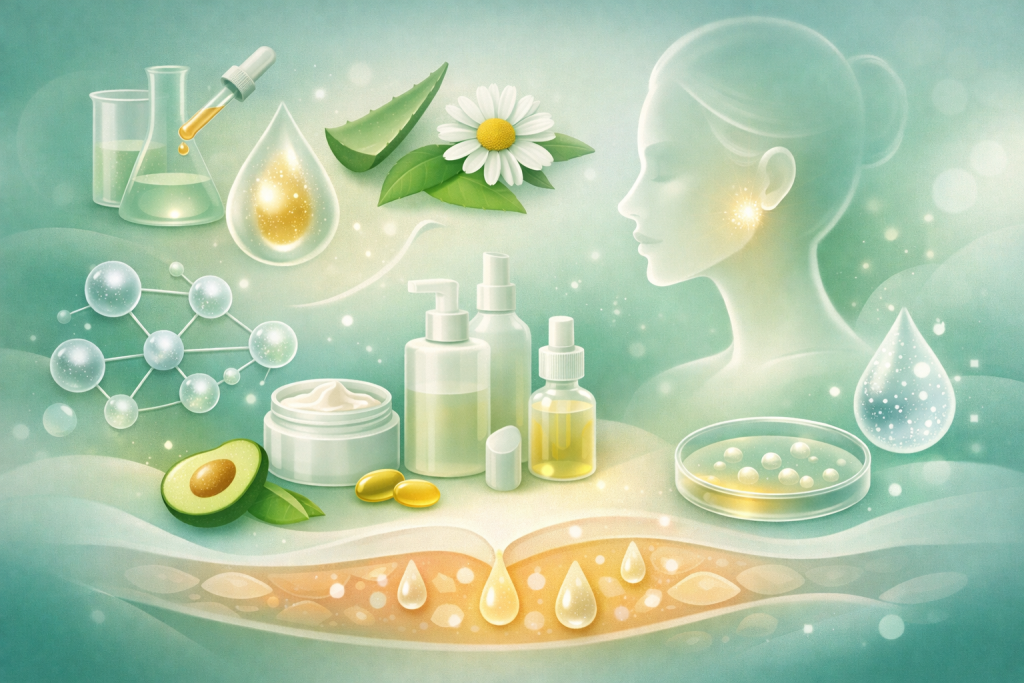
Skincare ingredients refer to all active ingredients incorporated into cosmetic formulations to support the skin’s natural functions. They can be plant-based (polyphenols, botanical extracts, from biological origin (peptides, ceramides) or synthetic (retinoids, niacinamide). Biologically speaking, these active ingredients can engage with several factors, such as: skin barrier, dermal fibroblasts, mechanisms related to oxidative stress, or collagen synthesis.
Their key feature resides in their capacity to act locally, at the cellular level, to help natural functions of the skin instead of replacing them.
Did you know?
Clinical studies have shown that certain molecules, such as niacinamide, produce a measurable improvement in skin barrier function and elasticity after 8 to 12 weeks of regular application.
How do they work ?
Main Action
Most skincare ingredients act through three main channels: the support for the lipid barrier, the modulation of oxidative stress, and gentle stimulation of cell renewal. As an example, antioxidants can neutralize certain reactive oxygen species, thereby helping to protect cell structures.
Effects on skin tissues
Skin (epidermis)
Certain active ingredients can strengthen cell cohesion and limit insensible water loss.
Dermis
Ingredients such as peptides or retinoids can be associated with stimulating collagen synthesis.
Mild inflammation
Certain plant extracts can help balance skin inflammatory mediators.
Cellular energy
Active ingredients that target mitochondrial function could support long-term cellular vitality.
What this means for longevity
Helping natural skin defense and regeneration mechanisms could promote a better resilience against environmental damage. This method is part of a vision of skin longevity contributing to cell support.
What this means for longevity
Helping natural skin defense and regeneration mechanisms could promote a better resilience against environmental damage. This method is part of a vision of skin longevity contributing to cell support.
Study Box
2015 – Randomized clinical trial (topical retinol)
https://pubmed.ncbi.nlm.nih.gov/26426451
Regular use of retinol has been associated with a significant improvement in dermal density and skin texture after several months.
Benefits
Supports hydration and barrier function
Active ingredients such as hyaluronic acid or ceramides can help contain water in the epidermis and strengthen lipid cohesion. Practically, this can result in more flexible, comfortable, and bright skin.
Improved texture and elasticity
Retinoids, peptides, and certain acids can support cell renewal and collagen production. In practice, the skin may appear more even and toned with gradual and appropriate use.
Protection against oxidative stress
Antioxidants such as vitamin C or polyphenols can help neutralize free radicals. This could support cellular vitality and help the skin cope with environmental aggressions.
Natural sources
- Green tea (polyphenols)
- Aloe vera
- Centella asiatica
- Oils rich in omega-3 and omega-6
- Berries rich in antioxidants
Dose, forms & bioavailability
According to data, concentrations vary:
- For Niacinamide, it varies between 2 and 5%
- For Retinol between 0.1 and 1%, depending on tolerance
- For Vitamin C, the amount is between 10 and 20%, depending on the form
La bioavailability depends on several factors : the pH of the formula, the delivery system, and the stability of the molecule.
Certain synergies are frequently studied, such as: vitamin C + vitamin E, retinol + peptides, and niacinamide + ceramides.
Regular use for several weeks is a key factor for result observation.
Safety & precautions
Skincare ingredients globally have a good tolerance profile when used at recommended doses. Side effects are still possible; some individuals can experience : redness, dryness or tingling sensations. Certain molecules (retinoids) are not recommended during pregnancy. Dermatological advice is recommended for individuals with sensitive skin, skin conditions, or combinations of powerful active ingredients.
How to incorporate it into a longevity routine
When to use
Antioxidants are often applied in the morning.
Renewing active ingredients (retinol, acids) are generally applied in the evening.
Possible ingredient combination
- Daily sun protection
- Ceramide-rich moisturizers
- Antioxidant serums
Example of a simple routine
Morning:
Gentle cleansing → Antioxidant serum → Moisturizer → SPF
Evening:
Cleansing → Targeted active ingredient (retinol or peptide) → Repair cream
For whom they can be interesting
Individuals whose skin is exposed to urban stress, mature skin or people who want to maintain their skin’s balance over the long term.
A conscious approach to supporting skin vitality?
Skincare ingredients do not replace natural mechanisms of the skin ; they help. These ingredients support the skin barrier and participate in cellular balance by modulating mild inflammation, which includes them in a broader vision of sustainable health. Adopting a thoughtful routine in a gradual approach that respects skin physiology can help preserve visible vitality over time. Skin longevity is not based on instant transformation, but on a gentle balance between science, regularity, and listening to the skin.
Sources
Draelos, Z. D. (2018). The science behind skin care: moisturizers. Journal of Cosmetic Dermatology.
https://pubmed.ncbi.nlm.nih.gov/30028038/
Kang, S., et al. (2001). Topical tretinoin improves photoaged skin.
https://pubmed.ncbi.nlm.nih.gov/11207686/
Pullar, J. M., Carr, A. C., & Vissers, M. (2017). The roles of vitamin C in skin health. Nutrients.
https://pubmed.ncbi.nlm.nih.gov/28805671/Proksch, E., et al. (2008). The skin barrier and its importance.
https://pubmed.ncbi.nlm.nih.gov/18489300/