Key information
- Solubilizing agent that allows essential oils and lipophilic active ingredients to disperse evenly in water.
- Works thanks to its amphiphilic structure, which is capable of connecting the aqueous phase and the oily phase.
- Contributes to the stability and tolerance of modern cosmetic formulations.
- Used in serums, lotions, mists, and liquid supplements for improved homogeneity.
- Available data suggest a generally well-tolerated safety profile at usual concentrations.
When it comes to the cosmetic and nutraceutical worlds, some ingredients might be overlooked, but they play a key role in product balance. PEG-40 Hydrogenated Castor Oil is one of those technical components that doesn’t claim any direct benefits for the skin or cells, but it helps active ingredients work in the best way possible.
Understanding its role provides a better understanding of how a formula can remain stable, homogeneous, and pleasant to use. In an approach focused on sustainable health and conscious longevity, the quality of the formulation contributes to overall consistency: stability, tolerance, and balance. In this article, we will see what this ingredient can really do.
What is it ?
PEG-40 Hydrogenated Castor Oil is a by-product of hydrogenated castor oil, modified by adding polyethylene glycol (PEG) chains.
Its origin is therefore based on a plant-based ingredient, which is castor oil, and a controlled chemical process that consists in hydrogenation followed by ethoxylation.
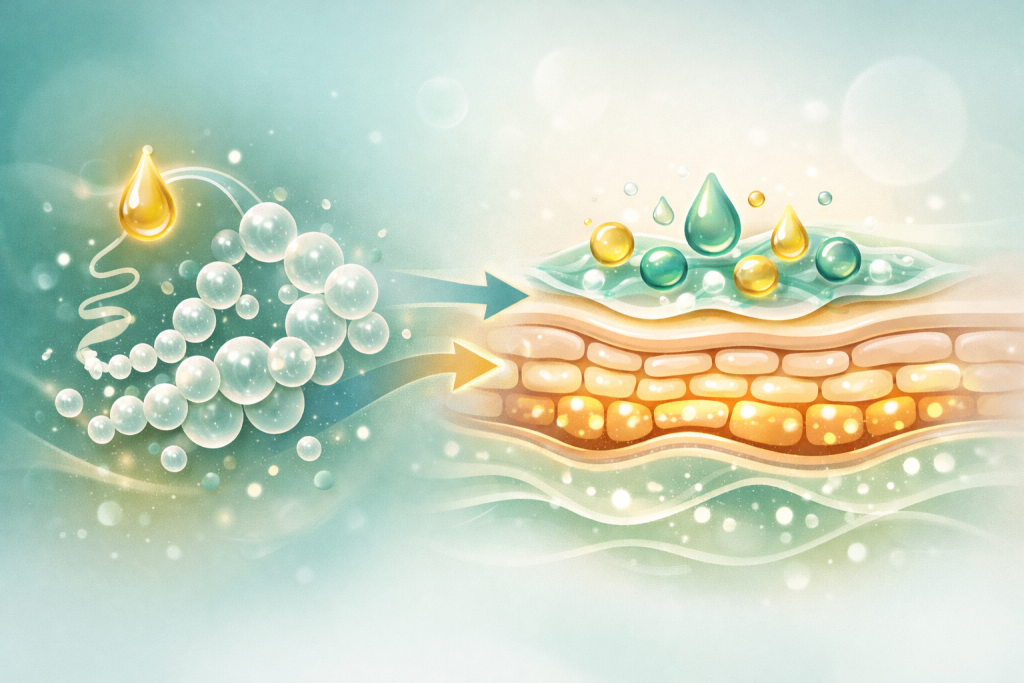
Its key feature is its amphiphilic structure as one part of the molecule is lipophilic (affinity with oils), and the other another is hydrophilic (affinity with water). This dual affinity allows it to create a bridge between water and fatty substances, promoting a fine and stable dispersion of fat-soluble active ingredients.
Did you know ?
Solubilizing agents such as PEG-40 Hydrogenated Castor Oil reduce the size of lipid microdroplets, thereby improving the stability and homogeneity of water-based formulas.
How does it work ?
Main Action
PEG-40 Hydrogenated Castor Oil acts as a solubilizer and nonionic surfactant. When an essential oil or lipophilic active ingredient is introduced into a water-based phase, it would naturally tend to float or separate. PEG-40 surrounds the oily particles and forms micellar structures that allow them to disperse evenly in water. This mechanism helps to prevent phase separation and improve solution transparency as well as to optimize the homogeneous distribution of assets.
Effects at the skin level
Le PEG-40 Hydrogenated Castor Oil does not directly interfere with cells, the skin, mild inflammation, or mitochondrial energy. It has rather an indirect impact as it improves the distribution of active ingredients and can contribute to a more uniform application on the skin, providing a more stable and consistent experience.
What it means in terms of longevity
From a conscious longevity perspective, the quality of a formulation is just as important as the choice of active ingredients. A stable and well-tolerated solubilizer can support skin balance by preventing local overconcentrations but also contribute to the stability of sensitive active ingredients while promoting regular and comfortable use.
Study box
2012 – Safety assessment (CIR Expert Panel)
Type of study: independent toxicological assessment review
Key result: PEG-40 Hydrogenated Castor Oil is considered safe at concentrations used in cosmetics, subject to purity and impurity control.
Benefits
1. Stability of formulations
From a scientific perspective, the stability of a formula depends on the balance between hydrophilic and lipophilic phases. PEG-40 Hydrogenated Castor Oil promotes the formation of stable micelles, limiting separation. This creates homogeneous serums, transparent mists, and greater consistency of use over time.
2. Improved distribution of Assets
Fine dispersion can improve the uniform distribution of an active ingredient across the skin surface. This does not alter the active ingredient itself, but can optimize its contact with the skin.
In practice, this results in a more uniform sensation upon application, a reduction in oily deposits, and a better sensory experience.
3. Contribution to overall tolerance
Nonionic surfactants are generally associated with better skin tolerance compared to other, more aggressive alternatives.
At standard concentrations, PEG-40 Hydrogenated Castor Oil is considered to be mildly irritating. It can support skin balance, particularly in water-based formulas containing essential oils.
Natural sources
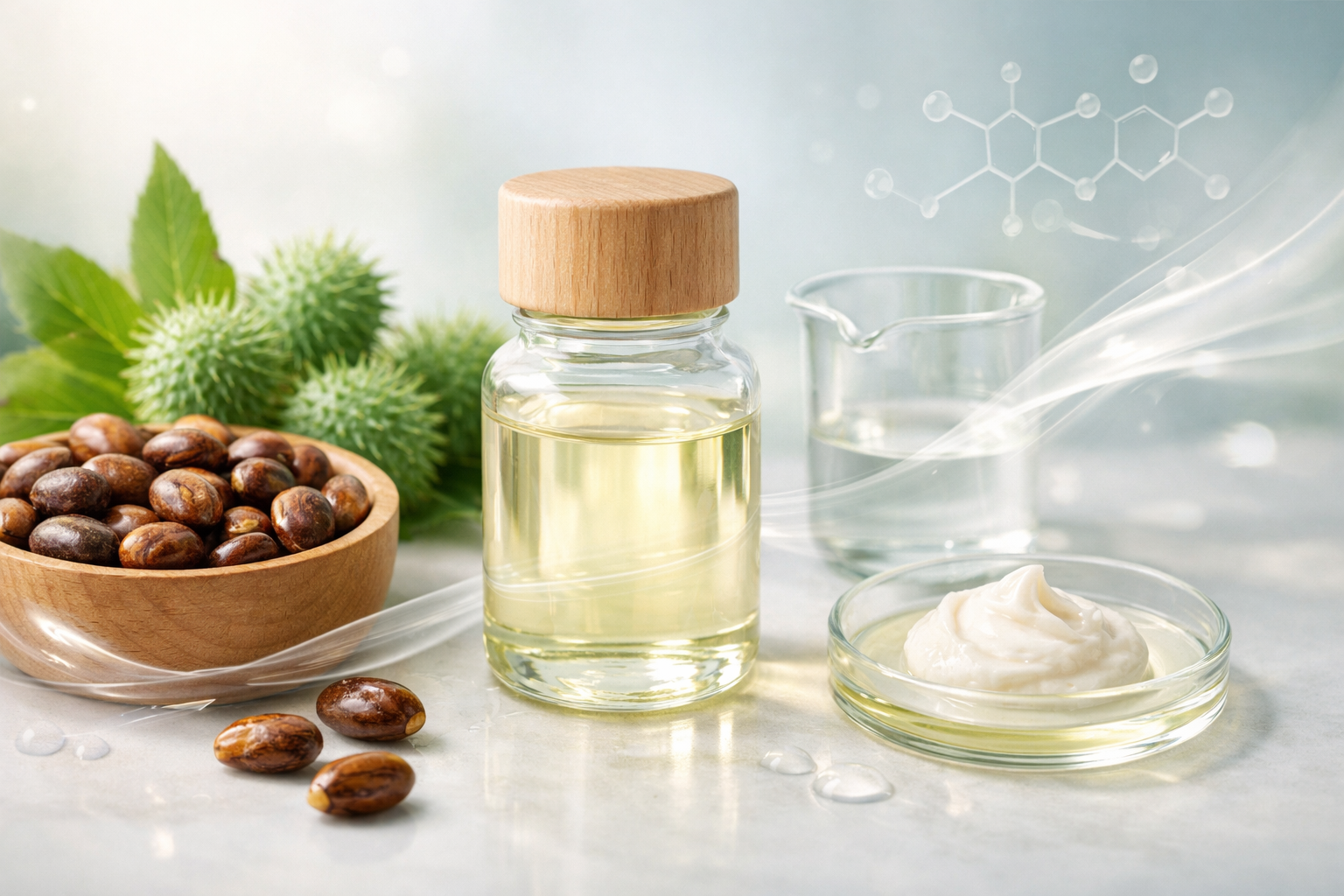
Le PEG-40 Hydrogenated Castor Oil can be found in castor oil (Ricinus communis), or derived from a hydrogenation process or controlled ethoxylation. It is not found in its natural state as such since it is a processed ingredient.
Dosage, forms & bioavailability
In cosmetics, concentrations vary between 0,5 % et 5 %, depending on the quantity of lipophilic assets to be solubilized. PEG-40 Hydrogenated Castor Oil is either available in liquid form or incorporated into solubilizing bases.
It is often combined with essential oils, fat-soluble vitamins, and mild co-emulsifiers. It is suitable for daily use in rinse-off or leave-on products, depending on the formulation. This is not a nutritionally active ingredient, which means that the concept of cellular bioavailability does not apply directly.
Security and precautions
The tolerance profile is generally considered good at recommended concentrations. As a side effect, irritation in highly reactive skin is possible. Ethylene oxide and 1,4-dioxane residues must be controlled, and the formula has to comply with European purity standards. As with any cosmetic product, a skin test may be recommended for those with sensitive skin.
How to integrate it into a longevity routine
When to use it
It is not used as a nutritional supplement.
It is found in skin care products such as serums, lotions, cleansers, and mists.
Possible combinations
PEG-40 Hydrogenated Castor Oil can be used along with essential oils, vitamin E, fat-soluble coenzymes, or plant extracts.
Example of a simple routine
In the morning, use a moisturizing mist containing a solubilized fat-soluble active ingredient.
In the evening, use a water-based serum enriched with antioxidants. The priority is consistency and regularity.
For whom is it particularly interesting ?
For individuals seeking light textures, transparent formulas, and people sensitive to overly oily textures.
A technical ingredient that promotes balanced skincare?
PEG-40 Hydrogenated Castor Oil is not a key ingredient for cellular vitality. It does not directly stimulate mitochondrial energy or modulate mild inflammation. However, its subtle role can contribute to the overall balance of a formula. In a sustainable approach to health, each component contributes to the overall consistency. A stable, homogeneous, and well-tolerated product encourages regular use, which can support continuity of care over time. Conscious longevity is not based solely on active ingredients, but also on the quality of the bases that carry them.
Sources
Cosmetic Ingredient Review Expert Panel (2012). Safety Assessment of PEGylated Castor Oils.
https://www.cir-safety.org/
European Commission – CosIng Database
https://ec.europa.eu/growth/tools-databases/cosing/
Rowe, R. C., Sheskey, P. J., & Quinn, M. E. (2009). Handbook of Pharmaceutical Excipients.