Developing strong and balanced legs requires careful attention to all muscle groups. Too often, fitness routines overemphasize the quadriceps at the expense of the posterior chain, which can lead to major structural imbalances. To fix this, the leg curl machine stands out as an essential tool for any lower-body workout routine. This targeted piece of equipment allows you to effectively isolate the knee flexors, offering a level of precision that compound movements cannot always replicate. Whether your goal is athletic performance, injury prevention, or purely aesthetic development, understanding how to use this tool is vital for maximizing every single repetition.
What is a leg curl machine and what muscles does it target?
The leg curl machine is an apparatus engineered to apply resistance during knee flexion. Unlike squats or lunges that engage multiple joints simultaneously, this machine isolates the movement to concentrate the entire workload on a specific area.
The primary objective of this exercise is strengthening the hamstrings. Located at the back of the thigh, this muscle group consists of three distinct muscles including the biceps femoris, the semitendinosus, and the semimembranosus. Together, they play a crucial role in flexing the knee and extending the hip. By stabilizing the rest of your body, the machine forces these muscles to support the entirety of the load, which promotes targeted hypertrophy and localized strength gains.
Beyond the hamstrings, the movement secondarily engages the gastrocnemius muscles, which form the upper part of the calves. To a lesser degree, the stabilizing muscles of the core and lower back come into play to maintain proper posture, especially on machine variations performed in a seated or lying position.
How to adjust the machine properly to prevent injuries?
Proper alignment is the foundation of a safe and effective workout. Before you even select your weight, it is indispensable to spend a few moments adjusting the different components of the machine to fit your unique anatomy.
The first adjustment involves the pivot point of the machine, which must be perfectly aligned with the rotational axis of your knees. If the seat or the backrest is poorly positioned, your knees will experience unwanted shearing forces; this reduces exercise efficiency and significantly increases the risk of joint pain. Take the time to move the backrest forward or backward so that your joints align naturally with the mechanical axis.
The second parameter to consider is the position of the roller pad. This should rest just below your calves, precisely above the Achilles tendon. If it is placed too high on the calves, your leverage is reduced and the movement loses its range of motion. If it sits too low against the heels, it risks slipping during the effort and causing constant discomfort. The tension must remain smooth, steady, and comfortable throughout the entire flexion.
What are the different types of leg curl machines and how do you use them?
Gyms typically offer several variations of this equipment, each providing a slightly different angle of work to challenge the posterior chain in unique ways.
The lying version, often referred to as the prone leg curl, positions the user face down on a bench. This setup allows for full hip extension, which heavily stretches the hamstrings at the start of the movement. To execute it correctly, lie flat on the pad, grasp the handles to stabilize your upper body, and pull the roller toward your glutes by contracting the back of your thighs. Be careful not to lift your pelvis off the bench during the peak contraction, which is a frequent mistake that shifts the load onto the lower back.
The seated version is particularly popular because it offers excellent stability. When sitting, your hips are flexed at a ninety-degree angle, placing the hamstrings in a different initial stretch position. After securing the lap pad tightly against your thighs to lock your body in place, press the lower roller downward and backward. This variation is highly recommended for individuals prone to lower back tension, as the lumbar spine is fully supported by the backrest.
Finally, the standing version allows for unilateral training, meaning you work one leg at a time. This approach is ideal for correcting strength asymmetries between your left and right legs. The underlying principle remains identical; your body stays upright facing the machine, and a single leg performs the backward flexion.
Why you should include the leg curl machine in your workout routine?
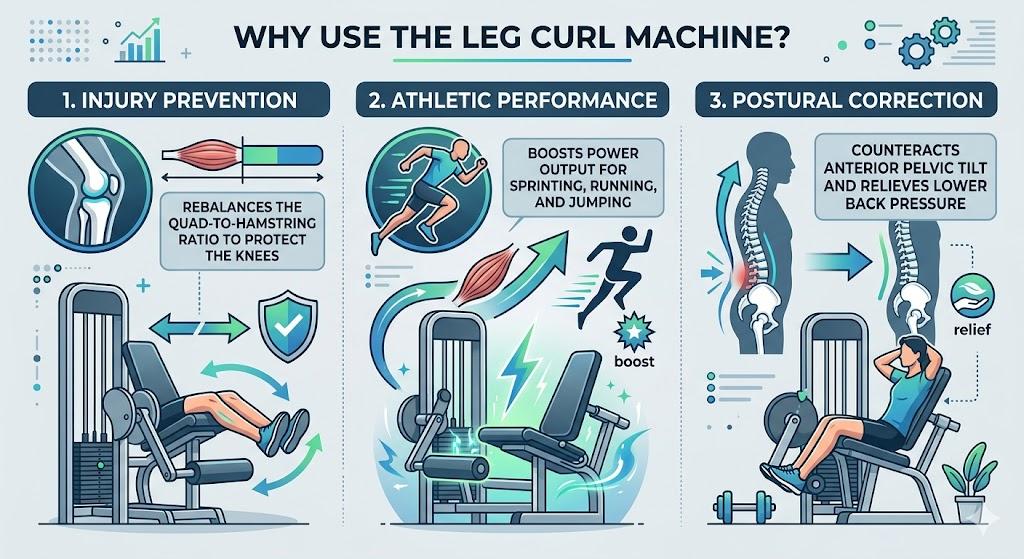
Integrating this exercise into your routine provides numerous advantages that extend far beyond simple aesthetics. The benefits can be felt both in daily life and across various sporting activities.
The primary advantage lies in injury prevention, particularly regarding knee health. In everyday life and during traditional weightlifting sessions, the quadriceps on the front of the thigh tend to become significantly stronger than the hamstrings. This strength imbalance can leave the anterior cruciate ligament vulnerable. By strengthening the back of the leg using the machine, you restore a healthy balance of forces around the knee joint, which stabilizes the patella and lowers the risk of strains or tendinitis.
Furthermore, powerful hamstrings directly enhance global athletic performance. These muscles act as the main drivers of propulsion during running, sprinting, and jumping. They also play a critical role as brakes during sudden decelerations or sharp changes of direction. Working on an isolation machine allows you to build the pure strength necessary to gain explosiveness on the field.
Lastly, this machine helps improve your overall posture. Weak or tight posterior muscles can cause the pelvis to tilt forward, a structural issue known as anterior pelvic tilt that accentuates the arch of the lower back and can lead to chronic lumbar pain. Regular strengthening helps keep the pelvis in a neutral, healthy position.
Common mistakes to avoid during the exercise
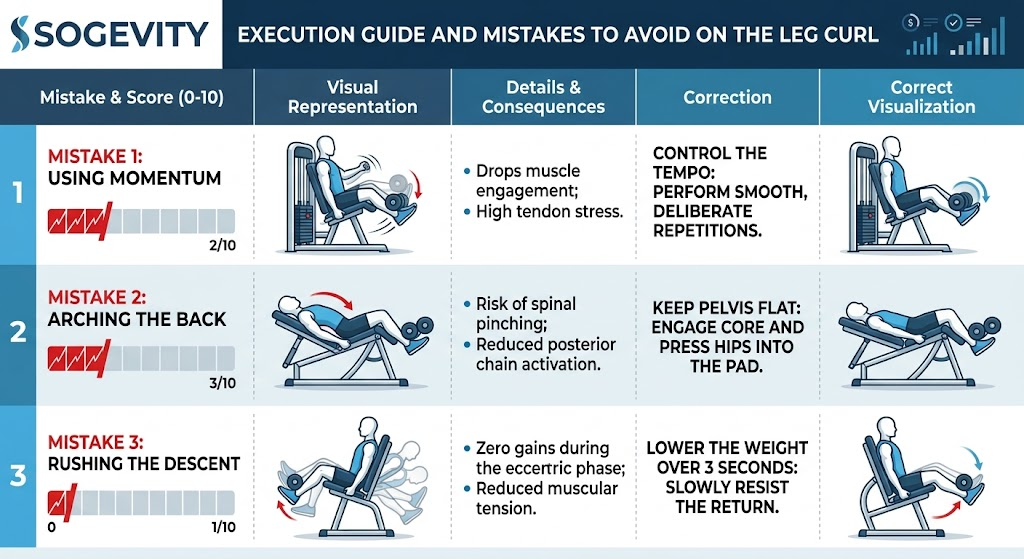
To get the most out of your training sessions and protect your physical well-being, several classic pitfalls must be avoided when using this apparatus.
The first mistake is relying on momentum to lift the load. Overloading the machine often forces people to swing or jerk violently at the start of the rep just to get the weight moving. Not only does this momentum decrease the actual work done by the hamstrings, but it also exposes your tendons to sudden, dangerous forces. The movement must be controlled from start to finish, featuring a smooth upward phase and a deliberate, slowed-down descent.
Another widespread flaw is excessive movement of the pelvis. During the phase of maximum effort, it is tempting to arch the lower back or lift your hips to leverage your body weight. This reflex compensates for a lack of thigh strength by recruiting the lower back, which can cause vertebral pinching. To counter this, actively contract your abdominals and imagine pushing your hips firmly into the seat or bench throughout the entire set.
Finally, neglecting the eccentric phase, which is the return to the starting position, severely limits your progress. Many lifters completely release all tension the moment the flexion is complete, letting the weight plates slam back down. Yet, it is during this controlled lowering phase that muscle fibers experience the microscopic tears necessary for building both strength and volume. Take at least two to three seconds to lower the weight.
Frequently asked questions
Can you replace leg curls with squats?
While the squat is an exceptional exercise for the lower body, it primarily targets the quadriceps and the glutes. The hamstrings only work to a limited degree during a squat because their length barely changes throughout the movement. Therefore, the machine remains essential for isolating and specifically developing the back of the thighs.
How often should you train your hamstrings?
For optimal results, a frequency of two sessions per week spaced at least forty-eight hours apart is ideal. This schedule allows muscle tissues adequate time to recover while maintaining a sufficient training volume to stimulate ongoing progression.
Is it normal to experience cramping in the back of the thigh?
Yes, the hamstrings are highly prone to cramping, particularly when worked in complete isolation or if they lack endurance. If this occurs, reduce the weight slightly, increase your hydration, and take the time to gently stretch the area between your sets.
Continue exploring longevity
Explore this longevity topic