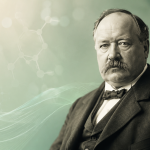
Isaac Newton was an English physicist, mathematician, and natural philosopher, widely regarded as one of the founders of modern science. He is best known for his work on gravitation, calculus, and optics. Although his research was not directly focused on human longevity, his work profoundly shaped the scientific method that now makes progress in aging biology and precision medicine possible.
Isaac Newton represents a figure who clearly transcended his time. In the late seventeenth century, he was not simply trying to explain isolated phenomena but to understand the fundamental laws governing the universe. His approach was methodical, radically rigorous, and intellectually ambitious. He became one of the first scientists to believe that nature could be described through universal laws. His famous statement, “If I have seen further it is by standing on the shoulders of giants,” reflects an intellectual posture based on the continuity of knowledge, an idea that remains central to major scientific revolutions today, particularly in fields related to health and longevity.
The journey
Isaac Newton’s path was far from linear. Born in 1643 in England, in a society still deeply shaped by religious traditions, he studied at Cambridge, where he quickly developed a strong interest in mathematics and natural philosophy. During the years when the university was closed because of the Great Plague of London, he carried out some of his most important discoveries. This period of isolation became a defining moment. Newton developed the foundations of differential calculus, formulated his theory of gravitation, and conducted major experiments on light. Recognition, however, did not come immediately. He published very little, often doubted his own work, and remained a relatively discreet figure for years. It was only after the publication of the Principia Mathematica in 1687 that he gained significant scientific visibility and gradually became a central figure across Europe.
His vision and scientific legacy
While Newton never addressed longevity in the modern sense, his vision of science was built on an idea that still influences current research: understanding fundamental laws makes it possible to transform the world. In the Principia, he famously wrote, “I do not know what I may appear to the world, but to myself I seem to have been only like a boy playing on the seashore.” This statement reflects a scientific mindset defined by humility and continuous exploration. Today, longevity researchers follow a similar logic: they aim to understand the fundamental mechanisms of aging before attempting to modify them. Another well-known statement often attributed to Newton, “Truth is ever to be found in simplicity, and not in the multiplicity and confusion of things,” illustrates a scientific approach that continues to influence modern disciplines such as molecular biology and predictive medicine. The idea that simple mechanisms can explain complex phenomena remains central to contemporary research on cellular aging.
Influence and impact
Isaac Newton’s influence goes far beyond the field of physics. By establishing a scientific method based on observation, measurement, and mathematical modeling, he helped create the intellectual framework in which today’s major innovations in health are developing. Modern technologies used to study aging, including medical imaging, biological modeling, and biophysics, are indirectly rooted in this way of thinking about science. Newton still generates debate within the scientific world. Some see him primarily as a mathematical genius, while others emphasize his role in building an entirely new way of understanding nature. What remains certain is that his influence is not only historical. It continues to shape how researchers approach the major scientific questions of our time, including those related to health and longevity.
A scientific legacy that transcends centuries
Isaac Newton cannot be considered a longevity figure in the modern sense. However, his influence on science remains fundamental. By transforming how scientists observe the world and formulate laws, he helped create the intellectual foundations that make today’s medical breakthroughs possible. His legacy is not limited to his discoveries but lies in the method he left behind. And that method continues to open new perspectives far beyond his own time.
Continue exploring longevity
Explore this longevity topic