Key information
- mild surfactant present in products to cleanse the skin.
- captures impurities and sebum thanks to its amphiphilic structure.
- helps preserve the skin’s balance over time.
- suitable for sensitive skin or reactive scalps
- studies show lower irritation potential than Sodium Lauryl Sulfate
At a time when long-term skin health is a key concern, choosing the right cleansing agents is essential. Cleansing does not mean stripping. The skin is a living, dynamic organ that relies on a delicate balance between hydration, microbiota, and the lipid barrier.
Disodium Laureth Sulfosuccinate is part of a gentler approach to cleansing designed to be more respectful of skin harmony. This ingredient is valued for its skin tolerance and non-aggressive profile. In this article, we will explain how it works in order to allow more informed choices when creating a routine focused on cellular vitality and long-lasting skin health.
What is it ?
Disodium Laureth Sulfosuccinate is a mild anionic surfactant used in skin and hair cleansing products.
Origin
It is the result of a reaction between fatty acid derivatives (often plant-based, such as coconut) and sulfosuccinate compounds. Its chemical structure is larger than that of conventional sulfates.
Biological and cosmetic role
Biologically speaking, it helps to emulsify fatty substances and solubilize sebum, which facilitates the rinsing of impurities.
Its key feature resides in its larger molecular size, which limits its penetration into the stratum corneum. This helps reduce irritation compared to smaller and more penetrating surfactants.
Did you know?
Skin tolerance studies indicate that sulfosuccinates have significantly lower irritation potential than Sodium Lauryl Sulfate in tests on human skin.
How does it work ?
Main action
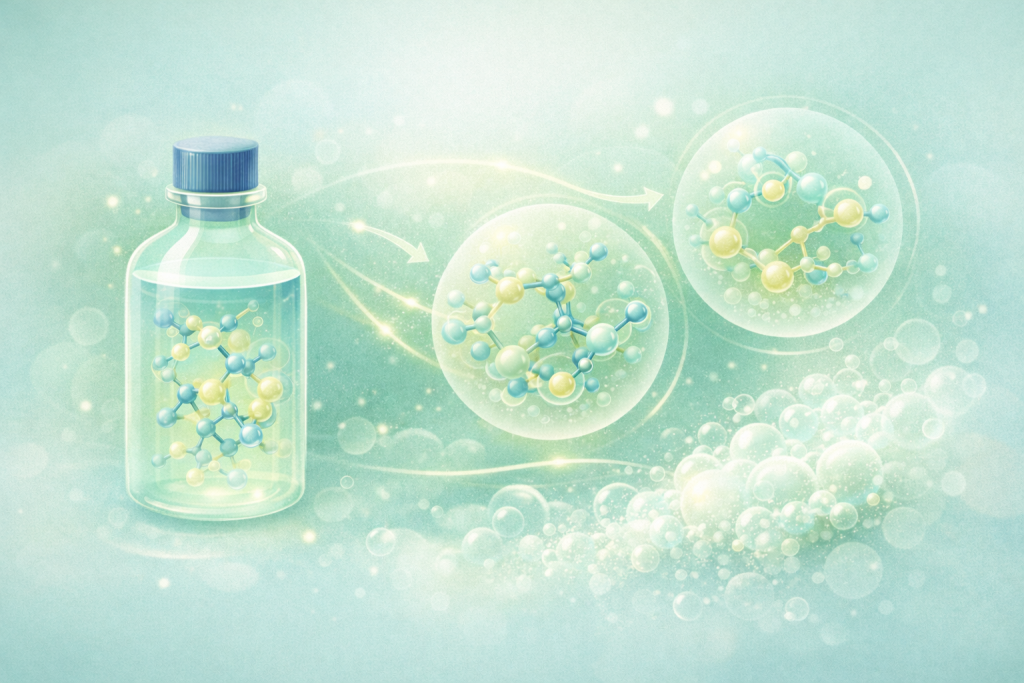
Disodium Laureth Sulfosuccinate acts mostly through an amphiphilic mechanism, as the hydrophilic part attracts water and the lipophilic part captures fats. This dual affinity allows impurities to be surrounded in the form of micelles, facilitating their removal during rinsing, while better respecting the skin’s structural lipids.
Effects on the skin
Skin
It helps maintain the integrity of the skin barrier by limiting excessive lipid loss.
Scalp
It supports effective cleansing while reducing the risk of irritation, which is beneficial for sensitive scalps.
Mild inflammation
Gentler cleansing helps limit mild inflammatory reactions associated with harsher surfactants.
What it means in terms of longevity
Preserving the skin barrier is part of a strategy for cellular longevity. Healthy skin maintains more easily its hydration, its microbiota, as well as its local immune balance more easily. A mild surfactant supports the natural functions of the skin over time.
Study box
2014 – Comparative in vitro and in vivo study
Study type: comparative skin irritation study
Link : https://pubmed.ncbi.nlm.nih.gov/ (comparative research on SLS vs. sulfosuccinate)
Key finding: sulfosuccinates showed lower irritation potential than sodium lauryl sulfate in controlled exposure tests.
Benefits
Support for the skin barrier
Aggressive surfactants can alter the intercellular lipids which are essential for the cohesion of the stratum corneum. Disodium Laureth Sulfosuccinate limits this disruption.
This translates into a sensation of less dry skin after washing, especially for skin prone to tightness.
Effective but measured cleansing
It effectively removes sebum and dirt without generating harsh foam.
It helps maintain a balance between cleanliness and respect for the skin’s physiology.
Suitable for sensitive skin
Its relatively high tolerance makes it a popular ingredient in formulas designed for children or reactive skin.
For people seeking to preserve their skin capital with a focus on long-term health, this may be a wise choice.
Natural Sources
Disodium Laureth Sulfosuccinate is not naturally present in nutrients. It is synthesized from coconut fatty acid derivatives, ethoxylated alcohol, and sulfosuccinic acid.
Dosage, forms & bioavailability
Dosages observés
In cosmetic formulas, it is generally used at concentrations between 5% and 20%, depending on the type of product (shampoo, shower gel, facial cleanser).
It is available concentrated as a liquid solution or as pre-formulated cleaning bases.
It is often combined with amphoteric surfactants (such as betaine), moisturizing agents (glycerin, panthenol), or biomimetic lipids. These combinations can enhance the overall softness of the formula.
Length of use
Suitable for daily use depending on individual sensitivity.
Safety & precautions
Disodium Laureth Sulfosuccinate is considered to have a high tolerance profile at standard concentrations. Side effects are possible; these can be mild irritation with prolonged exposure or dryness if the overall formula is unbalanced. Avoid contact with the eyes and choose well-balanced, comprehensive formulas. A dermatologist’s opinion may be relevant in cases of pathological or hypersensitive skin.
How to integrate it into a longevity routine
When to use it
It can be used on a daily basis on the face or scalp. It is also possible to use it after exposure to pollution or exercise.
Possible combinations
Disodium laureth sulfosuccinate can be used along with a moisturizing serum or a cream rich in physiological lipids. It is also possible to use it with active ingredients that support the skin barrier (ceramides).
Example of a simple routine
- Gentle cleansing with Disodium Laureth Sulfosuccinate
- Moisturizing serum
- Protective cream
- Sunscreen during the day
For whom is it particularly interesting
For sensitive reactive skin or people looking for a minimalist and gentle routine.
A gentler cleansing routine for long-lasting skin balance?
Disodium Laureth Sulfosuccinate illustrates a shift towards more conscious formulations. It helps preserve the integrity of the skin barrier, which is fundamental to cellular vitality.
From a longevity perspective, every action counts. Gentle cleansing, limiting unnecessary inflammation, and supporting natural balance are all choices that contribute to lasting skin health.
Adopting more respectful surfactants could be a simple way to support the skin over time, with serenity and consistency.
Sources
CIR Expert Panel (2010). Final report on the safety assessment of sulfosuccinates as used in cosmetics. International Journal of Toxicology.
Ananthapadmanabhan, K. P., et al. (2004). Mild cleansing formulations and their effect on skin barrier function. Journal of the American Academy of Dermatology.
Loden, M. (2003). The clinical benefit of moisturizers. Journal of the European Academy of Dermatology and Venereology.