Key information
- Amphoteric surfactant present in coconut oil, used for cleansing
- It may help preserve the skin barrier thanks to its low aggressiveness
- Supports the balance of the skin and scalp by limiting irritation
- Useful in a skin care routine that respects skin cells
- Dermatological studies show that it is generally better tolerated than some conventional anionic surfactants
In a world where longevity is no longer solely dependent on diet but also on the quality of daily care, certain ingredients like Cocamidopropyl Betaine deserve special attention. Found in many skin and hair cleansers, it is often selected for its mildness and ability to support skin balance. Understanding its role allows a more conscious approach to the products we use every day in skincare routines. Preserving the skin barrier, limiting mild inflammation, and respecting the skin’s ecosystem also contribute to a sustainable vision of vitality.
What is it ?
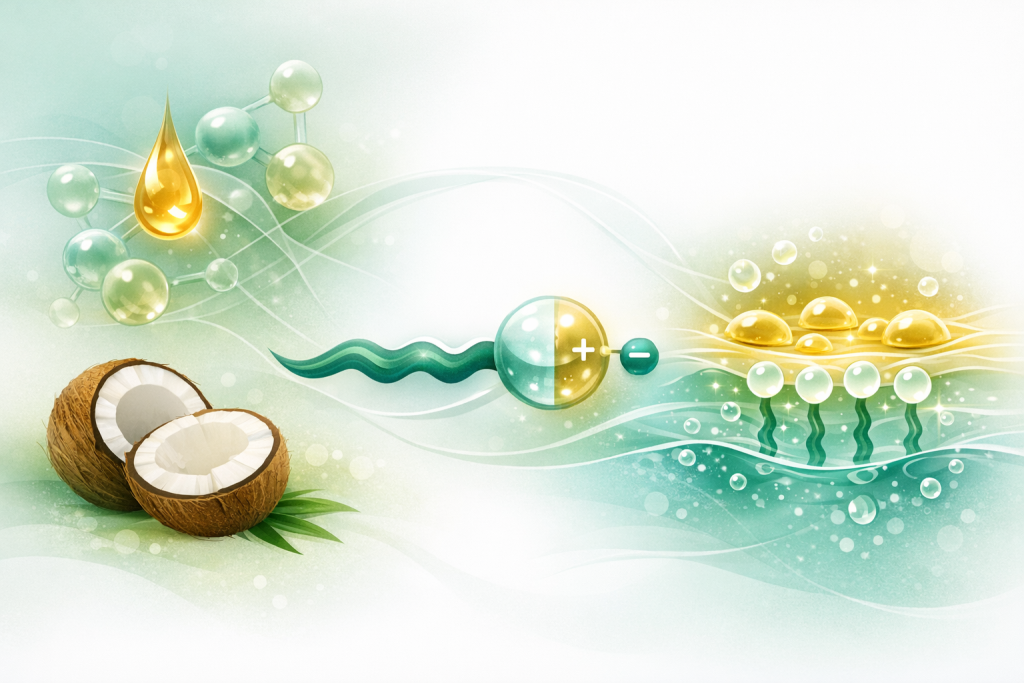
Cocamidopropyl Betaine is an amphoteric surfactant derived from fatty acids obtained from coconut oil. It is chemically modified to obtain a stable and functional molecule. It has a cosmetic role as it allows water and oils to mix, facilitating the removal of impurities, sebum, and environmental particles. This ingredient is valued for its amphoteric structure, namely because it can behave either as a cationic or an anionic agent depending on the pH. This property makes it more compatible with the skin compared to other aggressive surfactants.
Did you know?
Dermatological studies suggest that Cocamidopropyl Betaine can reduce the irritant potential of formulas containing more powerful surfactants when used in combination.
How does it work ?
Main action
Cocamidopropyl Betaine acts by reducing the surface tension between water and lipids. It surrounds fatty particles to form micelles, allowing them to be eliminated during rinsing. This cleansing action can be performed without excessively altering the essential lipids of the skin barrier when the formula is balanced.
Effects on the skin
In the skin, as well as in the scalp, this ingredient may limit dehydration associated with cleansing, helps maintain the integrity of surface cells, and reduce feelings of tightness. In the same way, it supports a more stable skin environment. A rough cleansing can weaken cell junctions and promote mild chronic inflammation. Conversely, a moderate surfactant can support cell renewal without disrupting physiological balance.
What does it mean in terms of longevity
From a sustainable health perspective, preserving the skin barrier means supporting cellular balance and protecting the mitochondria of surface cells from indirect oxidative stress but also limiting repeated inflammatory signals. An ingredient like Cocamidopropyl Betaine can therefore be part of a skincare approach that is respectful of skin vitality over time.
Study Box
2011 – Comparative in vitro and in vivo study
(Link: https://pubmed.ncbi.nlm.nih.gov/21635812/)
Cocamidopropyl Betaine showed lower irritation potential than certain anionic surfactants used alone.
Benefits
Cleansing that respects the skin barrier
Surfactants that are too powerful can excessively extract surface lipids. Thanks to Cocamidopropyl Betaine’s amphoteric structure, it can contribute to more modulated cleaning. In practice this results in a more comfortable skin after washing and a scalp less prone to dryness.
Improved formula tolerance
It is frequently used with other cleaning agents to reduce their potential aggressiveness. In practice, this allows the formulation of skincare products better suited for sensitive or reactive skin (showergels, shampoos).
Supporting the balance of the skin microbiota
A gentle cleaning can help preserve the skin’s microbial ecosystem, which is essential for natural body defense.
By limiting the repeated balance disruption of the skin, it promotes a more stable skin environment associated with improved long-term vitality.
Natural sources
Cocamidopropyl Betaine is synthesized from fatty acids from coconut oil and sometimes palm kernel oil. It is also a derivative of dimethylaminopropylamine. Cocamidopropyl Betaine is then purified for cosmetic use.
Dosage, forms & bioavailability
In cosmetic formulas, it is generally used between 3 % et 10 % in terms of concentration depending on the product type. It is available in liquid form and directly integrated to cleansing gels, shampoos, cleansing foams, and products for sensitive skin. There is no significant systemic bioavailability, as its action remains superficial. Its efficiency depends on the gorilla and on the pH of the product. It can be used in combination with: glycerin, panthenol, and superfatting agents.
Safety & precations
Cocamidopropyl Betaine is generally well tolerated when it is properly purified. However, traces of impurities resulting from the manufacturing process may cause reactions in certain sensitive individuals. Rare cases of contact dermatitis have been reported. It is recommended to choose dermatologically tested products and perform a skin test if you have very reactive skin. Individuals with a history of allergies should consult a healthcare professional. The quality of manufacturing remains a determining factor.
How to incorporate it into a longevity routine
When to use it
During daily cleansing, morning and evening, as part of a routine suited to your skin type.
Possible combinations
Cocamidopropyl Betaine can be used along with moisturizing agents, topical antioxidants, and biomimetic lipids.
Example of a simple routine
- Gentle cleanser containing Cocamidopropyl Betaine
- Antioxidant serum
- Cream that strengthens the skin barrier
For whom is it particularly interesting
Individuals with sensitive skin, fragile scalps, or people seeking gentle cleansing as part of a sustainable health approach.
Can gentle cleansing support skin vitality over time?
Taking care of the skin is not just about aesthetics. Every gesture influences the balance of the cells and the quality of the skin barrier, as well as the level of inflammation. Cocamidopropyl Betaine, with its moderate profile, can help preserve this fragile balance. It does not transform the skin, but can support its natural functioning with greater serenity. In a conscious approach to longevity, choosing respectful ingredients contributes to more sustainable vitality—where gentleness becomes a real lever for balance.
Sources
Ananthapadmanabhan, K. P., et al. (2011). Mild cleansing without barrier damage. International Journal of Cosmetic Science.
https://pubmed.ncbi.nlm.nih.gov/21635812/
Fowler, J. F. (1999). Cocamidopropyl betaine allergy. Dermatitis.Loden, M. (2003). Role of surfactants in skin barrier function. Clinics in Dermatology.