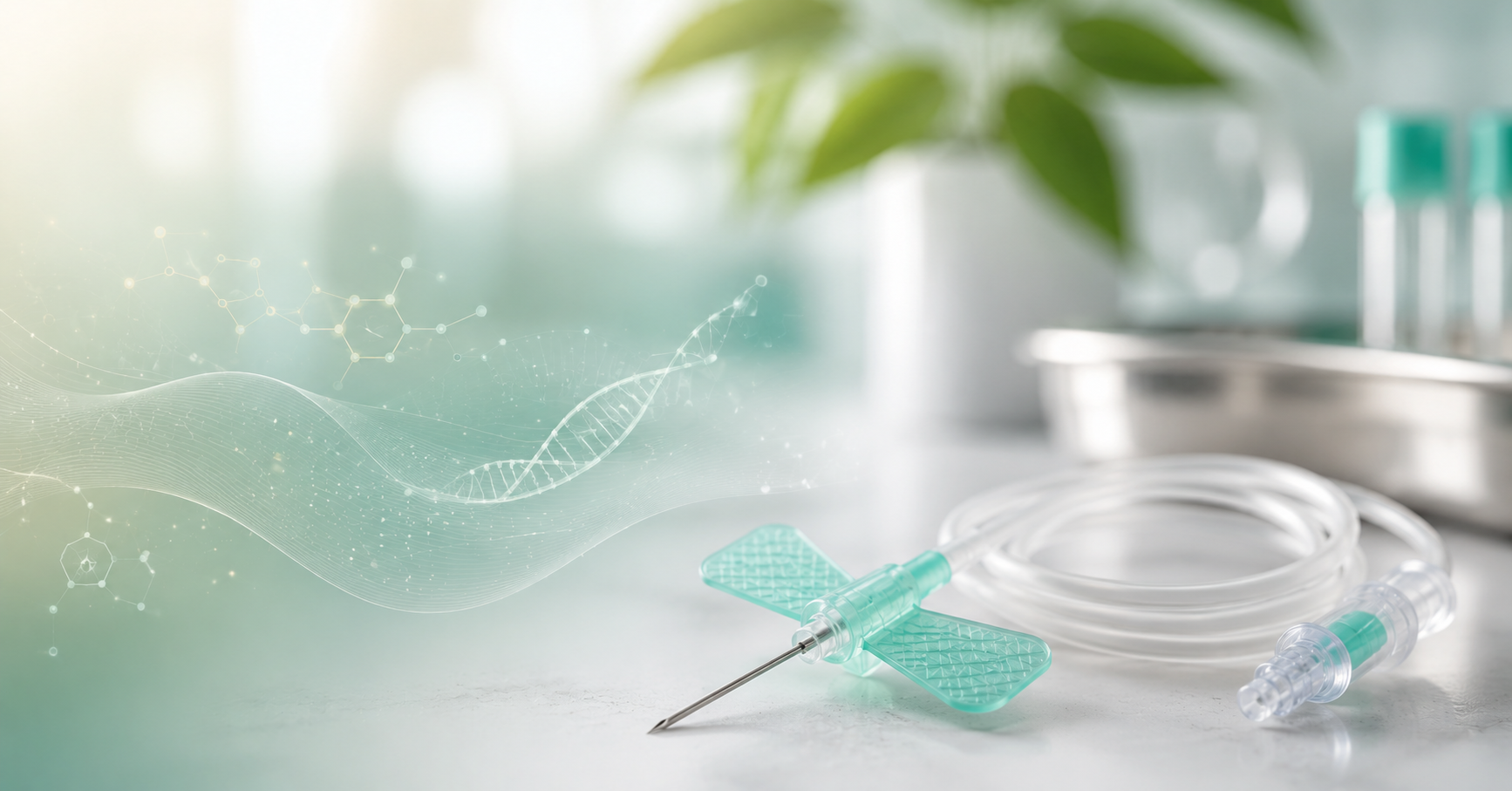
The butterfly needle (also called a winged infusion set) is a blood collection device designed for situations where veins are difficult to access or particularly fragile. It is commonly used in laboratories, hospitals, and pediatric or geriatric care settings.
In practice, healthcare professionals don’t use it by default. They choose it when a standard straight needle is likely to fail or require multiple attempts. In those cases, the butterfly needle becomes a precision tool rather than routine equipment.
What is a butterfly needle in practice?
A butterfly needle is a thin needle connected to two flexible wings and a short tubing system. The wings allow the clinician to stabilize the needle between their fingers during venipuncture, which significantly improves control compared to a standard straight needle.
In real clinical use, it is mainly used for:
- difficult blood draws (small, mobile, or hard-to-see veins)
- anxious or highly sensitive patients
- low-volume blood samples
- short or highly controlled infusions
Real-world example in a laboratory
A patient arrives dehydrated after severe gastroenteritis. Their veins are collapsed and difficult to access. With a standard needle, multiple attempts may be required. A butterfly needle allows fine angle adjustments and often makes it possible to complete the blood draw in a single attempt.
Is a butterfly needle less painful?
The short answer: often yes, but not always.
Pain during a blood draw depends less on the type of needle and more on three factors: vein quality, practitioner skill, and the number of attempts required.
Why it can be less painful
A butterfly needle is often perceived as less painful in specific situations because:
- the needle is very fine (often thinner than standard phlebotomy needles)
- insertion angle is more controlled thanks to the wings
- it reduces repeat attempts by improving accuracy
Real-world example
In a 6-year-old child with difficult veins, a standard needle may require two or three attempts. With a butterfly needle, a single well-placed insertion is often enough. In that case, overall pain is clearly reduced.
When the difference disappears
If veins are easily accessible, an experienced clinician can achieve similar comfort with a standard needle. In such cases, the advantage of a butterfly needle becomes minimal.
What are the disadvantages of using a butterfly needle?
The butterfly needle is not a universal solution. In clinical practice, it is used selectively because it has several technical limitations.
1. Risk of clotting in the tubing
The small tubing between the needle and collection system slightly slows blood flow. Under certain conditions (slow draw or fragile veins), this can increase the risk of partial clot formation.
👉 Real example: during a slow blood draw in a hypotensive patient, blood may begin to clot inside the tubing before the tubes are fully filled.
2. Not suitable for long infusions
Butterfly needles are designed for short procedures. For long-term intravenous therapy (such as prolonged antibiotics or hydration), they are not appropriate.
Clinicians instead use peripheral IV cannulas designed to remain in place for hours or days.
3. Higher cost than standard needles
A butterfly needle is more expensive than a standard blood draw needle. When used at scale in laboratories, this cost difference becomes significant.
For this reason, it is reserved for cases where it provides a clear clinical benefit.
4. More technical to handle
Compared to a straight needle, a butterfly needle requires:
- precise insertion angle control
- careful tubing management
- stable hand positioning throughout the draw
👉 Real example: a nursing student may perform a standard venipuncture more quickly than a butterfly needle procedure if they are not yet comfortable managing the flexible tubing.
5. Risk of movement if not stabilized
If the wings are not properly held or secured, the needle may shift slightly during blood collection. This can increase discomfort or lead to small hematomas.
When do clinicians actually choose a butterfly needle?
In real-world practice, the decision is highly practical.
Difficult or fragile veins
- elderly patients
- children
- dehydrated individuals
- chemotherapy patients
Low-volume or delicate blood sampling
- small laboratory tests
- rapid diagnostic panels
- cases requiring a single successful attempt
Patient comfort and anxiety
For anxious patients, reducing the number of needle attempts is often more important than the type of device used.
Butterfly needle vs standard needle: the real difference
The difference is not simply “pain vs no pain.” It is about strategy.
- standard needle → fast and efficient for easy veins
- butterfly needle → precise and reliable for difficult access
👉 In practice, skilled clinicians choose the tool that maximizes first-attempt success.
Conclusion
A butterfly needle is not always less painful, but it becomes clearly advantageous when veins are difficult or when a first-attempt success is critical.
Its main drawbacks—cost, technical handling, and limited use for long infusions—explain why it is not used universally.
However, in appropriate situations, it improves both patient comfort and procedural accuracy, making it a valuable tool in modern phlebotomy practice.
Continue exploring longevity
Explore this longevity topic