Key takeaways
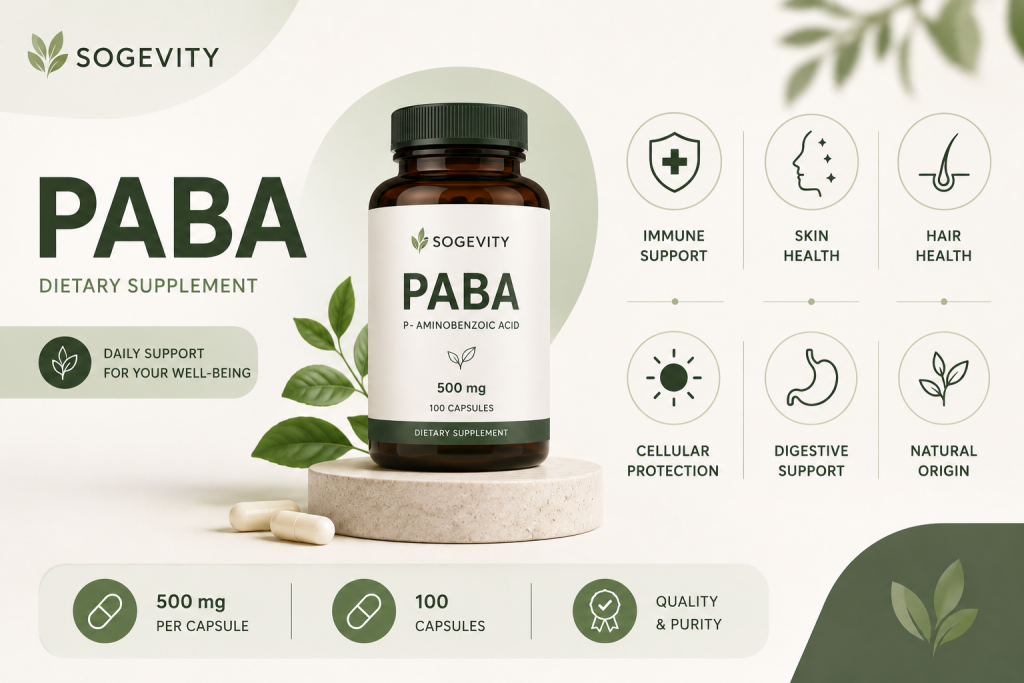
- paba (para-aminobenzoic acid) is a naturally occurring compound found in certain foods and produced by some gut bacteria.
- once considered part of the vitamin b family, it is no longer classified as an essential vitamin for humans.
- researchers have explored its potential role in skin health, connective tissue function, and hair pigmentation.
- unlike many trendy supplements, paba attracts attention because of the biological questions it raises rather than the promises it makes.
- some early studies suggested a possible relationship between paba and premature graying, although current evidence remains limited.
- paba was once widely used in sunscreen formulations before newer UV filters gradually replaced it.
- growing interest in paba reflects a broader shift in wellness: from correcting deficiencies to supporting long-term resilience.
There is a good chance you have never heard of paba.
And honestly, that would not be surprising.
In a wellness industry that constantly moves from one trend to the next, some compounds seem destined to remain in the shadows. They never become social media sensations. They are rarely featured in longevity podcasts. They do not inspire endless discussions about biohacking or optimization.
Paba is one of those compounds. Yet every few years, it quietly finds its way back into scientific conversations.
Not because researchers have discovered some spectacular new benefit. Not because it suddenly promises to reverse aging. Quite the opposite. Scientists remain interested in paba because it refuses to fit neatly into a category.
It is not quite a vitamin. Not quite a nutrient. Not quite a pharmaceutical compound either. For decades, it has occupied a strange middle ground, one that raises more questions than answers. And perhaps that is precisely what makes its story interesting. Because the history of paba mirrors a larger shift taking place in health and longevity research. For a long time, nutrition was primarily concerned with survival. The question was simple: what does the body absolutely need in order to function?
Today, researchers are often asking something different.
What helps the body remain resilient?
What supports adaptation?
What allows biological systems to keep doing their job year after year?
Paba sits quietly within that conversation. It may never become one of the most famous supplements on the market. But its story offers a fascinating glimpse into how our understanding of health continues to evolve.
What is it?
Paba stands for para-aminobenzoic acid.
At first glance, the name is hardly inspiring.
In fact, it sounds more like something you might encounter in a university chemistry textbook than on the shelf of a wellness store.
Yet behind this technical name lies a surprisingly interesting history.
For much of the twentieth century, paba was considered part of the vitamin b complex. It was often referred to as vitamin bx, a label that seemed perfectly reasonable based on the scientific knowledge available at the time.
Then the picture became more complicated.
As researchers learned more about human nutrition, they realized that paba did not behave like an essential vitamin. Humans do not require a specific dietary intake of paba in order to prevent a deficiency disease.
That discovery changed its classification. But it did not end scientific interest. If anything, it created a new set of questions. Because biology rarely operates in black and white. Some compounds are essential. Some are irrelevant. And then there is a large group of compounds that fall somewhere in between. Paba belongs to that group.
It naturally occurs in a variety of foods. Certain bacteria can also produce it. Researchers have studied its involvement in several biological processes, including those related to folate metabolism in microorganisms.
Over time, scientists also became interested in its possible relationship with skin health, connective tissues, pigmentation, and cellular protection. None of these areas provides a complete explanation for why paba matters.
Together, however, they suggest that this small compound may be participating in a much larger biological story.
Why is paba attracting scientific interest?
The answer says as much about modern science as it does about paba itself. For years, researchers approached health through a relatively straightforward lens. Find a deficiency. Correct it. Problem solved.
That approach transformed public health and remains enormously important today. But as populations live longer, new questions inevitably emerge.
What happens after basic nutritional needs have been met?
What determines whether someone remains vibrant and active at seventy, eighty, or ninety years old?
Why do some individuals seem to maintain their resilience remarkably well while others experience a more rapid decline?
These questions have pushed researchers toward a deeper exploration of the biological processes associated with aging. And this is where compounds like paba begin to attract attention.
Not because they are miracle solutions. Not because they offer guaranteed outcomes.
But because they may help scientists better understand the systems that allow the body to adapt to stress over time. The concept of resilience appears repeatedly throughout longevity research. Resilience is what allows the body to recover from challenges. It is what enables tissues to repair themselves. It is what helps maintain balance despite constant environmental and metabolic pressures.
And make no mistake: those pressures are everywhere. A poor night’s sleep. A stressful week at work. Too much sun exposure.
Environmental pollution. Intense exercise. Even the simple act of producing energy inside our cells. Life itself is demanding. The remarkable thing is not that we experience stress. The remarkable thing is that our bodies spend every day adapting to it.
Researchers continue to explore whether compounds such as paba may play small but meaningful roles within these adaptive systems. The science is far from settled.
Yet the questions themselves have become increasingly relevant.
Did you know?
Long before modern sunscreen ingredients became widely available, paba was one of the most commonly used ultraviolet-absorbing compounds in sun protection products.
For decades, it helped protect skin from UVB radiation and played an important role in the early evolution of sunscreen technology.
Although it has largely disappeared from modern formulations, this historical connection to skin protection remains one of the reasons scientists became interested in studying the compound more closely.
How does it work?
A relationship with oxidative balance
One of the most fascinating aspects of aging research is that many of its biggest questions begin with something incredibly ordinary.
Breathing. Eating. Moving. Producing energy. In other words, living.
Every one of these activities generates reactive molecules commonly known as free radicals. That may sound alarming. It should not.
Free radicals are not inherently bad. In fact, they are a normal part of biology. The problem arises when the balance begins to shift. When production exceeds the body’s ability to manage these molecules, oxidative stress can increase. You can think of it as a form of biological wear and tear.
Not catastrophic damage. Not an emergency. Just the cumulative effect of countless small challenges occurring over time.
This idea has become central to many discussions surrounding healthy aging. Not because oxidative stress explains everything. It does not.
But because it appears to influence many of the systems associated with long-term health. Researchers have explored whether paba may participate in some of the mechanisms involved in maintaining this balance. The evidence remains limited.
Still, the topic continues to attract attention because it speaks to a broader principle. Perhaps healthy aging is not about avoiding stress altogether. Perhaps it is about preserving the capacity to respond to stress effectively. That distinction may seem subtle.
Yet it changes the conversation entirely.
An interest in connective tissues
Most of us rarely think about connective tissues. Until something reminds us they exist.
A stiff joint. A slower recovery after exercise. Skin that no longer bounces back quite as quickly as it once did.
Suddenly, the invisible architecture of the body becomes much easier to notice. Connective tissues are remarkable structures. They help hold everything together while allowing the body to remain flexible and adaptable. In many ways, they are the scaffolding behind everyday movement and function. And like every other biological system, they change over time.
Researchers have long been interested in understanding how nutrition influences these tissues throughout the aging process. Paba entered that conversation decades ago when scientists began exploring its potential role in certain connective tissue conditions. The findings have never been definitive. Yet interest persists.
Perhaps because connective tissue health touches so many aspects of everyday life.
- Mobility.
- Comfort.
- Recovery.
- Physical resilience.
These are not always the most glamorous topics in wellness.
But they often become increasingly important with age.
The curiosity surrounding hair pigmentation
If there is one reason many people first encounter paba, it is because of an old and surprisingly persistent story. Gray hair. Few visible signs of aging generate as much fascination. Or as much wishful thinking.
For decades, reports have circulated suggesting that paba might influence hair pigmentation. The story began with several early studies in which some participants experienced partial restoration of hair color while taking paba supplements. The findings were intriguing. They were also difficult to reproduce consistently. And that is where the story becomes more complicated.
Subsequent research failed to establish a clear cause-and-effect relationship. Today, most experts agree that paba should not be viewed as a proven solution for reversing gray hair. Yet the topic refuses to disappear. Partly because gray hair itself remains deeply symbolic. And partly because the biology behind pigmentation is still not fully understood.
In a way, the story says something interesting about science. Sometimes the most valuable studies are not the ones that provide definitive answers. Sometimes they are the ones that reveal how much we still have left to learn.
What this may mean in everyday life
One of the challenges of writing about supplements is managing expectations. Modern wellness culture often rewards dramatic narratives. A supplement transforms your energy. A nutrient changes your life. An ingredient unlocks the secret to longevity. Reality tends to be less dramatic. And far more interesting. The biological processes most closely associated with healthy aging usually operate quietly.
You do not feel your cells repairing themselves.
You do not notice connective tissues adapting.
You do not wake up one morning and suddenly become resilient.
These changes occur gradually, often beneath conscious awareness. Paba seems to belong to that category of compounds. Its appeal is not rooted in immediate transformation.
Rather, it reflects a growing interest in supporting the systems that help maintain balance over time. This is one of the reasons longevity research feels so different from traditional wellness culture. The focus is shifting away from enhancement and toward preservation. Not how to become superhuman. But how to remain fully human for as long as possible.
Study spotlight
paba and premature hair graying: a scientific mystery that never fully disappeared
Some of the earliest interest in paba emerged during the 1940s and 1950s when researchers began investigating its potential effects on premature graying. Several reports described individuals whose hair appeared to regain some pigmentation during supplementation.
At the time, the findings generated considerable excitement. After all, visible signs of aging have always attracted attention. The problem was that later studies struggled to reproduce the same outcomes consistently. As often happens in science, the initial enthusiasm gradually gave way to caution.
Today, researchers generally view these findings as intriguing but inconclusive. Yet the story continues to appear in discussions surrounding paba because it illustrates a fundamental truth about scientific discovery. Answers are rarely immediate. Sometimes a question remains open for decades.
Potential benefits
The skin often tells a bigger story
When people talk about skin health, the conversation usually revolves around appearance.
- Wrinkles.
- Elasticity.
- Hydration.
- Complexion.
Yet skin is doing far more than simply reflecting how we look. It is constantly interacting with the outside world. Every day it negotiates with sunlight, pollution, temperature changes, microbes, and countless environmental signals.
In many ways, skin serves as a living record of the challenges the body encounters. This may help explain why researchers became interested in paba in the first place. Its historical connection to sunscreen products naturally led scientists toward broader questions about skin biology and protection.
While current evidence remains limited, paba continues to appear in discussions surrounding skin wellness because of its potential relationship with cellular resilience and connective tissue function. What makes this particularly interesting is the perspective it encourages. The health of the skin may not begin with what we apply to its surface. It may begin much deeper. With the countless biological processes working quietly beneath it every single day.
supporting cellular resilience
There is a tendency in wellness culture to focus on outcomes. People want to know what a supplement does.
Will it improve energy?
Will it make skin look younger?
Will it increase lifespan?
These are understandable questions. They are also, in some ways, the wrong questions. Because biology rarely works through a single outcome. More often, health emerges from thousands of tiny adjustments happening simultaneously throughout the body.
Cells repairing themselves. Proteins being recycled. Tissues adapting to stress. Immune cells responding to their environment. Hormones adjusting to changing conditions. Most of this activity goes completely unnoticed. And yet it is happening all the time.
This is why the idea of cellular resilience has become so important in modern longevity research. The goal is no longer simply to identify compounds that produce immediate effects. Researchers increasingly want to understand what helps biological systems remain functional over the long term.
What helps cells continue adapting?
What helps tissues recover from repeated challenges?
What helps maintain balance despite the inevitable wear and tear of life?
Paba occasionally enters this discussion. Not because it has been shown to dramatically change the aging process. Not because it represents a breakthrough in longevity science.
But because it may participate in biological systems connected to adaptation and maintenance. That distinction matters. The future of healthy aging may have less to do with finding miracle solutions and more to do with understanding how countless small processes work together. There is something humbling about that idea. And perhaps something reassuring as well.
A reminder that wellness is rarely about a single ingredient
One of the most persistent myths in the supplement world is the belief that one ingredient will eventually solve everything.
A single nutrient. A single molecule. A single discovery. Reality tends to be messier. And far more interesting. The body functions as an ecosystem.
- Sleep affects metabolism.
- Metabolism influences inflammation.
- Inflammation influences recovery.
- Recovery affects energy.
- Energy shapes movement.
- Movement affects sleep.
Everything is connected.
Seen through this lens, paba becomes less interesting as an isolated supplement and more interesting as part of a much larger conversation. A conversation about how different systems interact.
How nutrition supports those systems. And how health is often the result of many small advantages accumulating over time. Perhaps that is one of the most important lessons longevity research continues to teach us.
The body rarely changes because of one thing. It changes because of patterns.
Natural sources
One reason paba has never generated the same sense of urgency as certain vitamins is that it naturally exists in a surprisingly wide range of foods.
In fact, many people consume small amounts of paba without ever realizing it.
It appears naturally in:
- mushrooms
- spinach
- whole grains
- eggs
- milk
- yogurt
- brewer’s yeast
- liver
- kidney
At first glance, this list may seem fairly ordinary. And perhaps that is the point.
Nutrition science often reminds us that some of the most interesting compounds are not found in exotic plants from remote regions of the world. Sometimes they are hiding in foods that have been part of the human diet for generations.
There is another fascinating aspect to the story. Certain bacteria living in the digestive tract are capable of producing paba. This connection may seem like a small detail, but it reflects a much larger shift taking place in modern health research. Scientists increasingly recognize that humans are not functioning alone. The microbiome—the vast ecosystem of microorganisms that inhabit the body—appears to influence far more aspects of health than researchers once imagined. The relationship between paba and gut bacteria is only one small piece of that puzzle.
Yet it serves as a reminder that biology is rarely as simple as nutrients entering the body and performing a single task. Health emerges from interactions. Often extraordinarily complex ones.
Dosage, forms & bioavailability
In today’s supplement market, paba is typically available in several forms:
- capsules
- tablets
- powders
- beauty-focused formulations
- multi-ingredient wellness supplements
One question inevitably follows.
How much should someone take?
The answer is not entirely straightforward. Unlike essential vitamins, paba does not have an established recommended daily intake.
Part of the reason is that it is no longer classified as an essential nutrient. Historically, researchers have used a wide range of dosages depending on the objective being studied.
As a result, there is no universally accepted protocol for general wellness purposes. This can sometimes frustrate consumers who are looking for clear instructions.
But uncertainty is not always a sign of poor science. Sometimes it simply reflects the fact that biology is still being explored. And perhaps that is worth remembering. In wellness culture, there is often a temptation to believe that more is better.
More supplements. More ingredients. Higher dosages.
Yet longevity research frequently points in another direction. Consistency tends to matter more than intensity.
Small habits repeated over years often influence health far more than aggressive interventions maintained for only a few weeks.
Extract quality: an often overlooked detail
Walk into any supplement store and most conversations will eventually arrive at the same topic.
Dosage.
How many milligrams?
How often?
How quickly will it work?
Far fewer people ask where an ingredient came from. Or how it was manufactured. Or whether the finished product was independently tested.
Yet these questions may be just as important. Perhaps more so. Two supplements can appear almost identical on a label while differing substantially in quality.
- Purity matters.
- Manufacturing standards matter.
- Storage conditions matter.
- Transparency matters.
Unfortunately, these are not always the most exciting aspects of wellness. There are no dramatic headlines attached to quality control. No viral social media posts celebrating good manufacturing practices.
Yet when it comes to long-term health, the basics often matter more than the trends. In many ways, longevity itself is built upon fundamentals.
- Adequate sleep.
- Nutritious food.
- Regular movement.
- Reliable products.
Nothing particularly glamorous. But remarkably effective when practiced consistently.
Safety & precautions
Paba is generally considered well tolerated when consumed in moderate amounts.
For most people, supplementation does not appear to cause significant issues. That said, it would be misleading to describe any supplement as entirely risk-free.
Some individuals may experience side effects such as:
- digestive discomfort
- nausea
- reduced appetite
- skin irritation
- allergic reactions
Historically, very high doses have occasionally been associated with more serious adverse effects.
For that reason, moderation remains important. There is a tendency in wellness culture to assume that if a little is good, more must be better. Biology rarely rewards that mindset.
The body tends to function best within a range of balance. Not too little. Not too much. Just enough.
As a precaution, pregnant or breastfeeding women, individuals taking medication, and anyone managing a chronic health condition should consult a qualified healthcare professional before introducing supplementation.
That recommendation may sound repetitive. Yet it remains one of the most responsible pieces of health advice available. Because context matters.
What is appropriate for one person may not be appropriate for another.
How to integrate it into a longevity routine
When to take it
For most individuals, paba is taken with food as part of a daily supplement routine. There is currently little evidence suggesting that precise timing dramatically influences outcomes. And that may be good news.
Because the healthiest routines are often the simplest ones. A supplement that becomes difficult to remember is rarely helpful. A supplement that fits naturally into an existing habit is far more likely to become sustainable.
What to combine it with
Paba is frequently found alongside:
- b-complex vitamins
- omega-3 fatty acids
- antioxidants
- skin-supportive nutrients
- wellness formulations focused on healthy aging
There is a practical reason for this. The body does not operate through isolated pathways. Biological systems constantly interact.
As a result, many people prefer approaches that support multiple aspects of health simultaneously rather than relying on a single ingredient. Whether that strategy is always necessary is open to debate. What matters most is remembering that supplements are only one piece of the larger picture.
A simple daily routine
It is easy to make longevity sound complicated.
Sometimes the conversation becomes dominated by expensive technologies, advanced testing, and increasingly elaborate protocols. Yet many of the habits most consistently associated with healthy aging remain surprisingly ordinary.
A simple day might include:
- exposure to natural daylight
- regular movement
- nutrient-dense meals
- adequate hydration
- meaningful social interaction
- restorative sleep
- moments of mental recovery
- targeted supplementation when appropriate
None of these habits is revolutionary.
Together, however, they create an environment in which the body can continue adapting effectively.
And adaptation may be one of the most valuable forms of resilience we possess.
Who may find it especially interesting?
Paba may appeal to:
- adults interested in healthy aging
- individuals focused on skin wellness
- people exploring nutritional approaches to hair health
- those interested in cellular resilience
- wellness enthusiasts seeking lesser-known compounds
- individuals curious about the history of nutritional science
Interestingly, many people who become interested in paba are not necessarily looking for dramatic results. They are often looking for understanding. They enjoy exploring the quieter corners of health research. The compounds that never became famous. The questions that remain unanswered. The areas where science is still evolving.
Paba happens to sit comfortably within that category.
Could healthy aging be less about optimization and more about preservation?
There is a phrase that appears almost everywhere in modern wellness. Optimization.
We are encouraged to optimize sleep.
- Optimize nutrition.
- Optimize productivity.
- Optimize performance.
- Optimize ourselves.
The word sounds appealing. But sometimes it creates the impression that the human body is a machine constantly in need of upgrading. The longer researchers study aging, however, the more another perspective seems to emerge. The body is already doing an extraordinary amount of work on our behalf. Every second of every day.
- Repairing.
- Adapting.
- Regulating.
- Protecting.
- Responding.
Most of these processes happen without our awareness. And perhaps that is why healthy aging may be less about optimization than preservation.
- Preserving mobility.
- Preserving energy.
- Preserving resilience.
- Preserving the ability to recover from challenges.
- Preserving the systems that quietly sustain us throughout life.
This is where the story of paba becomes unexpectedly meaningful.
Not because it offers certainty. It does not.
Not because it promises transformation. It does not.
But because it reminds us that health is often built through small, cumulative advantages rather than dramatic breakthroughs. Paba remains a relatively modest compound in the world of nutritional science. Much remains unknown. Research continues. Questions remain open.
And yet, perhaps that uncertainty is precisely what makes it worth discussing. Science rarely moves in straight lines. Sometimes the most interesting discoveries begin with curiosity rather than confidence.
Paba may never become a headline ingredient. It may never dominate conversations about longevity. But its story reflects something important.
Healthy aging is not always about finding something new. Sometimes it is about understanding the systems that have been quietly supporting us all along.
Sources
Bentley, R. (1990). The shikimate pathway and paba biosynthesis. Critical Reviews in Biochemistry and Molecular Biology, 25(5), 307–384.
Roe, D. A. (1971). A history of para-aminobenzoic acid in nutrition and medicine. American Journal of Clinical Nutrition.
National Library of Medicine. PABA research archive.
https://pubmed.ncbi.nlm.nih.gov/
National Institutes of Health. Oxidative Stress and Human Health.
https://www.ncbi.nlm.nih.gov/
Institute of Medicine. Dietary Reference Intakes: B Vitamins and Related Compounds.
Combs, G. F. The Vitamins: Fundamental Aspects in Nutrition and Health.
Murray, M. T., & Pizzorno, J. Textbook of Natural Medicine.
Historical publications on paba and pigmentation research archived through PubMed.
https://pubmed.ncbi.nlm.nih.gov/