Definition
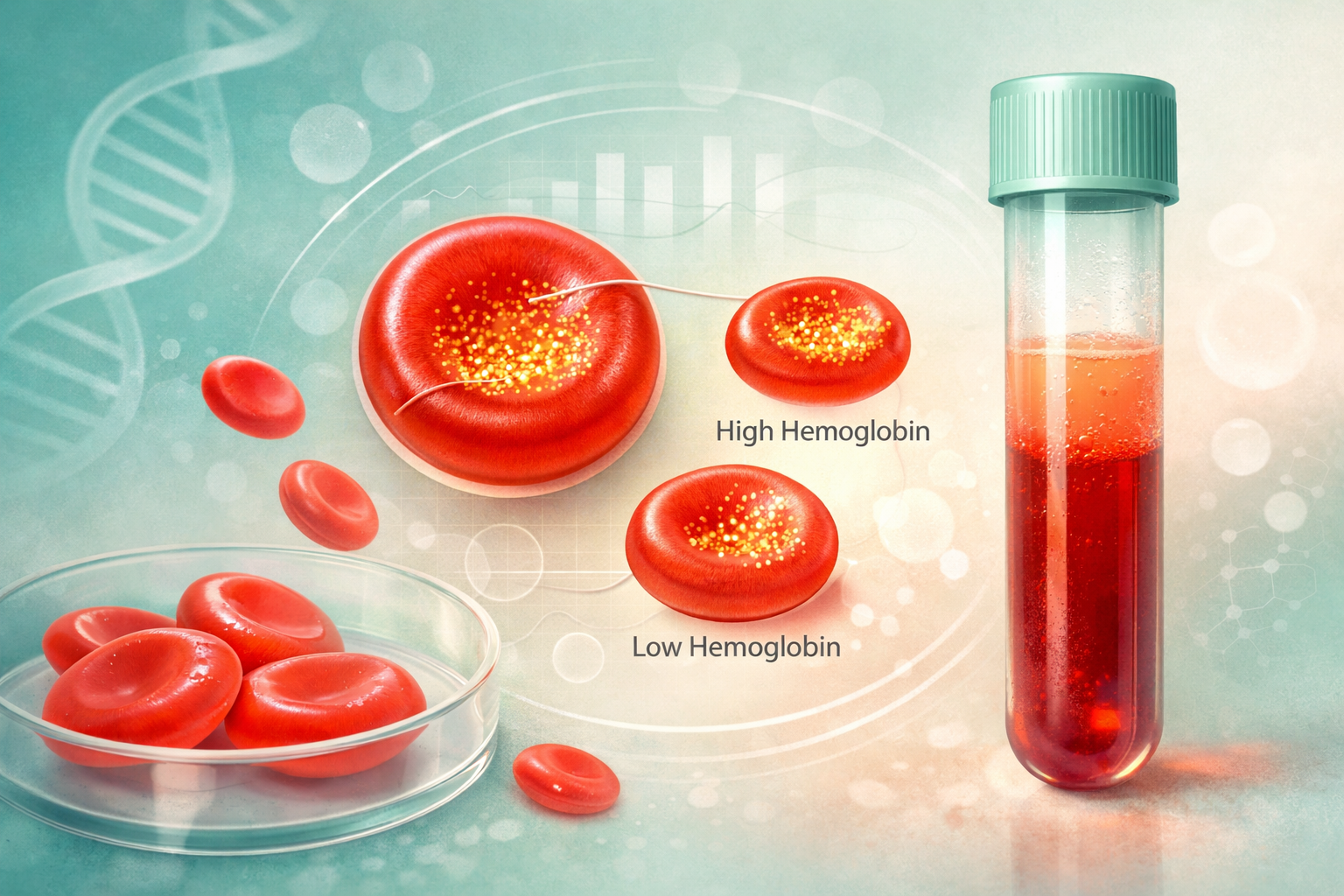
MCHC (Mean Corpuscular Hemoglobin Concentration) refers to the average amount of hemoglobin concentration within red blood cells. It s a part of the erythrocyte indices measured in a complete blood count (CBC).
It is generally expressed in grams per deciliter (g/dL) or grams per liter (g/L), although this may vary slightly between laboratories. Importantly, this parameter does not reflect the total amount of hemoglobin in the blood, but rather indicates the hemoglobin concentration within red blood cells.
A normal value indicates that red blood cells are adequately loaded with hemoglobin. Conversely, a decrease may indicate hypochromia, which is often associated with iron deficiency or certain types of anemia. An increase is less common, and may be observed in specific conditions, such as hereditary spherocytosis or analytical errors.
MCHC is always interpreted in conjunction with MCV (Mean Corpuscular Volume) and MCH (Mean Corpuscular Hemoglobin), thereby allowing accurate characterization of red blood cell disorders.
Origin and Context of Use
MCHC was introduced with the automation of hematological analysis in the 20th century. Hematology analyzers enabled the standardization of erythrocyte index measurements.
Over time, its use has emerged in routine blood testing in order to refine the analysis of anemia. It helps complement standard parameters, such as total hemoglobin and hematocrit.
Clinical laboratories routinely include it in the first-line assessments. Moreover, its interpretation has been integrated into modern classifications of anemia, providing a more precise understanding of disorders of erythropoiesis.
As a result, it has become a standard parameter used in hospital settings and general practice.
How Is It Calculated?
MCHC is calculated from two parameters measured by blood analyzers: hemoglobin and hematocrit. The calculation is based on the relationship between hemoglobin concentration and the volume of red blood cells.
Automated analyzers use spectrophotometric techniques to measure hemoglobin and impedance or flow cytometric to assess cell volume. The result reflects the average hemoglobin concentration within red blood cells.
A decrease means that red blood cells contain less hemoglobin, often appearing paler under the microscope. An increase may indicate that the erythrocyte membrane or specific analytical conditions are altered.
Therefore, MCHC is interpreted in conjunction with other indices to avoid errors due to isolated interpretation.
When Is It Used?
MCHC is mainly used in the diagnosis and monitoring types of anemia. It helps differentiate between types of anemia, such as hypochromic, normochromic or hyperchromic anemia.
It is involved in the assessment of iron deficiency, chronic diseases and genetic disorders affectiong red blood cells. In addition, it is used in internal medicine to guide further investigations.
Physicians rely on it when evaluating fatigue, pallor or suspected hematological disorders. It also contributes to monitoring the treatment of anemia in order to assess therapeutic response.
Benefits and Objectives
MCHC provides a precise assessment of hemoglobin concentration in red blood cells.
✓ It improves diagnostic accuracy.
✓ It helps differentiate between types of anemia;
✓ It guides further investigations;
✓ It complements standard erythrocyte indices;
✓ It aids in monitoring hematological treatments;
✓ It supports the overall interpretation of red blood cell parameters;
Overall, its main objective is to provide an indirect indicator of the oxygen-carrying capacity of red blood cells.
Risks, Limits or Controversies
MCHC has important limitations in its interpretation. It may be influenced by pre-analytical errors or technical variations between analyzers.
For example, certain biological conditions, such as hemolysis or lipemia, can affect the results.
Therefore, an abnormal value is not sufficient to establish a diagnosis. Its interpretation requires consideration of the clinical context and other blood parameters.
In addition, minor variations are not necessarily indicative of disease, and blood test results may vary between laboratories.
Research and Innovations
Progress in flow cytometry and artificial intelligence have improved the precision of erythrocyte indices. Modern systems can simultaneously analyze cell morphology and composition.
Current research focuses on integrating MCHC into predictive algorithms for hematological diseases. The aim is to detect subtle abnormalities at an earlier stage.
Furthermore, advanced automation also enables better standardization of results between laboratories.
Short FAQ
What does MCHC mean in a blood test?
MCHC is an index used in the complete blood count that measures the average hemoglobin concentration in red blood cells. It provides indication of their oxygen-carrying capacity.
What is the normal MCHC value?
To be considered normal, the value is generally between 32 and 36 g/dL. These values may vary slightly depending on the measurement methods used.
What does a low MCHC mean?
It often indicates hypochromia related to iron deficiency or certain types of anemia. In practical term, red blood cells contain less hemoglobin.
Is a high MCHC dangerous?
A high value is less common, and may be related to red blood cells abnormalities or technical artifacts. Its clinical significance requires medical interpretation.
Is MCHC enough to detect anemia?
No, It must be interpreted with other indices such as MCV or MCH.
Why does MCHC vary?
These variations may be related to hemoglobin production, red blood cell size and certain medical conditions.
Can it change rapidly?
Yes, particularly during treatment or correction of deficiencies, although changes are usually gradual.
It is always reliable?
Yes, most of the time, it is reliable, but results may be influenced by technical errors or specific sampling conditions.
It is a specific test?
No, it is part of the complete blood count, and it is never used on its own.
Key points
The MCHC blood test is an index that measures the average hemoglobin concentration in red blood cells. It is a part of the complete blood count and helps in the detection of anemia.
Its interpretation depends on the clinical context and other erythrocyte indices. On its own, it has no diagnostic value, but it is precise and useful tool for understanding disorders of blood oxygenation.
Related Longevity Concepts
Scientific context
Field: Clinical medicine, biology, and preventive health
Biological process: Human physiology, pathology, and health-related mechanisms
Related systems: Metabolic, immune, cardiovascular, nervous, and cellular systems
Relevance to longevity: Understanding medical terminology and biological processes helps clarify how diseases, symptoms, biomarkers, and treatments influence long-term health, prevention, and healthy aging.