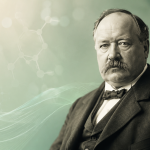
Rosalind Franklin is a British chemist and X-ray crystallographer known for her decisive role in the discovery of the structure of DNA. Although her name remained in the background for many years, her work is now considered fundamental to modern biology. Her scientific approach, grounded in experimental rigor and a deep understanding of life at the molecular level, forms one of the foundations of today’s research on longevity and cellular health.
There are scientific figures whose influence extends far beyond their own time. Rosalind Franklin belongs to those who transformed the way we understand life without ever seeking public recognition. Her trajectory is defined by rare scientific rigor, exceptional technical precision, and a constant determination to reach the core mechanisms of biology. At a time when molecular biology was still in its early stages, she defended a simple but demanding idea: to understand life, one must first understand structure. Her work on DNA was not only a major discovery, it opened an entire field of research that decades later directly supports the sciences of longevity, preventive medicine, and modern cellular biology.
The journey
Rosalind Franklin was born in London in 1920 into a family strongly committed to education and intellectual discipline. Very early on, she chose chemistry, a path that was still uncommon for women at the time. She studied at Cambridge, where she quickly stood out for her ability to combine theoretical knowledge with experimental precision, a quality that would define her entire career. After her studies, she first worked on the structure of coal and graphite, a field that might seem far from biology but allowed her to master a crucial technique: X-ray crystallography. This method makes it possible to analyze the internal structure of matter by studying the way it diffracts X-rays.
The turning point came when she joined King’s College London in the early 1950s. There, she applied her expertise to the study of DNA. It was in this laboratory that she produced the famous diffraction image later known as Photo 51. This image made it possible to identify the helical structure of DNA with remarkable precision. Yet her work remained largely underestimated for years, and her contribution was only publicly recognized long after the structure of DNA was published by Watson and Crick.
After this period, she continued her research on viruses, particularly the tobacco mosaic virus. She established herself as a major scientific figure in the study of complex biological structures. Her work was cut short only by her premature death in 1958 at the age of thirty-seven, leaving behind a scientific legacy of considerable influence.
Her vision of longevity
Even though Rosalind Franklin did not speak directly about longevity in the modern sense, her work forms one of the scientific foundations on which today’s research in cellular health is built. Her approach is based on a central idea: understanding molecular structure makes it possible to understand life itself. Decades later, this idea became one of the pillars of research on biological aging.
DNA is not only the carrier of genetic information. It also plays a central role in cellular repair mechanisms, biological aging, and the emergence of chronic diseases. By revealing its structure, Franklin indirectly opened the way for research on genetic stability, DNA repair, and the prevention of cellular aging. Today, studies on telomeres, cellular regeneration, and age-related diseases all rely on a structural understanding of life that follows directly from her work.
Her way of working also reflects a very specific vision of science: nothing can be affirmed without solid experimental proof. This level of rigor remains essential today in the fields related to longevity, where many promises are still based on fragile hypotheses. Franklin therefore embodies a deeply rigorous scientific approach built on observation, measurement, and verification.
No reliable public quotation directly related to longevity or the biology of aging can be confidently attributed to Rosalind Franklin. In accordance with the rules of this portrait, no quotation has therefore been created. However, her scientific publications and correspondence consistently reflect one conviction: the molecular structure of life is the key to understanding it. This idea remains one of the pillars of modern longevity research.
Her influence and impact
Rosalind Franklin’s influence goes far beyond the discovery of DNA. Her work helped transform biology into a discipline structured around molecular precision. This transformation made possible the emergence of entire scientific fields such as modern genetics, advanced cellular biology, and more recently personalized medicine.
Her influence is also measured through the debates she continues to inspire. Her role in the discovery of DNA was long minimized, making her today a central figure in discussions about scientific recognition and the place of women in research. Beyond this historical dimension, however, her scientific legacy remains profoundly concrete. Current research on longevity, the prevention of age-related diseases, and genetic medicine all rely on a structural understanding of life that can be traced back to her work.
She did not build a movement, nor did she promote a media-driven vision of science. Yet her influence remains immense precisely because it is based on a fundamental scientific contribution rather than on visibility.
Understanding life before extending it
Rosalind Franklin never spoke about longevity in the contemporary sense. Yet her work forms one of the scientific foundations on which the most advanced research in cellular health and the biology of aging now stands. By revealing the structure of life, she opened a path that continues to reshape modern medicine. Her influence does not rest on a spectacular theory but on exceptional scientific precision. And if the longevity of the future depends above all on understanding life at the molecular level, then her legacy is still far from revealing all its consequences.
Continue exploring longevity
Explore this longevity topic