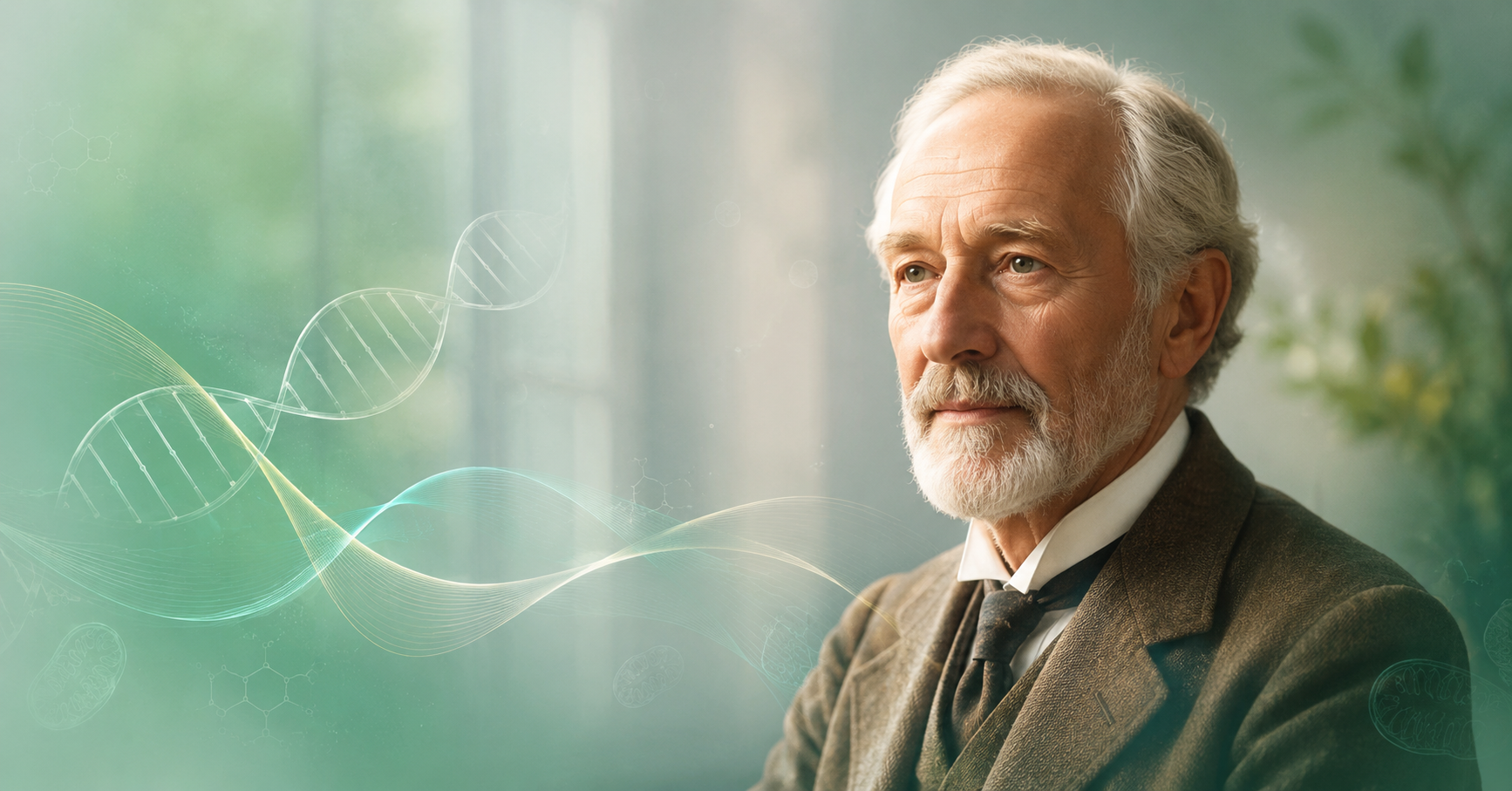
Adolf Eugen Fick, born in 1829 and died in 1901, was a German physiologist and physician well-known for formulating the law of diffusion: “Fick’s Law”. His work made it possible to describe gas exchange within organism in a quantitative terms, particularly between the lungs and tissues. By introducing physical principles into the study of living systems, he had a lasting impact on modern physiology and established essential foundations for understanding the biological mechanisms involved in health and longevity.
Adolf Fick emerged in a scientific context marked by a profound transformation of the methods used to study living organisms. At a time when medicine remained largely descriptive, he introduced an approach based on measurement, modeling and the mathematical formalization of biological phenomena. This direction was grounded in a key idea: that physiological functions can be understood through universal laws. By applying the principles of physics to biological systems, he helped to contribute to the evolution of physiology into a structured discipline capable of linking observation with quantification. His work established the concept of a flow as a central element in understanding the human body; a perspective that continues to shape contemporary health sciences.
His career
Adolf Fick was born in Kassel, at a time when Germany was experiencing strong intellectual momemtum. He studied medicine and natural sciences, first in Marburg and later in Berlin, where he was exposed to major developments in physics and chemistry. Early on, he developed a strong interest in how these disciplines could help explain the mechanisms of living systems. This curiosity led him toward experimental physiology, a field that was still emerging at the time.
“In his eulogy of Ludwig, Fick summarizes the position of the 1847 group by saying that although certain isolated problems in physiology had been treated in a physical manner, by such men as E. H. Weber, Volkmann, and Müller, the 1847 group were the first to assert as a general law that ‘a vital phenomenon can only be regarded as explained if it has been proven that it appears as the result of the material components of living organisms interacting according to the laws which those same components follow in their interactions outside of living systems.'” – The Organic Physics of 1847 and the Biophysics of Today – PAUL F. CRANEFIELD
In the 1850s, he developed a rigorous approach to analyzing the exchange of substances within biological tissues. In 1855, he formulated the law of diffusion, which describes how particles spread along a concentration gradient. This law represented a major advance, as it made possible to quantify phenomena that had previously been observed without a clear theoretical framework. It quickly found application in the study of gas exchanges, particularly in understanding lung function.
At the same time, Fick became interested in measuring oxygen consumption in humans. He developed methods to estimate exchanges between blood and tissues, leading to an experimental approach of metabolism. His work gradually gained recognition within European scientific institutions. He held several academic positions and participated to the diffusion of a physiology grounded in measurement and mathematical modeling. This trajectory helped establish his ideas firmly within the scientific field of the late 19th century.
His vision of longevity
Adolf Eugen Fick developed fundamental principles describing the diffusion of gases across biological membranes. His work on diffusion emphasizes the role of concentration gradients in governing the movement of substances such as oxygen and carbon dioxide between compartments in living organisms. These principles became a cornerstone of quantitative physiology by providing a physical framework for understanding respiratory exchange.
In this way, longevity can be understood as the long-term maintenance of physiological balance and functional stability within living systems. When exchanges between different biological compartments are efficient and well-regulated, cells are more likely to preserve their functional capacity over time. Conversely, a progressive disruption of these exchanges may contribute to the gradual decline of physiological functions. Although this perspective is grounded in a 19th-century biophysical framework initiated by Fick’s work on diffusion, it also resonates with contemporary research on tissue perfusion, cellular oxygenation, and the biological mechanisms associated with aging.
Adolf Eugen Fick’s work on diffusion provided a quantitative framework for describing the movement of gases and solutes across biological tissues. His formulation of diffusion laws emphasized the role of measurable physical relationships, particularly concentration gradients, in governing physiological exchange processes. While Fick did not propose a general theory of biological systems or longevity, his contributions helped establish the use of physical principles in physiology. This approach became an important step in the development of quantitative biological sciences.
By introducing physical laws into the study of living organisms, Fick helped shift the scientific view toward analyzing the underlying mechanisms of vital functions. This focus remains central today in research on health and aging, where the efficiency of internal exchanges is considered as a determining factor in biological stability.
His influence and impact
Adolf Fick’s influence extends far beyond classical physiology. His law of diffusion has become a fundamental tool for modeling the exchange of substances within biological systems. It is used in the study of respiration, blood circulation and transport of nutrients, as well as in fields, such as pharmacology and biomedical engineering.
His contribution helped establish a quantitative approach to medicine, in which biological phenomena are analyzed from measurable data. This evolution enabled the development of predictive models and analytical tools that are now widely used across scientific research. As a result, his work therefore extends beyond the historical framework of physiology into a broader interdisciplinary context.
Main debates concern how to represent the complexity of living systems. By introducing physical laws into biology, Fick participated to a simplification, reducing these complex phenomena to a structured models. While this approach has been argued, it remains widely adopted due to its effectiveness in describing and predicting biological behavior. Still today, it continues to serve as a methodological foundation in the study of living systems.
A legacy that continues
Adolf Fick profoundly transformed the understanding of human body by introducing a framework based on flows and equilibria. His work helped shape a form of physiology capable of linking observation with modeling, paving the way for a more precise analysis of the internal mechanisms that sustain health.
His legacy keeps influencing today’s research on biological dynamics and the conditions that support systemic stability. Through the concept of diffusion, he laid the groundwork for an enduring reflection on the exchanges that make life possible and their role in the processes of aging.