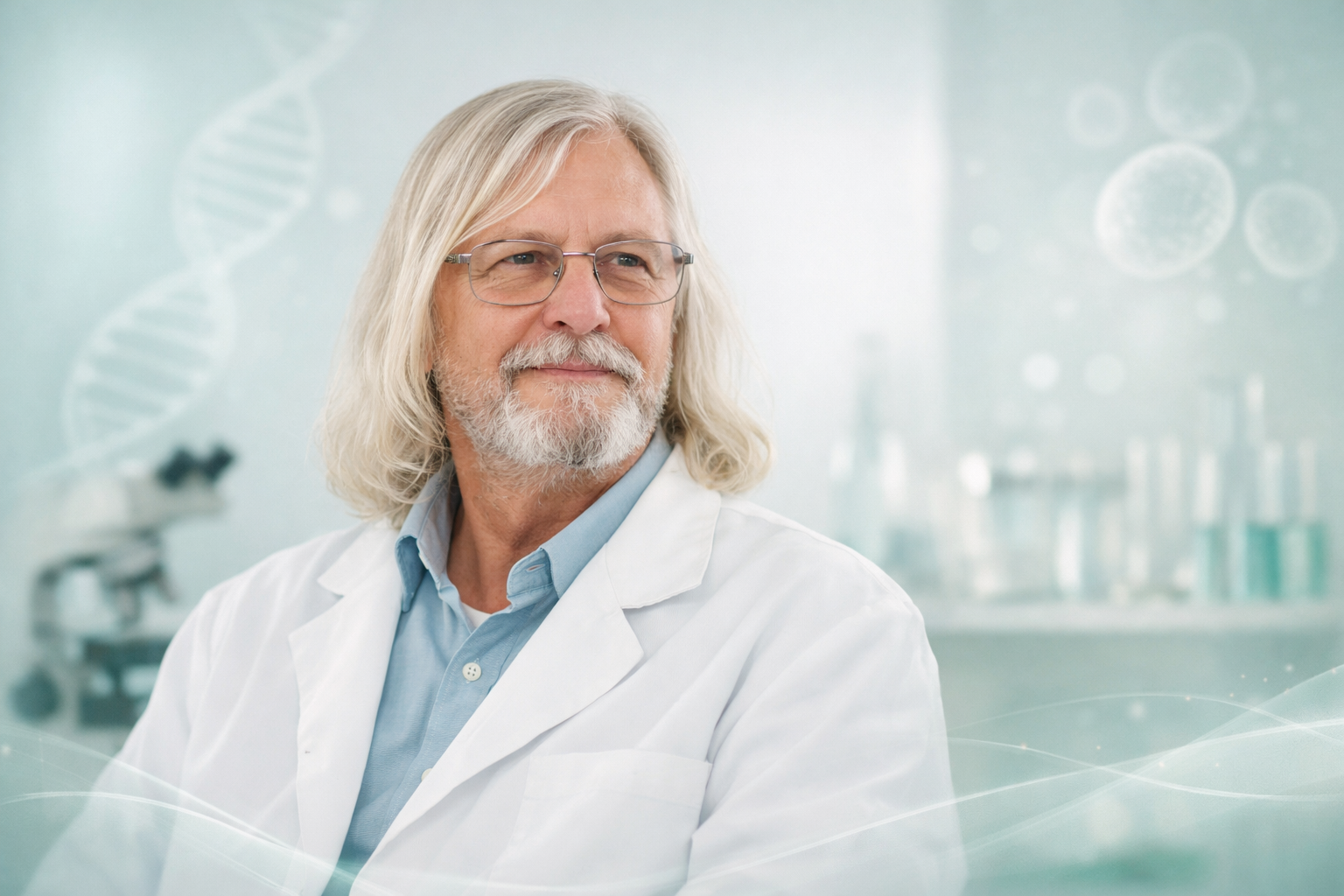
Born in 1952 in Dakar, Didier Raoult is a French microbiologist known for his work on bacteria and giant viruses. Director of IHU Méditerranée Infection in Marseille, he became globally known during the COVID-19 pandemic for promoting controversial treatments. His career combines scientific discoveries and media controversies, raising questions about how science communicates with the public and influences collective health.
Didier Raoult has always been an extraordinary character. With his druid-like hair and his frank speech, he never goes unnoticed. A scientist among the most cited in the world, he built his reputation on a phenomenal ability to discover new bacteria and giant viruses. But Raoult is also a style: provocative, self-confident, and allergic to mathematical models he often considers disconnected from reality. For him, science is done at the patient’s bedside, through direct observation. This approach pushed him into the heart of a global debate on ethics and medical rigor.
A journey
Didier Raoult’s journey began in Senegal, before he settled in Marseille, the city that would become his stronghold. Very early, he became passionate about the invisible. In 1984, he created the Rickettsiae unit and started accumulating major discoveries on intracellular bacteria. His rise was steady until the creation of the IHU, an ultra-modern center dedicated to tropical diseases.
The big turning point came in 2020, while the world panicked over SARS-CoV-2. Raoult thus claimed to have found “the solution”: a mix of hydroxychloroquine and azithromycin. The announcement was explosive. While part of the public saw immediate hope, the international scientific community quickly became disappointed, pointing out a lack of solid evidence and a methodology considered too weak.
Vision of longevity
Didier Raoult is not a longevity specialist in the anti-aging sense. His focus is survival against infection. For him, people live longer if diseases are diagnosed quickly and pathogens are treated effectively. It is a very pragmatic view of medicine: observe, test, treat.
He often mocked those he calls “prophets of doom.” His favorite phrase, “I am not Nostradamus, I never predict anything,” sums up his philosophy. He prefers to stick to observable data at the moment rather than futuristic projections. This anti-model stance attracted many people tired of pandemic uncertainties, but it also earned him criticism when he seemed to downplay certain real epidemic risks.
Influence and impact
Raoult’s influence on French microbiology is immense. He has trained generations of researchers, and his team has identified a remarkable number of new pathogens. It is foundational work that will remain in the records. Yet the “Raoult phenomenon” also left darker traces. The massive promotion of an unvalidated treatment created a split between experts and the public. Today, his legacy is tainted by investigations into the conduct of some clinical trials and the retraction of certain scientific articles. He remains a polarizing figure: a laboratory genius for some, a researcher lost in mass communication for others.
Eventually, Raoult has marked the history of contemporary medicine, both through real discoveries and the controversy he sparked. His trajectory shows how difficult it is to reconcile the long time of research with the urgency of a health crisis and the pressure of social media. Whether appreciated or not, he forced everyone (scientists, politicians, and citizens) to think about the place of expert voices in our society.
Continue exploring longevity
Explore this longevity topic