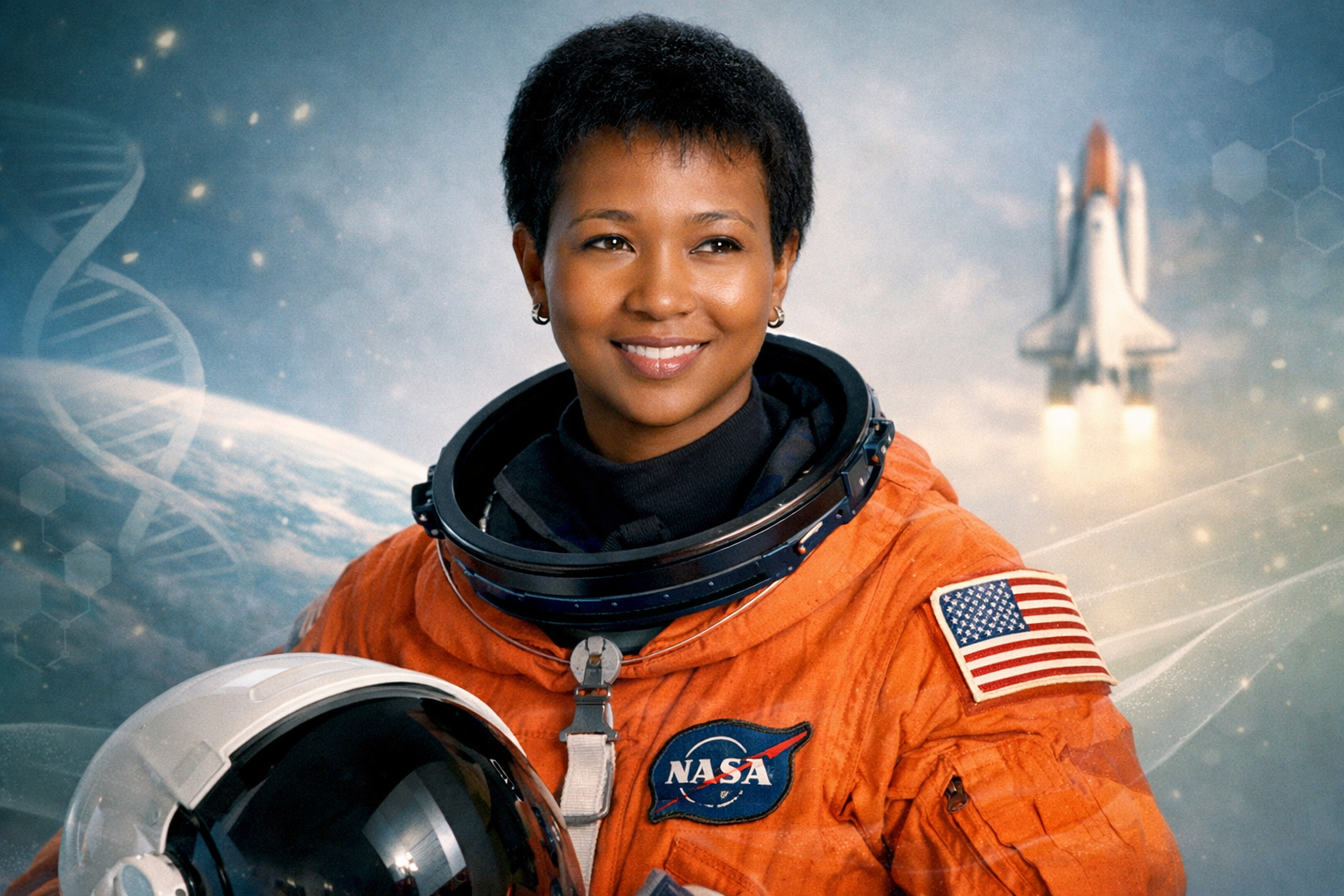
Physician, engineer and former astronaut, Mae Jemison is best known for being the first African American woman to travel into space during the STS-47 mission with NASA in 1992. Her work, however, goes far beyond this historic achievement. For more than thirty years, she has defended a global scientific vision in which health, human longevity and technological innovation are deeply connected. Today, her influence stands at the intersection of medicine, science and the future of humanity.
From her earliest public appearances, Mae Jemison has never presented herself as simply a former astronaut. She embodies an energy directed toward the future and toward transforming the way science can improve human life. Her message is not limited to space exploration, but rather to the ability of science to extend quality of life and make societies more resilient. She repeatedly emphasizes the need to think about longevity not as an accumulation of years, but as broader access to knowledge, healthcare and technology. As she has said in many public talks, “Never limit yourself because of others’ limited imagination.” This sentence captures her position perfectly: longevity is not only biological, it is also intellectual and social.
The journey
Mae Jemison’s career has never followed a linear path. Trained in medicine at Cornell University, she began her career in public health, particularly in Africa and Asia. Very early on, she became interested in the impact of healthcare systems on life expectancy. This field experience deeply shaped her vision of scientific progress. She never saw medicine as an isolated discipline, but rather as a global lever for improving human life.
Her entry into NASA in the 1980s represented a new stage, but also a change of scale. For her, spaceflight was not a personal achievement, but a symbol of human potential. During the STS-47 mission, she participated in scientific experiments related to the human body in microgravity, an experience that strengthened her interest in human biology and in how the body adapts to extreme environments. From that moment on, she became a visible figure in the public debate about science and the future of humanity.
After leaving NASA, she did not step away from the scientific world. On the contrary, she created educational initiatives and research programs designed to connect innovation, health and the long-term future. Her career therefore reflects a constant effort to link science, public health and the future of human life.
Her vision of longevity
The vision of longevity defended by Mae Jemison is deeply scientific, but also deeply human. For her, longevity cannot be reduced to anti-aging medicine or biotechnology alone. She repeatedly stresses the importance of scientific education, access to knowledge and the ability of societies to anticipate future challenges. In her public talks, she explains that longevity depends just as much on the social environment as on medical progress.
She often reminds audiences that major scientific breakthroughs have always been linked to a broader vision of human progress. In one widely shared statement, she said: “The difference between science and the arts is not that they are different sides of the same coin, but they are manifestations of the same thing.” This sentence clearly illustrates her way of approaching longevity: she never separates biology, technology and culture.
She also challenges the idea that innovation should be reserved for a scientific elite. In her view, the future of longevity will depend on the ability of societies to integrate science into everyday life. She imagines a future in which advances in medicine, space exploration and technology will not only allow people to live longer, but above all to live with greater autonomy and freedom. She also highlights the role of space exploration in understanding the human body. According to her, studying aging in space opens new perspectives for understanding human biological limits.
Her influence and impact
Mae Jemison’s influence today goes far beyond the scientific sphere. She occupies a unique position in the public debate about the future of health and longevity. Her impact is based less on direct medical discoveries than on her ability to connect fields that are often considered separate. She acts as a bridge between traditional medicine, technological innovation and long-term thinking about the human future.
Her message sometimes sparks debate, particularly regarding the real role of space exploration in human health. Some consider her ideas mainly symbolic. Others believe that she is helping to broaden the way longevity is understood. Her influence is especially visible in scientific education programs and in initiatives aimed at making science more accessible. In this way, she contributes to transforming the very narrative of longevity by moving it toward a broader and more inclusive vision.
A broader vision of human longevity
Mae Jemison does not belong to the traditional longevity movement focused solely on biotechnology or anti-aging medicine. She represents a broader approach in which life expectancy depends as much on science as on access to knowledge and on society’s ability to imagine the future. Her career shows that longevity is not only a biological issue, but also a matter of vision. In a world where the boundaries between health, technology and exploration are becoming increasingly blurred, her influence could continue to grow in the years ahead.
Continue exploring longevity
Explore this longevity topic