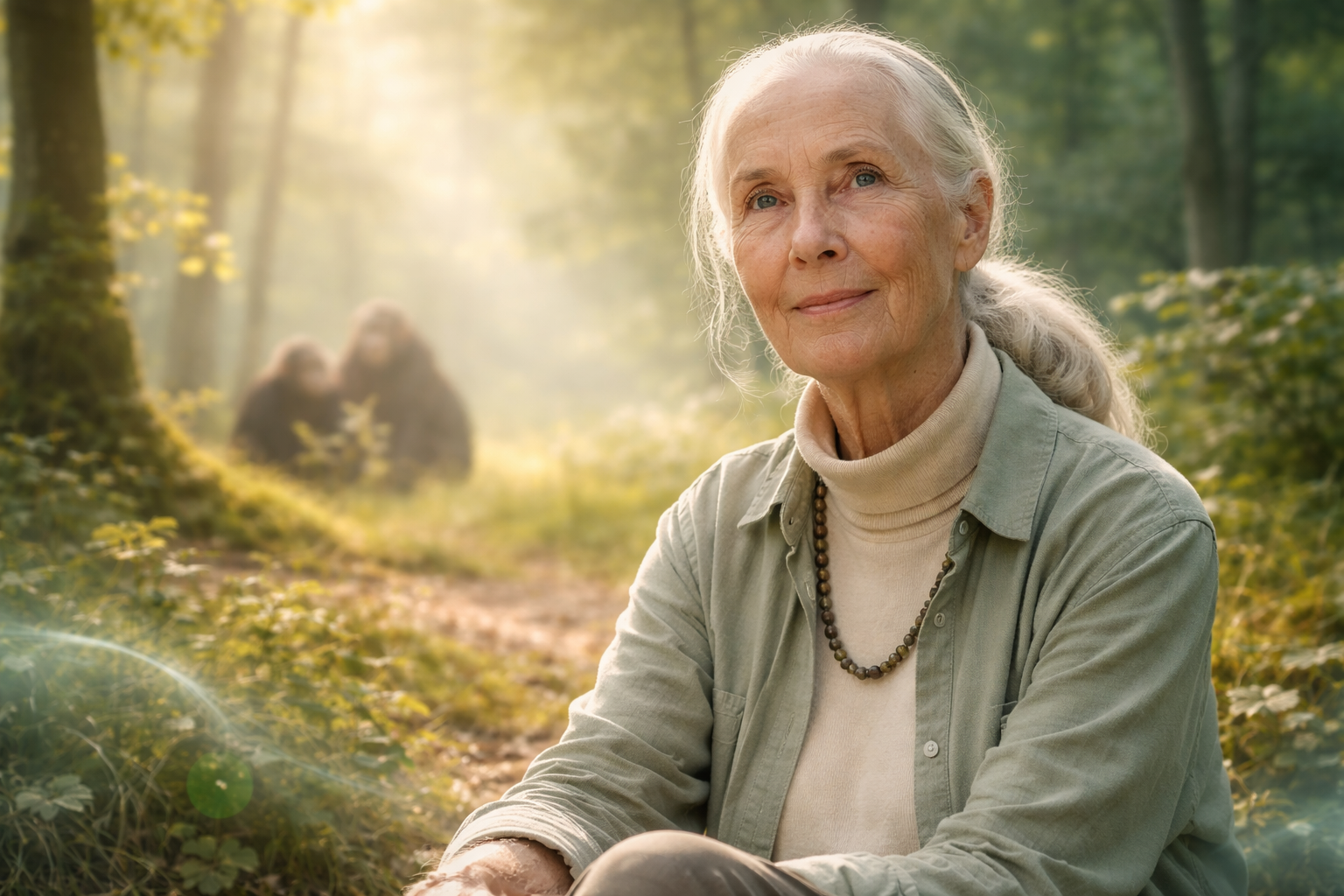
Jane Goodall is a British primatologist and anthropologist who became one of the most influential scientists of the 20th century. She is known for decades of unprecedented observations of wild chimpanzees and her global commitment to nature conservation. Her work not only transformed our understanding of animal behavior but also influenced contemporary reflections on humanity’s relationship with the environment.
Jane Goodall, who passed away at the age of 91 in 2025, embodied an unwavering scientific curiosity and a humanistic message of coexistence between humans and nature for over sixty years.
Born on April 3, 1934, in London, Dame Valerie Jane Morris Goodall began her extraordinary journey as an explorer at a time when women in field science were rare. Driven by an early fascination with animals and the natural world, she left an ordinary life to immerse herself in the heart of the Tanzanian forest, where in 1960 she established a research camp to observe chimpanzees in their natural habitat—a radically different approach from conventional behavioral sciences of the era.
Endowed with contagious energy, exceptional patience, and profound empathy, Goodall became known for her immersive method and refusal to strictly separate humans from animals. Her ability to turn simple observations into major scientific discoveries challenged decades of prejudice.
Her journey
Jane Goodall grew up in a family that encouraged exploration and curiosity about nature. Instead of following a traditional scientific path, she initially worked as an assistant before receiving unexpected support from anthropologist Louis Leakey, who invited her to study wild primates in Tanzania despite her lack of formal primatology training.
At age 26, she arrived at Gombe Stream National Park in Tanganyika (now Tanzania), aiming to live among chimpanzees. There, she implemented a long-term observational approach without conventional scientific safety nets, gradually gaining the chimpanzees’ trust. This bold choice allowed her to document for the first time behaviors such as tool use and complex social relationships, previously considered unique to humans.
Initially met with skepticism by parts of the scientific community, her discoveries were gradually recognized as foundational. She later earned a PhD from the University of Cambridge, published several books based on her observations, and in 1977 founded the Jane Goodall Institute to continue and share her work.
Her vision of longevity
For Jane Goodall, longevity is not measured only in years but in the continuity and enduring impact of an intellectual and ethical quest. She defines longevity as maintaining engagement with the natural world and turning curiosity into a driving force for change. Goodall frequently emphasized that a life directed by listening and understanding is what makes it truly fruitful.
In a past interview, she stated: “Change happens by listening and then starting a dialogue with the people who are doing something you don’t believe is right.” This highlights her belief that lasting influence comes not from dogma but from ongoing exchange between humans and their environment.
Her vision of longevity also stresses that understanding animal life enriches our own conception of living fully. By observing chimpanzees as individuals with distinct personalities and sophisticated social bonds, she expanded behavioral science and highlighted the importance of emotional connection across species.
From the 1980s onward, Goodall broadened her mission from biologist to global conservation advocate. She traveled extensively to raise awareness of environmental urgency, promoting collective action and ethical responsibility toward the planet and all its inhabitants, human and animal alike.
Her influence and impact
Jane Goodall’s influence extends far beyond academia: her discoveries fundamentally changed paradigms about animal intelligence and human origins. Her empathetic observation method, giving names rather than numbers to chimpanzees, humanized scientific study and encouraged a holistic understanding of animal behavior.
Her impact is also evident in education and activism. The Jane Goodall Institute and the Roots & Shoots program have inspired millions of young people to engage in environmental protection, linking local action with global transformation. These initiatives perpetuate her ideas by instilling in new generations the belief that every action matters.
Debates have arisen around interpretations of some of her field methods, yet the significance of her work is undeniable: today, her vision of the interconnectedness of all life continues to influence researchers, educators, and policymakers.
Legacy and Lessons for the Future
Jane Goodall embodied a powerful idea: profound understanding of life requires patience, empathy, and intellectual courage. Her scientific and human longevity is not limited to her lifespan but is manifested in the enduring transformations she inspired in science, education, and collective consciousness. Her legacy is not only in primatological discoveries but also in a vision of the world where every species is recognized as part of a fragile and precious network. In this sense, her example will continue to inspire new commitments and reflections for future generations.
Continue exploring longevity
Explore this longevity topic