
Key information
- May help strengthen the skin barrier and limit water loss
- Rich in long-chain fatty acids, which are stable against oxidation
- Helps maintain lipid balance which is essential for cell vitality
- Used on the skin to support its softness and elasticity
- Studies in cosmetic formulations show its high resistance to oxidation compared to other vegetable oils
The quality of lipids applied to the skin is often overlooked. The skin is a living interface between the environment and our cells, and depends on a precise lipid balance to preserve its suppleness and protective function. Meadowfoam Seed Oil is valued for its stability and its ability to support the skin barrier without weighing it down.
Used in cosmetics, this plant-based oil helps the skin maintain lasting hydration and an environment that promotes cellular balance. In this article we will explore its origin, see how it works, and the benefits in a skincare routine dedicated to skin vitality.
What is it ?
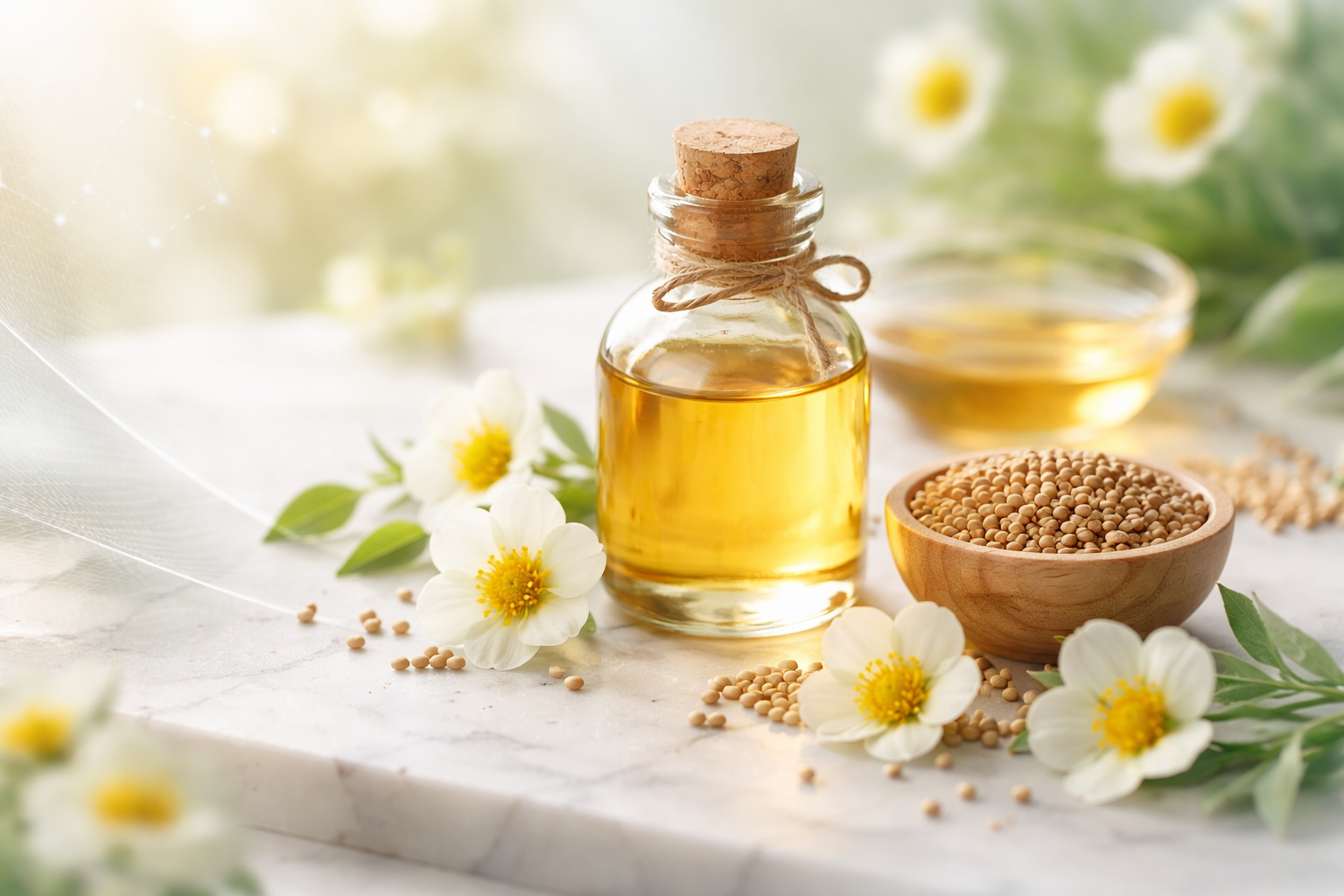
Meadowfoam Seed Oil is extracted from the seeds of the Limnanthes alba plant, which is a plant native to North America, grown mainly for its oil-rich seeds. Its key feature lies in its unique lipid composition. This oil contains mostly long-chain fatty acids (C20–C22), including eicosenoic acid and docosenoic acid.
In the body, these lipids are not intended for traditional nutritional use but are beneficial when applied to the skin. Their structure gives the oil high oxidative stability and an affinity with the skin’s natural lipids.
This stability is key as it limits damage from air, light, or heat, which can help preserve the integrity of formulas and support skin balance.
Did you know ?
Meadowfoam Seed Oil has naturally high oxidative stability, which could help protect cosmetic formulations from rancidity and lipid degradation.
How does it work ?
Main action
Its action is mainly based on a biomimetic film-forming effect.
When applied to the skin, the oil forms a light lipid film that limits transepidermal water loss (TEWL). This mechanism helps to support the barrier function, which is essential for maintaining hydration and protecting skin cells.
Its high concentration of long-chain fatty acids allows it to remain on the surface while partially blending into the skin’s natural hydrolipidic film.
Effects at the skin level
Skin
It can support skin suppleness and contribute to lipid balance, particularly in cases of dry or fragile skin.
Mild inflammation
By promoting a functional skin barrier, it may indirectly help limit imbalances associated with mild skin inflammation.
A preserved barrier creates a more stable environment for epidermal cells, which helps maintain harmonious cellular vitality.
What it means in terms of longevity
From a sustainable health perspective, preserving the integrity of the skin barrier can help maintain balanced skin over time.
Meadowfoam Seed Oil does not alter skin biology, but it can support its natural functions and promote an environment favorable to cellular balance.
Study box
2018 – Comparative study in cosmetic formulation
Type: laboratory oxidative stability study
Key result: Meadowfoam Seed Oil showed superior resistance to oxidation compared to several common vegetable oils, suggesting potential benefits for the stability of topical skincare products.
Benefits
Support for the skin barrier
Scientifically speaking , reducing water loss is a key indicator of barrier function. Oils rich in long-chain fatty acids can strengthen the hydrolipidic film and support this function.
In practical terms, this can result in more comfortable skin that is less prone to tingling sensations.
Hydratation durable
By limiting water evaporation, it can help maintain more stable hydration throughout the day.
In a skincare routine, it is often used as the final step to “seal in” the moisturizing active ingredients applied earlier.
Long-lasting hydration
Its natural resistance to oxidation can help prolong the quality of a cosmetic product.
For the user, this means an oil that retains its sensory and functional properties for longer.
Natural sources
Meadowfoam Seed Oil is naturally present in limnanthes alba seeds, cold-pressed virgin oil, refined oil for cosmetic use and esterified derivatives used in dermatological formulations.
Dosage, forms & bioavailability
Meadowfoam Seed Oil is mostly used on the skin. The common concentrations in formulas vary between 1 and 20%. Meadowfoam Seed Oil exists as virgin oil, fractionated oil, and meadowfoam esters. It can be used with ceramides, hyaluronic acid, niacinamide. Daily use is possible depending on skin type Its bioavailability is essentially local as it acts on the surface and upper layers of the epidermis.
Security and Precautions
The tolerance profile is generally considered good for cosmetic use.
Side effects are rare but may include skin reactions in very sensitive skin types.
Perform a skin test before use .
In the case of specific dermatological conditions, professional advice is recommended.
How to incorporate it into a longevity routine
When to use it
It is to be applied in the evening or as the final step in a moisturizing routine.
Possible combinations
It can be used with moisturizing or repairing active ingredients to optimize skin barrier support.
Example of simple routine
- Gentle cleansing
- Moisturizing serum
- Light cream
- A few drops of Meadowfoam Seed Oil to lock in moisture
For whom is it particularly interesting
For people with dry or mature skin or individuals looking for a gentle and stable approach to lipid care. It can also be used in cold or dry environments.
A stable lipid approach to support skin balance?
In a modern approach to longevity, the skin deserves a subtle and scientific attention. Meadowfoam Seed Oil exemplifies this approach as it is a stable, low-profile plant-based oil that supports the skin’s natural barrier functions.
It does not promise drastic change, but it can contribute to a more balanced skin environment, promoting cellular vitality and lasting softness.
When judiciously incorporated into a consistent routine, it fits into a skincare strategy that respects biological mechanisms, helping skin evolve with serenity.
Sources
- Gunstone, F. D. (2011). Vegetable Oils in Food Technology. Woodhead Publishing.
- Miwa, T. K. (1971). Structural determination and uses of meadowfoam oil. Journal of the American Oil Chemists’ Society.
- Knothe, G. (2010). Oxidative stability of meadowfoam oil. Industrial Crops and Products.
Continue exploring longevity
Explore this longevity topic


