Key Takeaways
- May help support the skin’s natural collagen production.
- Acts as a cellular messenger by stimulating fibroblasts.
- Is associated with maintaining elasticity and firmness within a longevity-focused approach.
- Primarily used topically in advanced dermocosmetic formulations.
- Clinical studies suggest progressive improvement in the appearance of wrinkles after several weeks of use.
In the field of skin longevity, certain active ingredients are gaining attention for their potential to support the skin’s natural regenerative processes. Palmitoyl tripeptide belongs to this category of scientifically designed compounds. Widely used in advanced skincare, it is studied for its potential role in supporting the extracellular matrix and maintaining cellular balance within the skin.
At a time when skin vitality is increasingly viewed as a reflection of overall well-being, understanding how this ingredient works allows for a more conscious and sustainable approach. Let us explore how palmitoyl tripeptide functions, the benefits it may offer, and how it can be integrated into a longevity-oriented routine.
What Is It?
Palmitoyl tripeptide is a biomimetic peptide, meaning it is a short chain of amino acids designed to mimic fragments naturally found in the body.
It consists of three amino acids linked to a fatty acid (palmitic acid), which enhances its ability to penetrate the skin barrier. This specific structure allows it to interact more effectively with skin cells, particularly fibroblasts.
Its biological role is based on a simple principle: acting as a cellular signal. By mimicking fragments of degraded collagen, it may encourage cells to support the natural processes of repair and dermal matrix synthesis.
Did you know?
Certain palmitoyl tripeptides have been studied for their ability to stimulate collagen production in vitro, suggesting a signaling effect that may support skin regeneration.
How Does It Work?
Main Action
Palmitoyl tripeptide functions as a signal peptide.
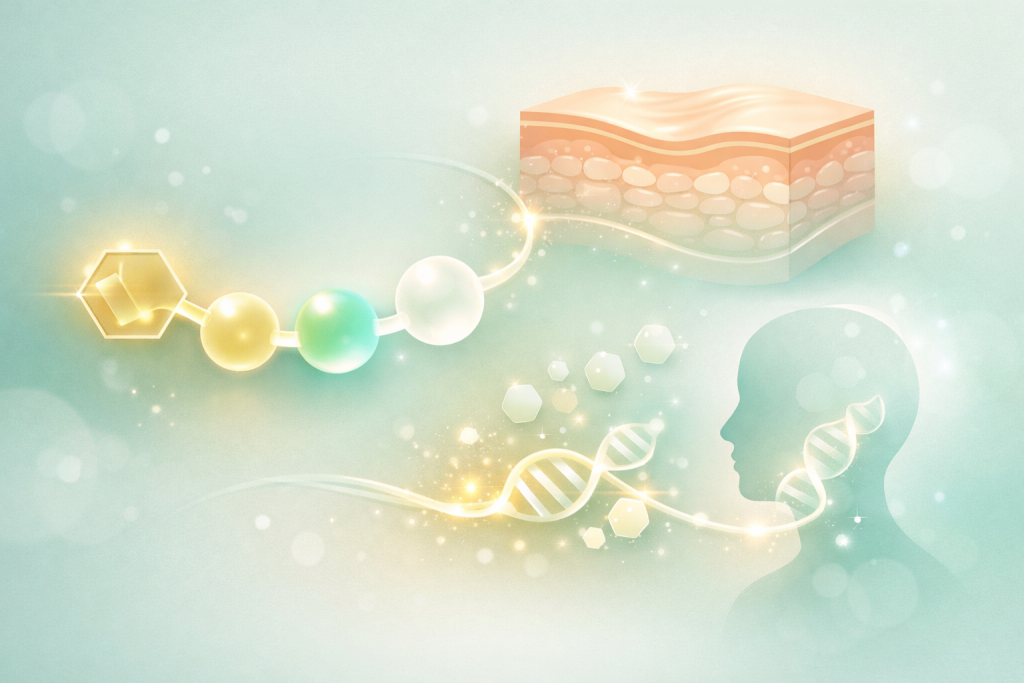
Once it penetrates the skin, fibroblasts may interpret it as a fragment derived from collagen breakdown. In response, these cells may support the production of new collagen and elastin fibers.
This mechanism contributes to maintaining the density and structural integrity of the extracellular matrix.
Effects at the Tissue Level
At the skin level, this may translate into:
- support for firmness
- progressive improvement in elasticity
- assistance in maintaining balance in low-grade, age-related inflammation
By promoting a more structured dermal environment, the peptide may help preserve local cellular energy and overall tissue quality.
What This Means for Longevity
In a longevity-focused approach, the objective is not transformation, but support of natural biological functions.
Palmitoyl tripeptide may therefore help accompany skin vitality by contributing to cellular balance and tissue resilience in the face of oxidative stress and time.
📌 Study Focus
2005 – Randomized double-blind clinical study
Link: https://pubmed.ncbi.nlm.nih.gov/16029679/
Key finding: measurable improvement in wrinkle depth and skin density after 8 to 12 weeks of topical application.
Benefits
Support for Skin Firmness
From a scientific perspective, collagen support is associated with maintaining dermal structure. Palmitoyl tripeptide may contribute to this process by stimulating fibroblast activity.
In practical terms, this may lead to visibly firmer-looking skin after several weeks of consistent use.
Progressive Improvement in Elasticity
Elastin plays a central role in tissue flexibility. By supporting the extracellular matrix, the peptide may help maintain smoother, more supple skin.
Within a daily routine, this may translate into improved texture and a more even appearance.
Support for Healthy Skin Aging
Aging is associated with a gradual decline in protein synthesis. Acting as a biological messenger, palmitoyl tripeptide may support the skin’s natural renewal processes.
It can therefore be integrated into a broader strategy aimed at preserving cellular vitality over time.
Natural Sources
Palmitoyl tripeptide is not naturally present in food sources.
It is a synthetic active ingredient inspired by naturally occurring collagen fragments. It is primarily found in:
- anti-aging serums
- firming creams
- eye contour treatments
- high-performance dermocosmetic formulations
Dosage, Forms & Bioavailability
In clinical studies, concentrations typically range between 1% and 5% in topical applications.
Available forms include:
- concentrated serums
- creams
- lightweight emulsions
Bioavailability depends on formulation technologies (liposomes, lipid carriers). Combining it with:
- vitamin C
- niacinamide
- hyaluronic acid
may support a synergistic approach.
Daily use for at least 8 to 12 weeks is generally required to observe visible results.
Safety & Precautions
Palmitoyl tripeptide generally demonstrates a favorable tolerance profile when used topically.
Possible (rare) effects:
- mild, temporary redness
- sensitivity in very reactive skin
It is recommended to:
- perform a patch test before first use
- seek professional advice in case of existing dermatological conditions
Its use is typically compatible with long-term skincare routines.
How to Integrate It into a Longevity Routine
When to Apply
Palmitoyl tripeptide is most often applied in the evening, when natural cellular repair mechanisms are most active.
What to Combine It With
It may be paired with:
- antioxidants
- hydrating ingredients
- daily sun protection in the morning
Simple Routine Example
- Gentle cleansing
- Palmitoyl tripeptide serum
- Moisturizer
- Daytime sunscreen
Who May Benefit Most
- Individuals noticing gradual loss of firmness
- Those seeking preventive skin support
- Anyone adopting a balanced, longevity-oriented skincare strategy
A Subtle Ally for Supporting Cellular Balance?
In a modern vision of longevity, the skin reflects an ongoing dialogue between cells, environment, and time. Palmitoyl tripeptide does not promise dramatic transformation, but it may fit within a gentle and coherent strategy aimed at supporting tissue structure and vitality.
By respecting biological rhythms and encouraging sustainable cellular balance, it contributes to a more conscious approach to skin aging. An invitation to support the skin with precision, consistency, and serenity.
Sources
Katayama, K., et al. (2005). A palmitoyl oligopeptide stimulates collagen synthesis and improves skin wrinkles. International Journal of Cosmetic Science.
https://pubmed.ncbi.nlm.nih.gov/16029679/
Lintner, K., & Peschard, O. (2000). Biologically active peptides: from a laboratory bench curiosity to a functional skin care product. International Journal of Cosmetic Science.
https://pubmed.ncbi.nlm.nih.gov/18492168/
Robinson, L. R., et al. (2005). Topical palmitoyl pentapeptide provides improvement in photoaged human facial skin. International Journal of Cosmetic Science.
https://pubmed.ncbi.nlm.nih.gov/16029679/
Continue exploring longevity
Explore this longevity topic