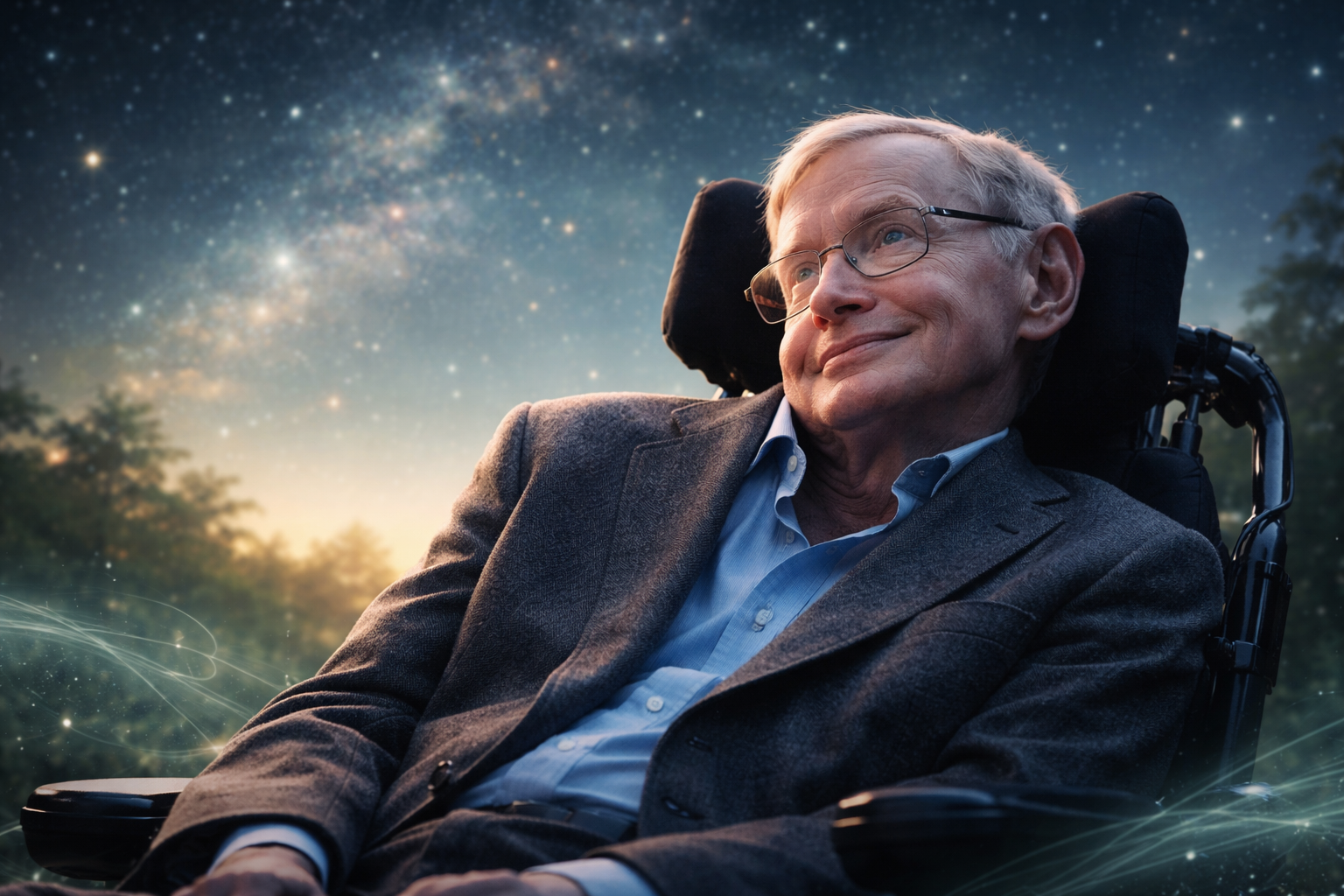
Stephen Hawking was a world-renowned British theoretical physicist, famous for his work on relativity, black holes, and cosmology. Diagnosed with a neurodegenerative disease at age 21, he lived more than fifty years with severe physical limitations. His research and public presence profoundly shaped our understanding of the universe and demonstrated a unique approach to life despite adversity.
Stephen William Hawking represents a unique figure in modern science, combining intellectual genius, courage in the face of challenges, and the ability to communicate complex ideas to the public. A theoretical physicist, cosmologist, and author, he popularized fundamental scientific concepts while living with amyotrophic lateral sclerosis (ALS) for over five decades, far beyond initial prognoses. His energy, laced with humor and clarity, is captured in his advice to “look up at the stars and not down at your feet,” encouraging curiosity, perspective, and meaning even when the body fails.
Career path
Born on January 8, 1942, in Oxford, England, Stephen Hawking grew up in an intellectually vibrant family. He displayed an early interest in mathematics and physics, despite middling school results. He studied physics at the University of Oxford, earning his undergraduate degree, before pursuing a doctorate at Cambridge, a world-leading center for theoretical physics.
At 21, while beginning his thesis, he was diagnosed with ALS, a neurodegenerative disease with a life expectancy of only a few years at the time. Rather than giving up, Hawking continued his research, establishing himself as one of the brightest minds of his generation while gradually losing mobility and speech. He communicated through assistive technologies, including a speech synthesizer.
Hawking’s breakthrough came when he and other researchers proposed that black holes are not completely black but emit radiation—now known as Hawking radiation—an idea that combined general relativity and quantum mechanics. Meanwhile, his book A Brief History of Time (1988) made complex concepts accessible to a global audience, cementing his status as an iconic figure in popular science.
His path, marked by extreme personal challenges and major intellectual achievements, exemplifies the coexistence of resilience and creativity, serving as a model for those reflecting on both biological and cognitive longevity.
His vision of longevity
Stephen Hawking was not a longevity researcher in the biomedical sense, but his life exemplified endurance and adaptation. His perspective on life, effort, and curiosity can be understood as a philosophical approach to the longevity of the mind. He famously said, “Remember to look up at the stars and not down at your feet… Work gives you meaning and purpose and life is empty without it,” emphasizing that curiosity, engagement, and purpose contribute to a fulfilling life even under physical limitations.
This statement highlights his belief that attitude toward life matters more than circumstances. He often remarked that despite the pain and challenges, he was “happier now than before developing the disease” because research and intellectual engagement gave his life meaning.
Hawking also stressed the importance of humanity’s long-term survival: in several interviews, he argued that “if humanity wants a long-term future, it must look beyond planet Earth.”
Thus, his vision of “longevity” extends beyond mere lifespan to include the durability of curiosity, creativity, and collective human endeavor. Persisting through adversity, exercising the mind, and leaving an intellectual legacy are forms of cognitive and cultural longevity.
Influence and impact
Stephen Hawking’s influence reaches far beyond theoretical physics. He helped popularize science for millions of readers, students, and enthusiasts, reshaping how complex ideas are communicated. His book A Brief History of Time sold millions of copies, bridging cutting-edge science and general culture.
His personal story—living more than fifty years with a disease that should have ended his life within a few years—became a model of resilience and inspiration. This human dimension of his legacy extends his impact well beyond the scientific community. However, some critics have noted that media focus on his celebrity sometimes overshadowed the nuances of his scientific contributions.
Enduring curiosity and intellectual longevity
Stephen Hawking reminds us that “longevity” is not measured solely in years but also in intensity of thought, sustained curiosity, and lasting influence. His life, marked by perseverance despite a debilitating disease, demonstrates how a life can be rich when guided by the pursuit of knowledge, idea-sharing, and intellectual engagement. Ultimately, Hawking leaves a legacy that continues to inspire not only physicists but anyone facing adversity, encouraging humanity to reach higher and look further. His impact projects toward a future where the mind, equipped with curiosity, may transcend apparent limitations.