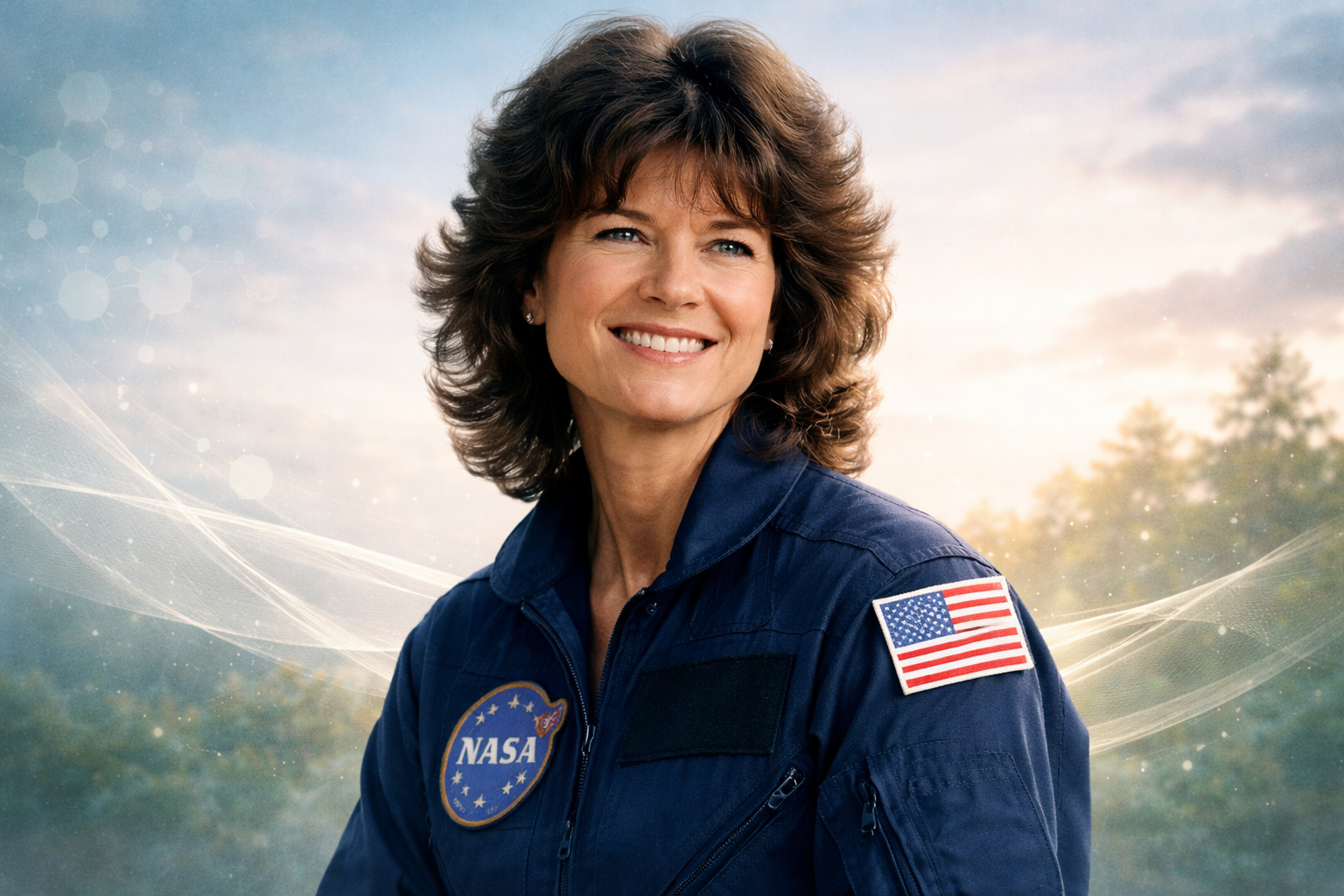
Sally Ride was an American physicist and the first woman from the United States to go into space. As a NASA astronaut in 1983, she became a major figure in science and science education. Her work is particularly relevant to longevity from a cognitive and societal perspective, as she dedicated the second part of her life to promoting scientific education as a key factor in long-term intellectual health and the future of innovation.
Sally Ride never fit the traditional image of a media-driven astronaut. Her style remained calm, discreet, and deeply focused on substance. Yet her career consistently reflected one central idea: the longevity of a society depends first on the strength of its scientific education. After studying physics at Stanford and being selected by NASA in 1978, she entered a world largely dominated by men without trying to become a symbol. Instead, she repeatedly emphasized the importance of scientific curiosity. “Science and math education is critical to our country’s future,” she stated in a public declaration shared by NASA. This sentence summarizes her trajectory: space was never just a technological conquest for her, but a long-term intellectual project.
The journey
Sally Ride’s path began far from the traditional centers of scientific power. As a child in California, she was interested in both sports and science. She was first a high-level tennis player before gradually turning toward physics. This transition was not dramatic but progressive. At Stanford University, she combined scientific and literary studies, a dual education that later shaped her pedagogical work. In 1978, she became part of the first group of astronauts selected from more diverse academic and personal backgrounds. Five years later, she became the first American woman in space aboard the space shuttle Challenger, a historic moment that instantly placed her on the global stage.
Yet after her space missions, she chose a different kind of influence. She took part in the commission that investigated the Challenger disaster and later turned toward teaching and research. She spent nearly three decades helping students and promoting scientific culture among young people. This decision marked a turning point. Instead of remaining only a symbol of space exploration, she became a key figure in scientific transmission and education.
Her vision of longevity
Sally Ride’s vision of longevity was not directly related to biological aging. Instead, it focused on intellectual and societal longevity. In her view, a society lives longer when it continuously develops scientific curiosity in younger generations. She often explained that interest in science must be encouraged early, because it determines a society’s future ability to innovate. In an interview, she said, “For whatever reason, I didn’t succumb to the stereotype that science wasn’t for girls. I got encouragement from my parents.” This statement reflects her broader belief that access to science must remain open and sustainable over time.
She also strongly emphasized curiosity as a lifelong driver of intellectual vitality. For her, science was not an elite discipline reserved for a few, but a natural way of exploring the world. She often explained that scientific curiosity begins with simple moments of wonder, such as watching early space missions on television as a child. This idea aligns with a modern view of cognitive longevity: curiosity helps people remain mentally active far beyond youth. In this sense, her approach questioned the traditional model in which science was limited to a small academic elite. Instead, she promoted a long-term vision in which broader access to scientific knowledge strengthens society’s ability to adapt to future challenges.
Her influence and impact
Sally Ride’s influence extended far beyond her role as an astronaut. She quickly became a reference point in the debate around women’s access to scientific careers. However, her most concrete impact came through education. After leaving NASA, she founded initiatives dedicated to promoting science among young people, especially girls. Her goal was not to create spectacular individual success stories but to gradually change how science was perceived by younger generations.
Her influence also generated debate. Some saw her primarily as a feminist icon, while others viewed her first and foremost as a scientist. This ambiguity ultimately strengthened her impact. She never actively tried to become a symbol, yet she became one through the consistency of her work. Her legacy is therefore not only technological but also cultural and educational. She contributed to shaping a long-term scientific mindset rather than a single historic achievement.
A legacy built on intellectual longevity and scientific curiosity
Sally Ride never described herself as a longevity thinker. Yet her entire career reflects a long-term vision of human progress. By focusing on curiosity, education, and scientific transmission, she helped shape a model of sustainable intellectual development. Her influence cannot be measured only by her spaceflight but by the generations of students and scientists she inspired afterward. In a world where innovation increasingly determines collective longevity, her legacy appears more relevant than ever. And perhaps the true conquest of space was, for her, also a conquest of time.