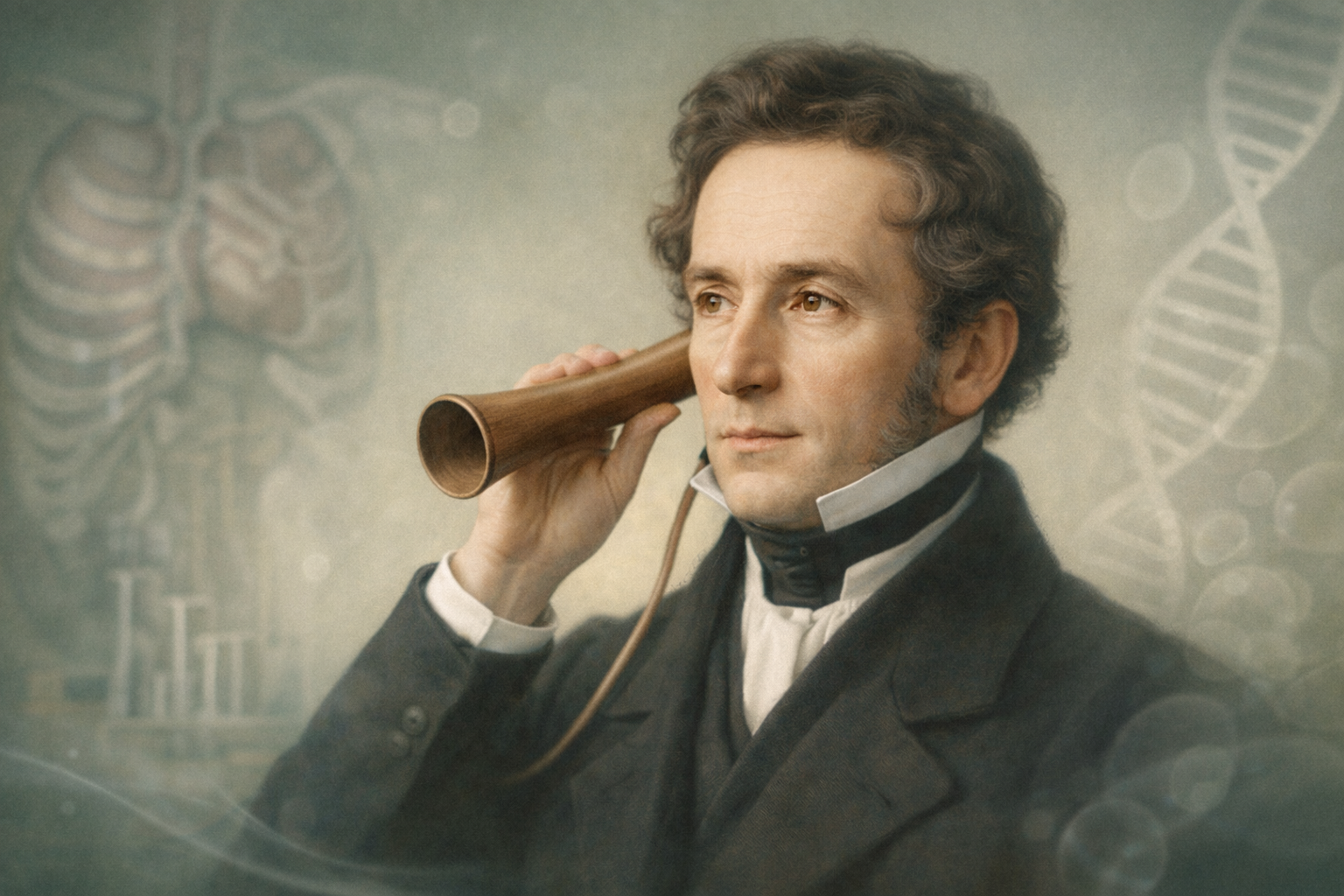
French physician René Laënnec is best known for inventing the stethoscope and establishing the modern method of medical auscultation. His work fundamentally transformed clinical practice by enabling physicians to listen to and interpret the internal sounds of the human body. This approach opened the way to more precise diagnoses of pulmonary and cardiac diseases, contributing significantly to the long-term evolution of medical knowledge and improvements in patient health.
At the beginning of the nineteenth century, medicine still relied largely on external observation and the descriptions provided by patients. In this context, René Laënnec represented a new generation of clinicians seeking to understand disease directly through the body itself. Trained in Paris, he developed a rigorous and methodical approach to clinical observation. His scientific curiosity was accompanied by a desire to transform everyday medical practice. In 1816, faced with the difficulty of examining a patient suffering from cardiac symptoms, he devised a simple instrument: a tube that allowed the physician to listen to sounds inside the chest from a short distance. This practical innovation marked the beginning of a diagnostic revolution. Auscultation gradually became a central tool in clinical medicine.
The journey
Early life and medical formation
Born in 1781 in Quimper, in Brittany, René Laënnec grew up in an environment closely connected to medicine. His uncle, a physician and professor at the medical school in Nantes, played a decisive role in his early training. Through this exposure, Laënnec developed a strong interest in anatomy and clinical observation.
At the end of the eighteenth century, he moved to Paris to pursue his medical studies. At the time, the French capital was one of the leading centers of transformation in European medicine. Hospitals increasingly became spaces for scientific observation and practical teaching. Laënnec quickly distinguished himself through his attention to clinical signs and his analytical rigor.
The context of his discovery
Laënnec worked notably at the Necker Hospital, where he conducted important research on pulmonary diseases. Tuberculosis was then one of the leading causes of death in Europe, making the study of thoracic diseases particularly urgent.
It was in this environment that the event leading to his most famous invention occurred. In 1816, rather than placing his ear directly on a patient’s chest, he rolled a sheet of paper into a cylinder to listen to internal sounds. The experiment proved surprisingly effective. He later refined the instrument using wood, creating the first stethoscope.
A publication that changed clinical medicine
In 1819, he published his major treatise De l’auscultation médiate. The work introduced a new clinical method based on listening to internal bodily sounds and correlating them with lesions observed during autopsies. This approach transformed medical diagnosis and established auscultation as a fundamental clinical skill.
His vision of longevity
Although the modern concept of longevity did not exist in Laënnec’s time, his work reflects a crucial shift in medicine: the transition from descriptive medicine to a diagnostic discipline grounded in scientific observation.
For Laënnec, understanding disease required listening to the body and interpreting its signals. The stethoscope became an instrument that extended the physician’s sensory perception. In De l’auscultation médiate, he wrote: “The stethoscope becomes the means of recognizing several diseases of the heart and lungs that had previously escaped observation.”
This idea represented a major transformation. Before Laënnec, physicians possessed few reliable methods to examine internal organs in living patients. Auscultation made it possible to identify abnormalities in breathing or heart sounds well before diseases reached their most severe stages.
This capacity for earlier detection forms one of the foundations of modern medicine. By allowing more precise diagnoses, it opened the possibility of earlier intervention and therefore potentially better survival outcomes for patients.
Laënnec also emphasized the importance of linking clinical observation with pathological anatomy. In his work he explained: “Careful observation of symptoms, compared with the lesions observed after death, clarifies the nature of diseases.”
This scientific reasoning anticipated what would later evolve into evidence-based medicine. In a contemporary perspective, it aligns with preventive approaches aimed at improving long-term health and extending life. Understanding the mechanisms of disease remains essential to improving longevity.
His influence and impact
A lasting medical symbol
The invention of the stethoscope remains one of the most enduring innovations in the history of medicine. Two centuries after its creation, the instrument continues to symbolize the medical profession worldwide.
A transformation of clinical practice
Laënnec’s influence extends far beyond the device itself. His work helped structure modern clinical medicine. Auscultation became a core skill in medical training and fundamentally changed the physical examination of patients.
His research also supported the development of pulmonology and cardiology, two fields that would gradually emerge during the nineteenth century. Identifying characteristic sounds such as pulmonary crackles or cardiac murmurs allowed physicians to classify diseases more precisely.
A legacy between technology and method
Laënnec’s legacy lies at the intersection of technology and scientific methodology. His invention demonstrated how a simple instrument could profoundly reshape the understanding of the human body.
Even today, the most advanced medical imaging technologies extend the same fundamental intuition: to observe, interpret, and understand the signals produced by the body in order to diagnose disease.
Listening to the body as a path to longevity
René Laënnec belonged to a generation of physicians who transformed medicine into a scientific discipline grounded in careful observation. The invention of the stethoscope illustrates how a simple innovation can profoundly reshape clinical practice and improve the ability to diagnose disease.
His legacy goes beyond the history of medicine. It reminds us that progress in understanding the human body often emerges from practical insights, new instruments, and renewed attention to the signals of life. In a modern context where preventive medicine, biological data, and diagnostic technologies continue to expand, Laënnec’s intuition remains strikingly relevant: listening to the body is still one of the first steps toward extending life.